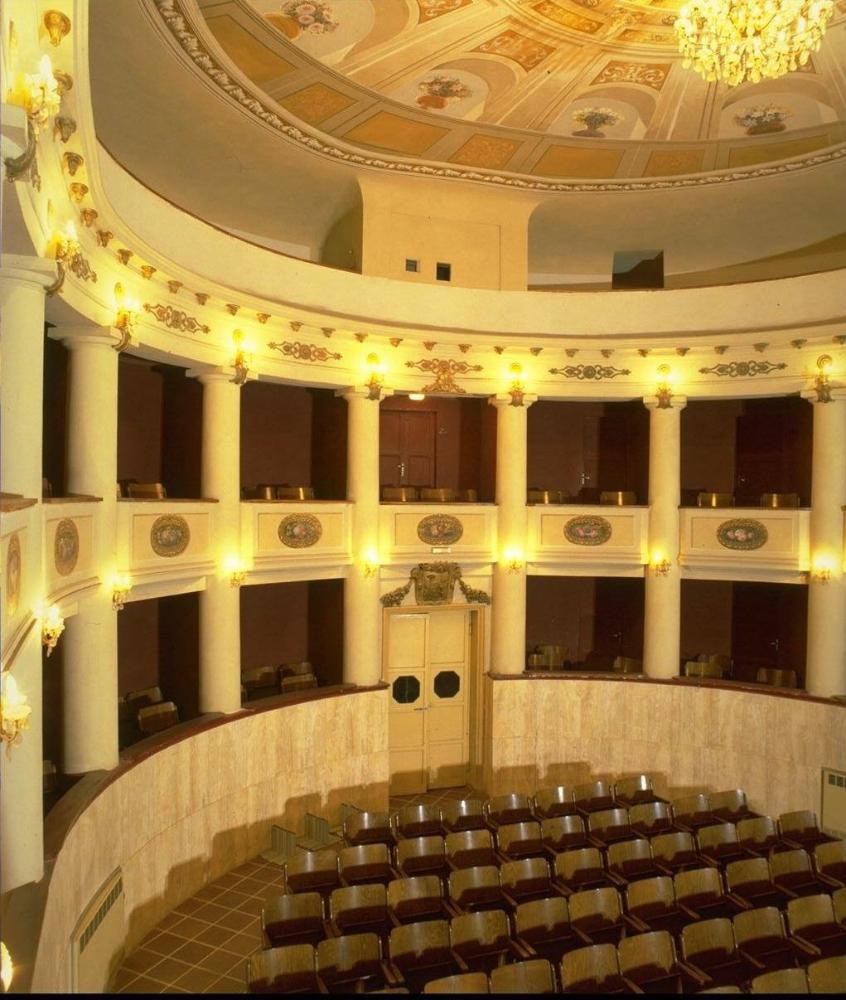


During the French occupation of Bologna (1796-1816), new literary and scientific institutions were established, some of which still exist today: in 1802 the Accademia di Belle Arti, in 1803 the Orto Botanico and Orto Agrario, and in 1810 the Società Agraria.
The history of the Arena del Sole
Many of Bologna’s convents were closed and religious orders forcibly removed. Amidst this wave of change and the evolving use of urban spaces, the Arena del Sole emerged. It was built on the site of the old Santa Maria Maddalena convent, expropriated from the Church, which included two churches and two cloisters.
Today, only one cloister from the 15th century, part of the bell tower, and fragments of significant frescoes (now displayed in the Pinacoteca since 1934) remain from the original convent. In 1799, Pietro Bonini, a leather merchant, conceived the idea of creating an open-air arena to host performances of all kinds during the summer afternoons, taking advantage of daylight.
The project was entrusted to Milanese professor Carlo Asparri, who completed the so-called ‘Arena del Sole’ in 1810. By chance, an engraving by C. Savini from 1825 survived, showing how the Arena was originally designed—since the cavea was destroyed and all architectural plans lost. Asparri had taught architecture at the Accademia di Belle Arti and studied under Filippo Antolini, who designed the Foro Bonaparte in Milan, a project that appears to have inspired Asparri’s work. The Arena also bears similarities to Milanese theater projects by engineer Pistocchi.
The structure of Arena del Sole
The Arena was built with a semicircular tiered seating arrangement reminiscent of theories championed by Francesco Milizia, a leading proponent of Enlightenment-inspired Neoclassicism. Milizia believed that public performance spaces should eliminate class distinctions, providing everyone with the same view of the show—no more state boxes or exclusive balconies, only the simplicity of ancient theaters. The Arena, however, wasn’t strictly built along Milizia’s guidelines; Savini’s engraving shows a wide horseshoe-shaped design rather than a perfect semicircle.
The stalls at Arena del Sole
The stalls were surrounded by steps bordered by a wall imitating rusticated stone, topped by a gallery decorated with faux niches. The decorations were painted by Luigi Cirri of Prato. A large garden greeted visitors at the Arena’s entrance.
The Arena was inaugurated in July 1810 with the play Corradino d’Este al torneo o l’eroe del Rubicone, performed by the Compagnia Comica Zuccato. The venue could hold up to 2,000 spectators, a number that was typical for the time, especially as people would crowd every available space.
Five years earlier, Napoleon Bonaparte had renovated Montagnola into an elegant promenade alongside the market square—making the Arena, from the outset, a central and popular spot, soon replicated in other city neighborhoods.
The Arena quickly became the go-to venue for the people, hosting dramas, comedy, masquerade balls, monastic and illusion acts, and juggling shows. In 1835, the Luigi Taddei company requested for the first time to cover the stalls with a canopy for evening performances. In 1887-1888, the theater closed for comprehensive renovation related to the creation of the modern Via Indipendenza. Its only remaining 19th-century facade was designed by engineer Gaetano Rubbi in 1888, standing out for its grand style, while the interior was more understated.
The facade of Arena del Sole
The facade consists of a high, majestic portico with three large arches supported by paired columns with Corinthian capitals. The unifying feature is the high cornice bearing a prominent inscription above the arches: “LUOGO DATO AGLI SPETTACOLI DIURNI” (“Place Dedicated to Daytime Performances”), highlighting the Arena’s unique character—even though evening events had already started by then. Topping the facade is a ‘tympanum’ with five academic-style statues, the centerpiece being a winged Apollo flanked by seated figures of Poetry (left) and Tragedy (right), all sculpted in concrete by Alfredo Neri.
In 1949, a retractable roof was installed and the steps removed to convert the Arena into an evening theater and cinema. It reopened in 1950 with the screening of “Cavalcata di eroi,” mostly as a movie theater for the next twenty years. In the 1970s, architect Cervellati proposed transforming the Arena into a cultural center with multiple theater and cinema halls, a library, and meeting spaces—a vision considered too ambitious at the time, so the Arena remained a theater.
The Municipality of Bologna acquires Arena del Sole
In May 1984, the City of Bologna purchased the building from Opera Pia Giovanni XXIII, undertaking a major renovation to provide the city with a suitable drama theater. The first phase, from August to December 1984, focused on structural upgrades and stage systems, allowing the theater to reopen under the artistic direction of Yuri Lubimov.
The second phase began in June 1986 and ended two years later, restoring the main hall, foyer, and rehearsal spaces. This period saw the installation of Italy’s first hydraulically powered, modular wooden stage, which could be raised to stage level, doubling its usable area from 13 to 25 meters. The metal grid for scene changes was extended over part of the stalls. Lateral balconies, a circular tier of seats, additional boxes, and a stepped gallery were all added, as well as full amenities and a small underground theater.
The third phase started in 1991, completing installations, furnishings, and adjacent theater structures—with new horizontal structures, roofing, flooring, systems, and fire-resistant walls. The stage was equipped with large and medium-sized dressing rooms and a communal dressing area for about fifteen actors. Removing a stage wall created an orchestra pit for around seventy musicians. Above the stage are skylights with automatic heat-activated opening mechanisms. The main hall hosts 952 spectators; the smaller hall seats between 220 and 300. Acoustical adjustments were carried out by G. Righini and R. Spagnolo from the Istituto Galileo Ferraris in Turin.
The modern Arena del Sole
The main theater, stage, and small hall are all equipped with air heating. Inside are a ticket office, three cloakrooms, management offices, two cafes, four rooms for small events, and exhibition spaces in the corridors. The present-day Arena is a flexible venue aligned with the needs of contemporary theater. Architect Gianfranco Dellerba, who oversaw the renovation, drew inspiration from the Renaissance theater in Sabbioneta and the Farnese in Parma for its U-shaped stepped seating.
Engineer Felice Monaco from the municipality’s technical office supervised the work. Architect Emilio Battisti handled the interiors, focusing on material choices like solid wood, sea-green velvet, glass, and iron—striking a balance between quality and restraint. On the south side, the theater features a windowed wall facing the 15th-century cloister, plus an inner courtyard and another on the north side opening onto via San Giuseppe.
The theater at Arena del Sole
The Arena del Sole Theater reopened on 20 February 1995 with a gala celebration attended by celebrities. The night, dedicated to Bologna, featured Dario Fo with his “Il tumulto di Bologna” and performances by singers Francesco Guccini, Luca Carboni, Andrea Mingardi, Stadio, Jimmy Villotti, and Steve Grossman. Today, the theater hosts a regular schedule of drama and dance events.
(Information by Caterina Spada)