


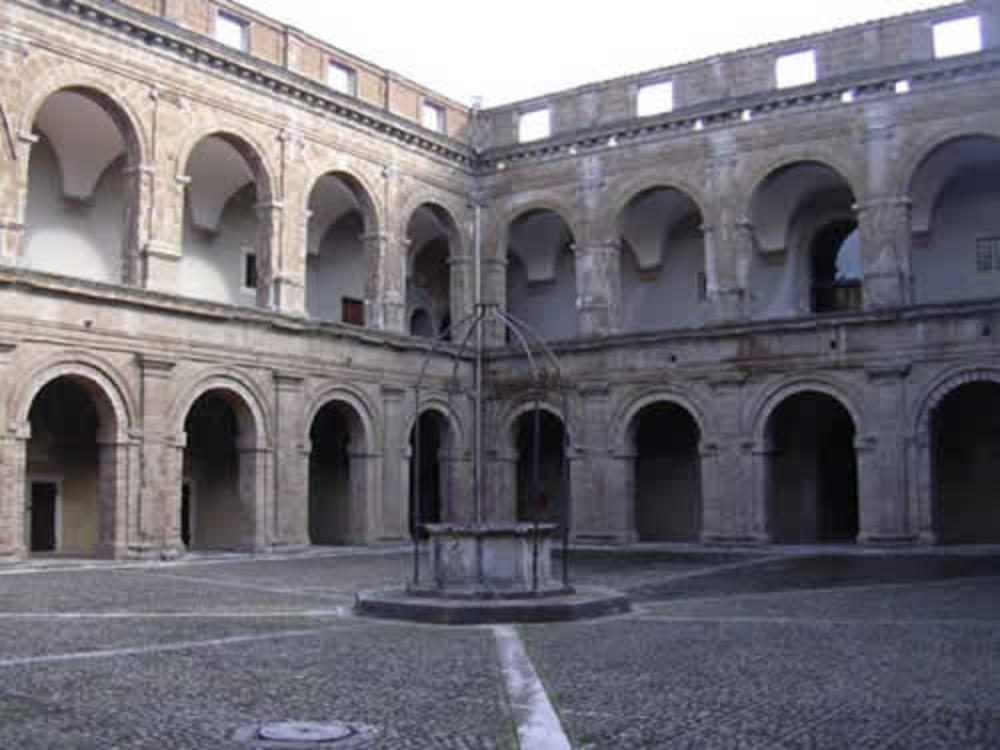


The Archaeological Museum of Agro Falisco is housed in the splendid Forte Borgiano, built at the end of the 15th century by Antonio da Sangallo the Elder, on the western spur of the Civita Castellana plateau, by the will of Pope Alexander VI Borgia.
It has a pentagonal plan, with five bastions, of which three are equipped with gun ports, and is surrounded by an artificial moat, except on the north side.
Under Julius II della Rovere (1503-1513), Antonio da Sangallo the Younger was tasked with continuing the work begun by his uncle. This phase sees the completion of the main courtyard, with its two-tiered arcade, the octagonal keep, and the rusticated entrance portal to the fort.
Considered one of the most important military works of the era, the Fort served as a papal residence until the early 1800s, when it was converted into a prison, first political and then, from 1846, military. After 1870, the fortress became a penitentiary, then a refuge for many families displaced during the Second World War, and finally, from the 1950s, was designated to house archaeological collections from the Faliscian territory.
The current exhibition, completed in 1985, includes nine rooms on the first floor of the arcade of the main courtyard, arranged according to topographic and chronological criteria.
Particular emphasis is placed on the main center of the territory, Falerii Veteres, present-day Civita Castellana, with its important ceramic production, from the oldest coarse ware with incised and relief decorations, to those of the 4th and 3rd centuries BC, featuring black gloss, silvered, painted over, and red-figure pottery, the latter represented by exceptionally high-quality works such as the stamnoi by the Diespater Painter. Testimonies of the many city sanctuaries are also present: in addition to architectural and votive terracottas, there is the tuff head with a bronze leaf crown, attributable to the cult statue of the oldest sacellum (first half of the 6th century BC) of the Celle sanctuary. Among curiosities is a skull with a gold dental prosthesis from a grave excavated at the end of the 19th century.
Equally significant are the finds from other important Faliscian sites, such as Corchiano, Vignanello, Nepi, and Narce. The latter center, in particular, offers interesting evidence with the rich burials of the 8th and 7th centuries BC, which contain, alongside fine goldsmithing and rich bronze vessels, some of the oldest imported Greek ceramics.
Information on the Archaeological Museum of Agro Falisco – Forte Sangallo
Via del Forte
01033 Civita Castellana (Viterbo)
0761513735
[email protected]
https://www.polomusealelazio.beniculturali.it/index.php?it/226/museo-archeologico-dellagro-falisco-forte-sangallo
Source: MIBACT