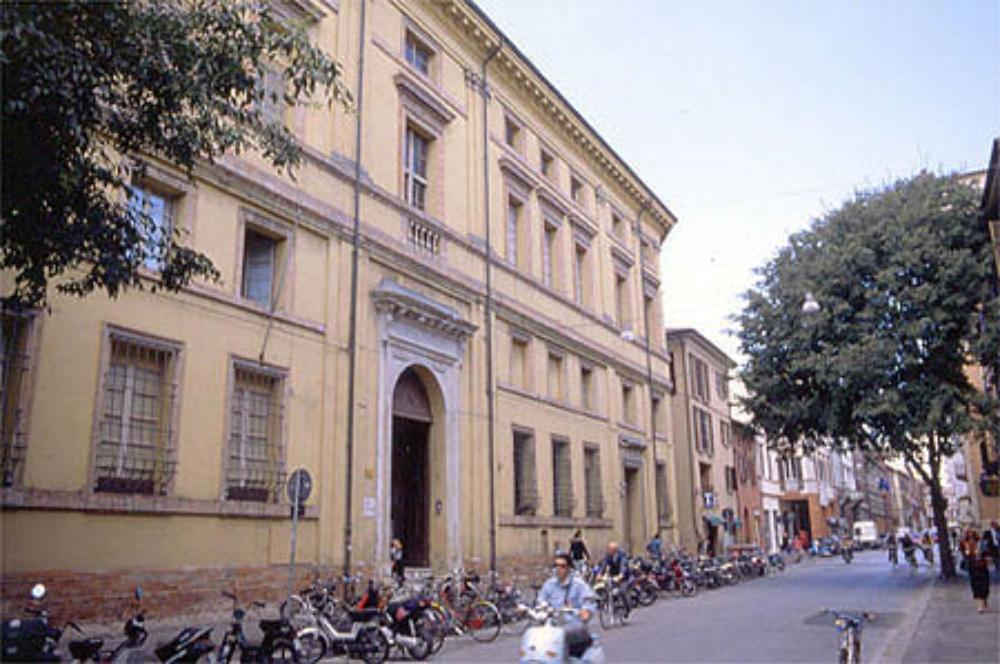


It was established in Forlì in the last thirty years of the 19th century by Antonio Santarelli, who gave coherence and precise directions for development to a heterogeneous antiquarian collection, conducting important recoveries in the area and extensive excavation campaigns in the sites of Bertarina di Vecchiazzano, Villanova, and S. Varano. The museum is now located on the ground floor of the Palazzo del Merenda; the latest arrangement (1960), including the lapidary exhibition, is credited to Guido A. Mansuelli, Giancarlo Susini, and Raffaele Turci. Its transfer to the convent complex of S. Domenico is planned.
The itinerary concerning the ancient demography of Forlì covers a wide chronological spectrum from the Lower Paleolithic up to the end of the ancient age. The stone artifacts from the Monte Poggiolo site, dated to about 800,000 years ago, illustrate one of the earliest human settlements in the Italian peninsula and all of Europe. Historical findings, many recovered by Santarelli himself, and recent acquisitions describe the development of cultures that succeeded each other around Forlì and the surrounding valleys from the Neolithic to the phase of Celticization of the Po Valley.
For the Neolithic, representative settlement structures are those of Vecchiazzano and the Via Decio Raggi site. Stone tools found almost everywhere along the Montone, Rabbi, and Ronco-Bidente valleys provide a good indicator of human presence during the Eneolithic. The most significant clusters relate to Bronze Age settlements at Bertarina di Vecchiazzano, Coriano, and the hoard of San Lorenzo in Noceto.
Some important artifacts date to the terminal phase of the Early Iron Age, such as the stele of S. Varano and the warrior’s tomb at Carpena, which yielded a complete panoply. The necropolis of Rocca S. Casciano documents the presence of Celts at the end of the 4th century BC, showing their adoption of Etruscan customs and swift integration with the local communities.
The diachronic sequence continues with evidence related to Roman Forum Livii from both the Republican and Imperial periods, from various areas of the modern urban fabric. These are especially represented by everyday objects (common and table ceramics, loom weights, oil lamps, glass, bronze household items) and some black and white geometric mosaic floors (1st century AD).
The museum also houses some extraordinary pieces from the Theodoric era (6th century): the polychrome marine-themed mosaic of the apse room in the grand “villa” of Meldola, the so-called marble portrait of Alaric, and a large gilded silver buckle decorated with stamping and embossing.
The Roman lapidary collection includes architectural elements, mosaic fragments, bricks, and other artifacts; inscriptions recovered in the urban center, notably the plaque of the funerary monument of C. Castricio, and from the ‘vici’ and ‘pagi’ in the territory. A final section is dedicated to inscriptions from the nearby municipality of Forum Popili (Forlimpopoli).
Information about the Archaeological Museum “Antonio Santarelli”
Corso della Repubblica, 72,
47121 Forlì (Forlì-Cesena)
0543712606
[email protected]
https://www.cultura.comune.forli.fo.it
Source: MIBACT