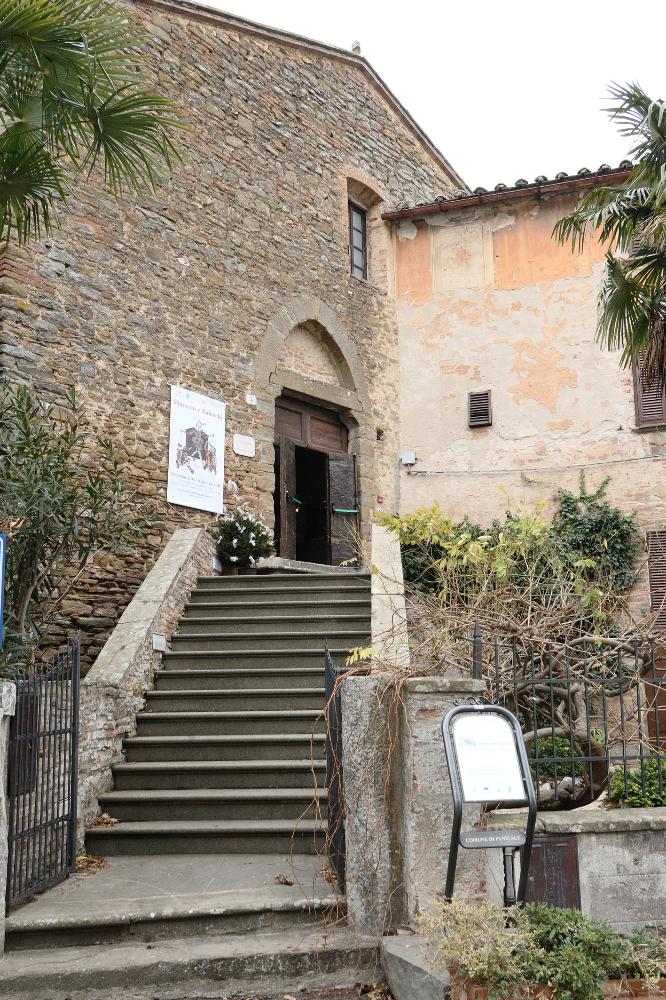


Inaugurated in 2001, the museum is housed in the sixteenth-century Church of Sant’Agostino, restored to preserve and display the numerous embroidered tulle artifacts previously kept by private owners and local churches. Needle embroidery directly on cotton or silk tulle spread from the early decades of the 19th century thanks to the improvement, by the English Heathcoat and Lurdley in 1809, of a loom for mechanically producing tulle, a very light, airy yet durable fabric characterized by hexagonal mesh holes. This embroidery technique, created to offer a production similar to bobbin and needle lace, was practiced by the nuns of the Virgin College of Panicale and taught to the students who attended at least until 1872, the year of its closure. From the 1930s, this tradition was revived by Anita Belleschi Grifoni from Panicale, who refined the craftsmanship, reworked the designs, and simplified the stitches. Convinced of the economic and social potential linked to this traditional female craft, Belleschi Grifoni founded a school and established the “Ars Panicalensis” brand. Since 1936, the company cooperated with ENAPI (National Agency for Crafts and Small Industries), also building connections with many contemporary artists who produced designs and embroidery patterns. Thanks to Mrs. Anita’s entrepreneurial spirit and her numerous social contacts, as well as the affordable cost of the products, the “Ars Panicalensis” embroidery became famous among nobles and middle to upper-class families, with pieces sold to the House of Savoy and the Torlonia princes. The school, like similar earlier experiences in the region, also aimed to guarantee women economic independence and personal fulfillment through the production and sale of their craftwork. After Anita Belleschi Grifoni’s death and the school’s closure, some embroiderers have continued to keep the traditional technique alive.
Information about the Anita Belleschi Grifoni Tulle Museum
Piazza Regina Margherita, 5/A
06064 Panicale (Perugia)
075837951
[email protected]
Source: MIBACT