
Tourism Italy 2026, 100 million visits in the first four months, increasing foreign spending, and AI in travel planning: ENIT–Isnart data outline a solid sector with an economic impact exceeding €108 billion.
Add us to your preferred sources.

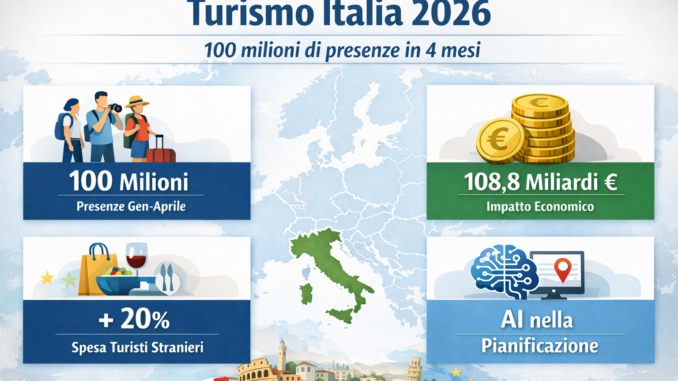
Tourism Italy 2026, increasing number of visits, foreign expenditure, Milan-Cortina Olympics, AI in tourism: the initial indications released by ENIT and Unioncamere-Isnart outline a scenario of consolidation for the sector, with estimates indicating over 100 million visits in the first four months of 2026 and an overall economic impact that reached €108.8 billion in 2025.
Summary
Spring 2026: Half of Accommodation Capacity Already Sold
According to the Isnart survey for Unioncamere and ENIT, between January and April 2026, the occupancy rate is already close to 50% both in hotels and in the non-hotel sector. After a 2025 of consolidation (with an average of 6 out of 10 rooms occupied), 2026 is opening with signs of further growth. Driving demand are primarily Germany, France, and Switzerland, confirming the strength of proximity European markets.
100 Million Visits in the First 4 Months
According to the Ministry of Tourism’s predictive model, over 100 million visits are estimated in the first four months of 2026. This figure, if confirmed, would strengthen Italy’s positioning as a highly resilient destination even in a complex international context.
Economic Impact: €108.8 Billion for the Industry
In 2025, almost 891 million total visits are estimated (including official accommodation and parallel markets), with an economic impact estimated at €108.8 billion for the extended tourism supply chain. The data includes expenses for lodging, dining, local transportation, shopping, cultural and recreational activities, highlighting tourism’s role as a cross-sector engine of the local economy.
Foreign Tourists: Less Volume, More Value
The international component accounts for 48% of flows, totaling approximately 431 million visits in 2025. But the most interesting data concerns spending: tourist expenses on the holiday destination are estimated at €60 billion, with a significant increase compared to previous years. The average daily expenditure per foreign tourist is €72 for accommodation and €105 for other expenses. There is a particular growth in the budget allocated to culture, dining, tastings, and experiences.
Major Events: Jubilee and Olympics Boost Visibility
The Jubilee caused an increase in clientele in Lazio (50% of operators report benefits), with also positive effects on Marche and Umbria. For the Milan-Cortina Winter Olympics, initial estimates indicate occupancy rates between 70% and 85% for February, with early bookings around 60% for the following months. A sign of the “long tail” effect of major events on the territory.
AI and Travel Planning: 20% of Foreigners Use It
One of the most interesting data points is artificial intelligence: about 20% of foreign tourists report having used AI tools to plan and organize their vacation in Italy. From logistics to itinerary choices, accommodation, and restaurants, AI is becoming an integral part of the decision-making process. For Italian industry, this is a clear signal: visibility, reputation, and content need to be optimized not only for traditional search engines but also for conversational ecosystems and automated planning tools.
Key Point for Industry
The data indicate a solid sector, but with ongoing transformation: less quantitative growth and more focus on generated value, experience quality, and the ability to intercept high-spending international demand.
The challenge for operators and destinations in Italy will be to capitalize on the effect of major events and to integrate technological innovation, training, and strategic positioning to maintain competitiveness in the medium to long term.
FullTravel Lab Analysis
ENIT–Isnart data indicate a phase of consolidation for Italian tourism, with growth gradually shifting from volume to value. Visits remain high, but there is an increase especially in average expenditure and the impact of international demand, while artificial intelligence is becoming a stable part of travel planning processes.

Key Numbers
- 100 million visits estimated in the first 4 months of 2026
- 891 million total visits in 2025
- €108.8 billion estimated economic impact on the tourism industry
- 48% share of international tourism
- €60 billion estimated foreign tourism expenditure
- 20% of foreign tourists using AI to plan their trip
For the Italian industry, the message is clear: intercepting high-spending international demand and optimizing presence in digital channels (including those based on AI) will be crucial to maintaining competitiveness in the coming years.
Pubblicato in TravelNews
Be the first to comment