

What to see in Lecce in one day is the leitmotif often heard. The Salento city needs more time to be admired in its beauty. For this reason, we created a guide to Lecce on what to see and do. However, for hurried travelers, we prepared a short itinerary that takes us to visit Lecce in one day.
A perfect idea is a weekend or a short stay in Lecce, the delightful capital of Apulian baroque, resting on a small plateau that dominates the entire Salento.
A good starting point can be the seventeenth-century Piazza del Duomo, the baroque and religious heart of the city, designed by the Duomo, the Episcopal Palace, and the Seminary.
The sea is not visible, but it is so close you can sense its breath. The wind, or rather the winds, are omnipresent: the humid and warm sirocco from the south, the cold and dry tramontana from the north; depending on which blows, the inhabitants choose whether to go to the sea on the Adriatic beaches or those of the Ionian.
Aside from the wind, what strikes about Lecce is the extraordinary combination of the “blue Salento” sky and the amber hues of the Lecce stone, a ductile material (limestone formed from the remains of marine fossil organisms), with which the palaces and many churches enclosed within the ancient walls have been built.
Beyond the sumptuousness, richness, and refinement of the decorations, the solemnity of the entire complex stands out most of all. Following via Libertini up to Porta Rudiae, you can admire religious buildings of great value, such as the church of Santa Teresa, the church of Sant’Anna with the former Conservatory, or the church of the Rosary, with a Greek cross floor plan and the original wooden ceiling coverings.
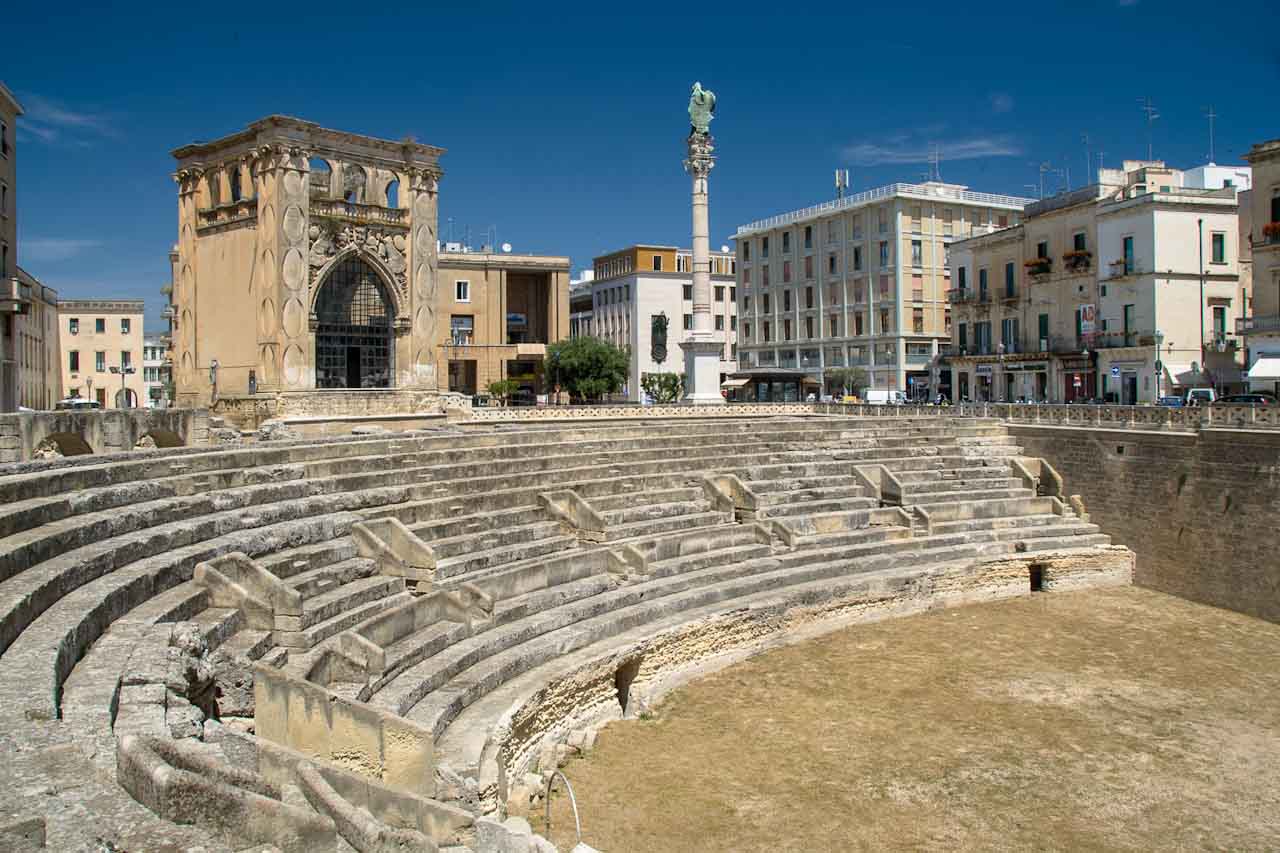
Another focal point is Piazza Sant’Oronzo, with the column topped by the statue of the saint in the act of blessing passersby. Much of the square is occupied by the Amphitheater built during the time of Emperor Augustus and uncovered only in the early 1900s.
Overlooking the Roman ruins stands the Sedile, a cubic building with high arches, built at the end of the 1500s as the seat of the mayor’s hearings and remained the town hall until the 1800s. Not to be missed is finally the Castle of Charles V, north of the square, a solid fortress with a central 14th-century tower, built to defend the city from the Turkish armies.
The Basilica of Santa Croce, the largest and most famous celebration of Lecce baroque (1549-1689), the adjacent Government Palace (former convent of the Celestines). The church of Santa Chiara, the Roman Theater, and the Romanesque church of Saints Nicolò and Cataldo, decorated internally with frescoes so precious that photographing them is forbidden.