


Nel 2006 l’UNESCO a conferit titlul de Patrimoniu Mondial unei părți largi a centrului istoric al reședinței de județ din Liguria, Genova, mai precis Strade Nuove și aproximativ un sfert din palatele nobiliare care făceau parte din sistemul Rolli. Povestea lor ne întoarce la perioada de glorie maximă a Republicii Maritime Genova.
Republic of Genoa under Andrea Doria
The city of Genoa became autonomous from the Holy Roman Empire starting in 1096, establishing itself as a free municipality. After various political hardships, which also cost it the loss of control over some strategic territories and even its independence (it had come under French control), in 1528, under the leadership of Admiral Andrea Doria, the city allied itself with Emperor Charles V.
This move allowed Genoa to regain its independence, becoming a sort of associate of the Spanish Empire. The city’s contribution to Charles V was mainly financial: Genoese banks issued loans to support Spain’s military and colonial enterprises, reaping enormous profits.
Thus, strengthened by new wealth, between the late 16th and early 17th centuries, the city adapted its appearance to its new role as a leading political interlocutor in Europe. The “Strade Nuove” were designed, along which the aristocratic residences of the most illustrious families of shipowners, bankers, and merchants arose: Doria, Spinola, Grimaldi, Lomellini, and Balbi, just to name the best known.

The New Streets
The New Streets in Genoa are the current via Garibaldi (formerly Strada Nuova or Via Aurea), via Cairoli (previously Strada Nuovissima), via Bensa and via Balbi. The concept that guided their construction, although simple, was enormously innovative at the time and would serve as an example for the urban development of other European cities: aristocratic families wanted to move their residences out of the medieval districts and concentrate them in an area where they were not in close contact with those of the lower classes of the population.
The first streets to be built were via Garibaldi (at the initiative of the Grimaldi family) and via Balbi, mainly occupied by the residences of the family of the same name. Via Cairoli, on the other hand, dates back to the second half of the eighteenth century and was created as a connection between the other two streets.
In via Garibaldi, the construction of such a complex of palaces on the rocky coast above the port required considerable construction and structural solutions, used here for the first time.
The fame of the New Streets also attracted Rubens who published the collection of drawings “Palazzi di Genova” to serve as an example for the European aristocracy.

The Palazzi dei Rolli in Genoa
Because of its primary political and economic role, during its golden age Genoa often had to welcome and host sovereigns, ambassadors, and high ecclesiastics who came for an official visit. Thus, the Rolli system was created, according to which the most eminent families, by a draw, were obliged to host visitors in their residences.
Periodically, a list of aristocratic residences was drafted, called the Rolli of public lodgings. There are five of them, dated between 1576 and 1664 and kept at the State Archives of Genoa (historic building from the 16th-18th centuries, whose original core is a 16th-century villa, with frescoed rooms and halls, purchased by the Jesuits in the 1600s to become their Novitiate.) Each residence, based on prestige and size, was registered in one of the three or four categories into which the list was divided. Thus, depending on the importance of the guests, it was decided which category was most suitable and, placing the names of the residences in a ballot box, the draw was carried out.
Only three palaces had the privilege of hosting “Pope, Emperor, king and legate, Cardinals or other Prince”: the residence of Giò Batta D’Oria, Palazzo Doria Tursi of Nicolò Grimaldi, and Palazzo Lercari Parodi.
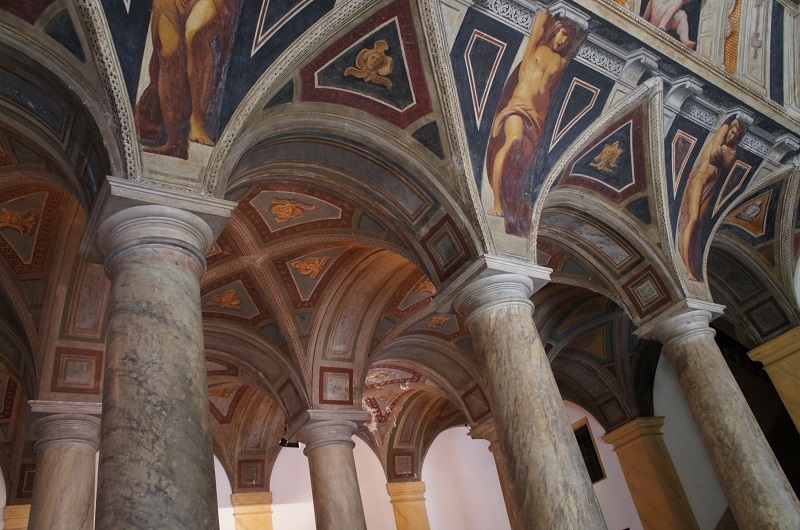
The structure of the Palazzi dei Rolli is quite similar. Inside, the visual impact is created by the succession of entrance hall, courtyard, grand staircase, and garden. The spaces are often adorned with pictorial and sculptural works by the most eminent artists of Genoese Mannerism and Baroque.
The palaces that have been listed in the Rolli at least once number a total of 163, but only 42 are part of the UNESCO World Heritage. They are mainly concentrated in via Garibaldi, in the nearby Salita Santa Caterina, Piazza Fontane Marose, and via Lomellini and in via Balbi.
Among those not chosen by UNESCO, the Palazzo Domenico Grillo, in piazza delle Vigne 4, Palazzo Bartolomeo Invrea in via del Campo 12, and Palazzo Spinola Franzone in via Luccoli 23 are still remarkable.

How to visit the Rolli
Almost all the Rolli palaces are today private residences or headquarters of banks, companies, or public institutions. On two weekends a year, in April and October, there are the Rolli Days, during which all the palaces are opened to the public and it is possible to visit them with the guidance of students and researchers from the University of Genoa.
During the year, some Rolli can be visited as they have now been transformed into museums. The Museums of Strada Nuova are housed in the Palazzi Rosso, Bianco, and Doria Tursi, on via Garibaldi between house numbers 9 and 18.
In the Palazzo Rosso the collections belonging to the Brignole-Sale family are preserved, partly housed in rooms that retain the original decorations and furnishings.

In Palazzo Bianco it is possible to admire works of Genoese painting, but also Italian masterpieces (Caravaggio, Lippi, Veronese), Flemish (Rubens, Van Dyck), and Spanish.
Palazzo Doria Tursi, the most imposing on the street, houses the last part of the museum route, with Genoese painting of the 17th and 18th centuries and the Paganiniana Room which preserves some relics belonging to the artist, including the famous violin known as Il Cannone.
The Palazzo Stefano Balbi, at via Balbi 10, is also known as the Royal Palace as, with the annexation of the Republic of Genoa to the Kingdom of Sardinia, it was acquired by the Savoia family and used as an official residence in the summer months. It now hosts a museum of decorative arts, with over two hundred highly valuable paintings, sculptures and, of course, the frescoes and furnishings of the residence.