


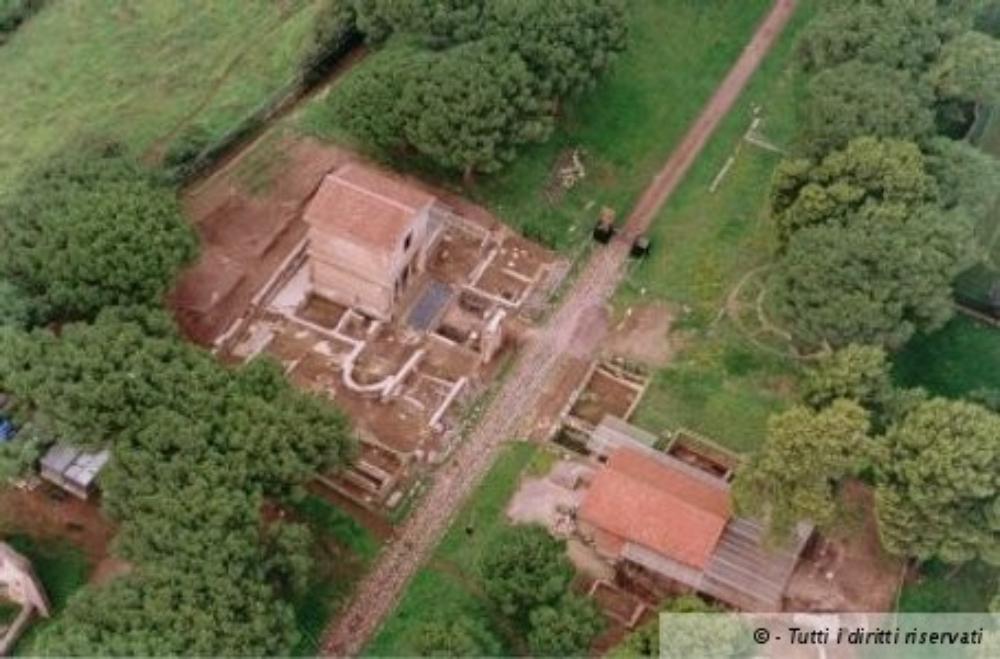


On the site, a stretch of the ancient Via Latina is preserved, which connected Rome with Capua, still paved for a long stretch with the ancient flint basalt, and on both sides numerous funerary monuments and historical and material testimonies from the Republican age to the early Middle Ages.
The discovery and excavations of the area were carried out between 1857 and 1858 by Lorenzo Fortunati, a teacher with a passion for archaeology. The first monument that stands out on the right of the road is the so-called Tomb of the Cornelii or Barberini, named after the aristocratic family who last owned the area.
The funerary monument, dating to the 2nd century AD, consists of two above-ground floors and an underground burial chamber, surrounded by a corridor, also used for burials, paved with mosaic. On the outside, original painted architectural terracotta decorations are preserved. The interior was covered with frescoed and stuccoed vaults.
Shortly after the Barberini tomb, on the left side of the road is the so-called Fortunati 25 tomb. Consisting of a square plan structure, with an underground burial chamber, it was accessed from the Via Latina by means of a staircase with two flights of steps that still retain traces of the marble slab cladding.
Continuing along the route of the Via Latina, which preserves the basalt pavement in some points, on the right side is the so-called Tomb of the Valeri, whose currently visible elevated structure was built at the end of the 1800s on the original masonry.
Opposite the Tomb of the Valeri is the Tomb of the Pancrazi, from the late 1st – early 2nd century AD, so called for the reference to the inscription that cites the funerary college of the “Pancratii,” placed on the front of a sarcophagus of spouses inside the first hypogeum room. The last visible tomb on the left side of the road is that of the Calpurnii: enclosed within a fence, it is composed of a single underground chamber that retains traces of the original plaster and stucco covering; arcosolia open on the wall to house the sarcophagi.
On the right side of the road, shortly before the end of the Park, stands the façade of the so-called Baccelli tomb, all that remains of a tomb that had remained intact in the elevation until 1959, when much of the building collapsed. The structure is the recurring one of 2nd century AD tombs, with two brick floors with decorated cornices, brackets, and architrave, and two underground funerary chambers, currently not accessible.
In the area behind the Tomb of the Pancrazi, the remains of a large villa built at the end of the 1st century AD and inhabited until the early 6th century emerge, when Demetriade, a descendant of the Anicii family, had a basilica dedicated to St. Stephen the Protomartyr erected in a sector of the villa, a pilgrimage destination even until the 13th century, the remains of which are still partially visible.



