


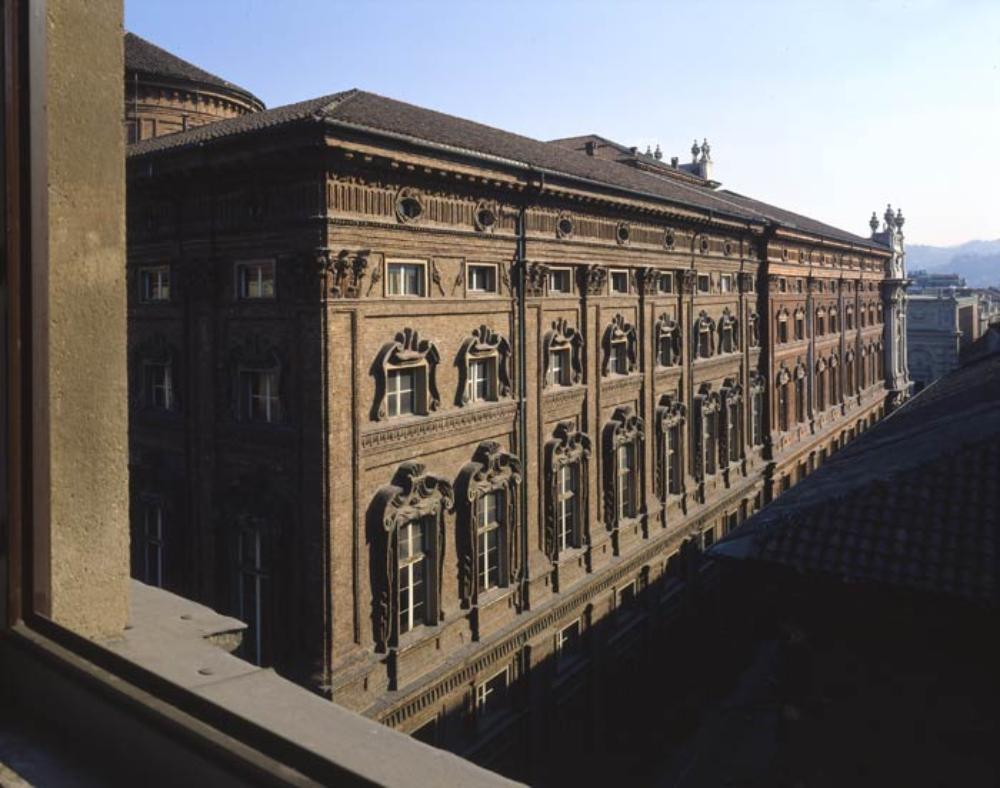

Il Palazzo Carignano was built by the will of Emanuele Filiberto of Savoy-Carignano, designed by the Theatine father Guarino Guarini who began its construction in 1679. It is one of the most suggestive and impressive palaces of the Italian seventeenth century, with a sinuous facade and a simple brick cladding, worked richly and originally.
The building was erected in the area used as stables by Prince Tommaso, progenitor of the cadet branch Savoy-Carignano, and originally had a C-shaped plan open onto the gardens; the current quadrangular structure is due to the addition of the nineteenth-century building constructed to house the Italian Parliament, completed in 1871, after the capital was moved to Rome. The central elliptical hall located in the seventeenth-century part, once used for parties, was transformed in 1848 into the chamber of the First Subalpine Parliament. The Palace houses in the rooms of the noble floor the National Museum of the Italian Risorgimento and on the ground floor the offices of the Polo Museale del Piemonte, as well as some offices of the Superintendence of Fine Arts and Landscape of Turin.
Reopened to the public, thanks to the support of the Compagnia di San Paolo, in 2011 with an exhibition dedicated to Stefano Maria Legnani called il Legnanino, the skilled painter who decorated its interiors between the late seventeenth and early eighteenth centuries, after half a century it is currently accessible with a permanent visit path to the Mezzogiorno apartment, also called the Princes’ apartment. This is a pathway conceived ‘in progress’, intended to expand and enrich itself as investigations underway will increase the level of knowledge about the palace, the events and the characters who inhabited it.
Information about Palazzo Carignano
Via Accademia delle Scienze, 5
10123 Torino (Torino)
011 5641791
[email protected]
https://www.polomusealepiemonte.beniculturali.it
Source: MIBACT