

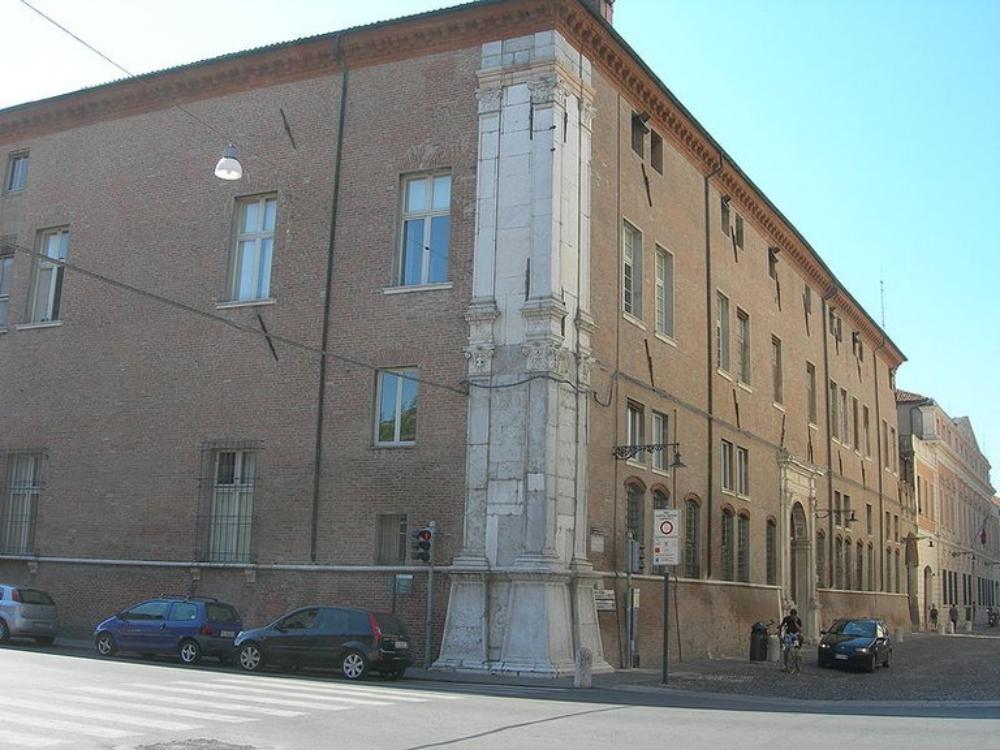

Finalized for university teaching, it originated in 1964 following the transfer of the Institute of Geology to Palazzo Turchi di Bagno. Established thanks to the interest of Professor Piero Leonardi, Venetian geologist, paleontologist, and naturalist, the museum displays on the noble floor of the building over two thousand pieces distributed in four sections dedicated respectively to Vertebrate Paleontology, Prehistory, Paleontology, and Geology. The first section gathers an important series of fossils arranged according to a systematic and evolutionary order: specimens of amphibians, Permian mesosaur reptiles, Triassic therapsids, a marine crocodile, and some Jurassic ichthyosaurs. Mammals are represented by skulls of giant perissodactyls from the Paleogene, the saber-toothed tiger, and the woolly rhinoceros from the Pleistocene. In the center of the room, some Italian Pleistocene skeletons are arranged, such as the dwarf elephant and hippo from Sicily, the ibex, and the cave bear. In the section dedicated to the development of the earliest human history, some cranial casts document the evolutionary path from australopithecus to modern man, while artifacts distributed over the long period between the Lower Paleolithic and the Iron Age document the cultural and material development of the human species. The Invertebrate Paleontology section exhibits fossils illustrated in their morphological and evolutionary aspects. The biological evolution of the Earth and the most important geological events are the protagonists of the last section, entitled Historical Geology, consisting of stratigraphic columns and environmental reconstructions related to the Mesozoic and Cenozoic sequences of the Dolomites and Veneto.
Information about the “Piero Leonardi” Museum of Paleontology and Prehistory
Corso Ercole I d’Este, 32,
44121 Ferrara (Ferrara)
0532293731
pnr@unife.it
https://www.museoferrara.unife.it
Source: MIBACT