

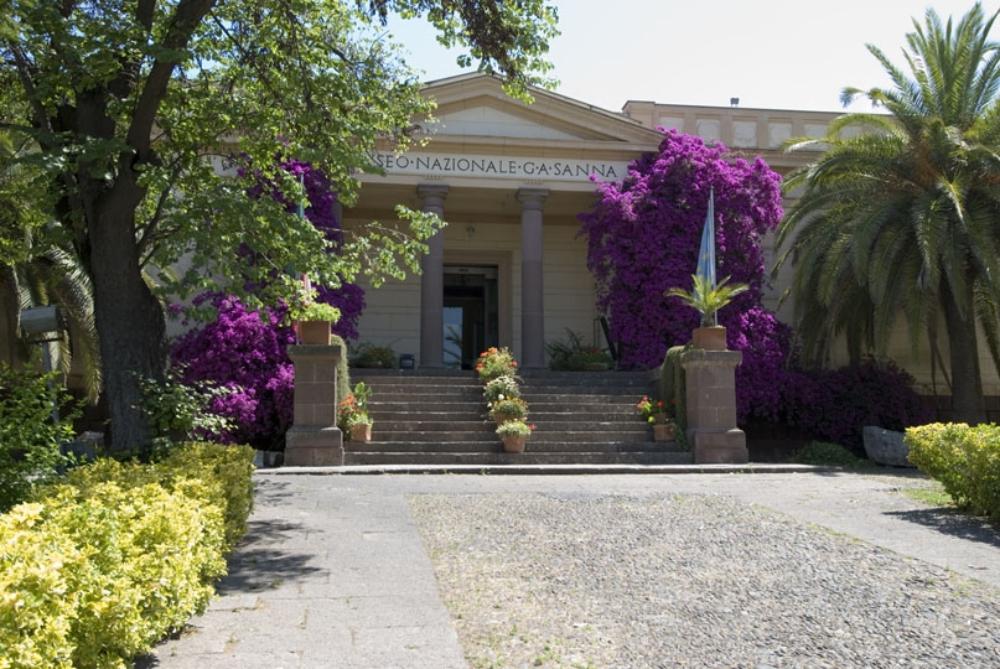

Costituisce la principale istituzione museale della Sardegna centrosettentrionale, per dimensioni ed importanza delle sue raccolte. Istituito nel 1878 come Regio Museo Antiquario, divenne nel 1931 “Regio Museo di antichità ed arte G.A. Sanna”, trovando un’adeguata sede espositiva in un edificio appositamente costruito. Alla donazione delle collezioni archeologiche e storico-artistiche del senatore e imprenditore sassarese, si aggiunsero negli anni altre collezioni private (Chessa, Dessì, Clemente ecc) e l’apporto dei materiali frutto degli scavi realizzati dalla locale Soprintendenza. L’esigenza di nuovi spazi portò alla costruzione di nuovi padiglioni e nel 1973 il museo fu riaperto al pubblico con un nuovo assetto. Negli ultimi anni l’offerta culturale si è notevolmente ampliata: nel 2000 è stata inaugurata la sezione medievale e moderna e nel 2011, dopo oltre vent’anni di chiusura, dovuta a problemi di degrado dei materiali, è stata riaperta la sezione etnografica.
The museum is currently divided into two sections, archaeological and ethnographic. The archaeological section traces the history of the territories of the provinces of Sassari, Nuoro, Gallura and Ogliastra from the Lower Paleolithic (500,000 years BC) to the eighteenth century through the phases of prehistory, the Nuragic age, Phoenician-Punic, Roman, medieval and modern. The chronological exhibition alternates with the topographical one, which delves into sites and contexts of particular importance (the sanctuary of Monte d’Accoddi, the pre-Nuragic hypogeum tombs, the city of Turris Libisonis). The path is enriched by useful educational aids including models, casts of monuments and a hologram of the architectural phases of the sanctuary of Monte d’Accoddi. The ethnographic section includes a collection of Sardinian folk ethnographic objects which is the oldest of its kind on the island. It consists of fabrics, jewelry, baskets, clothes and traditional furnishings from the last three centuries, largely belonging to the Clemente collection. Awaiting the expansion of the exhibition spaces, only one room has been set up for now, dedicated to traditional Sardinian clothes (second half of the nineteenth century – first half of the twentieth century), arranged by geographical areas.
Informazioni su Museo Nazionale Archeologico ed Etnografico “Giovanni Antonio Sanna”
Via Roma, 64
07100 Sassari (Sassari)
0703428203
pm-sar@beniculturali.it
https://www.museosannasassari.beniculturali.it/index.php
Fonte: MIBACT