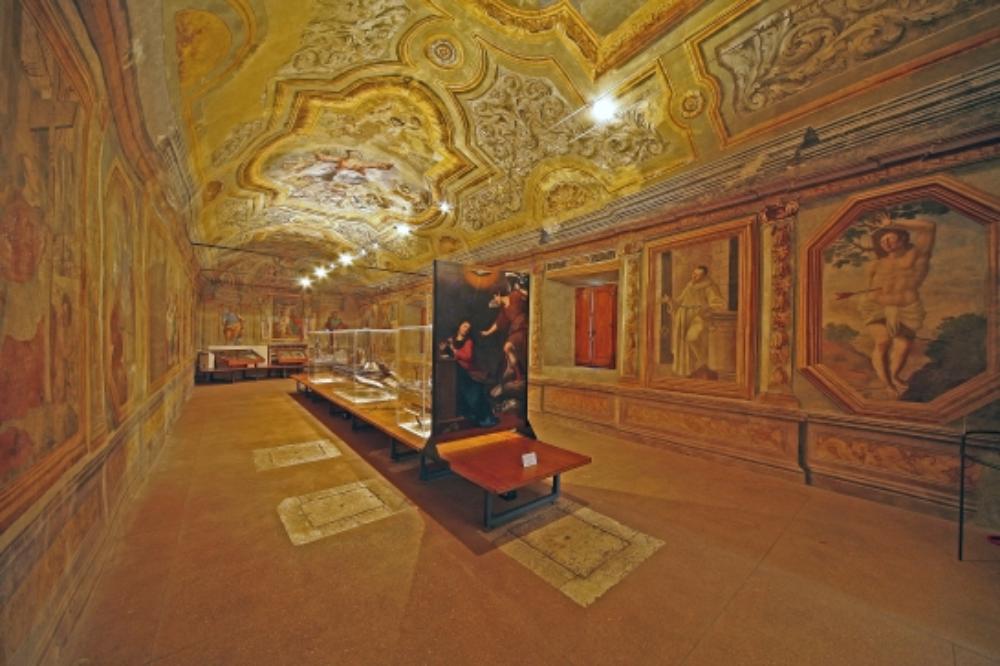
La exhibition gallery of the National Central Library of Rome permanently displays the works commissioned following a competition held in 1970 pursuant to Law 717/1949, later amended by 237/1960, the so-called “2% law,” which stipulated that whenever a public building was constructed, a quota of no less than 2% of the total planned expenditure had to be allocated for its “decoration” with works of art.
The competition provided for seven sculptures in travertine or peperino and four in metal for the gardens; for the interiors, a large sculpture in metal, three tapestries, and two frescoes. These works were created by important artists of the time: for the sculptures Osvaldo Calò, Saverio D’Eugenio, Oreste Dequel, Silvio Olivio, Ariosto Trinchera, Luigi Venturini, Raul Vistoli, Franco Cannilla, Carlo Carchietti, Pietro Consagra, Augusto Vanarelli, Aldo Caron; for the tapestries Afro and Capogrossi; for the frescoes Anna Romano, who also made the large wooden ceiling for the Conference Hall.
The current headquarters of the library therefore not only represents a moment of synthesis — as important as it has been little valued so far — of some architectural debate trends of the post-war period, but is also a container of a “snapshot” of the most representative artistic movements of the Sixties-Seventies of the last century.