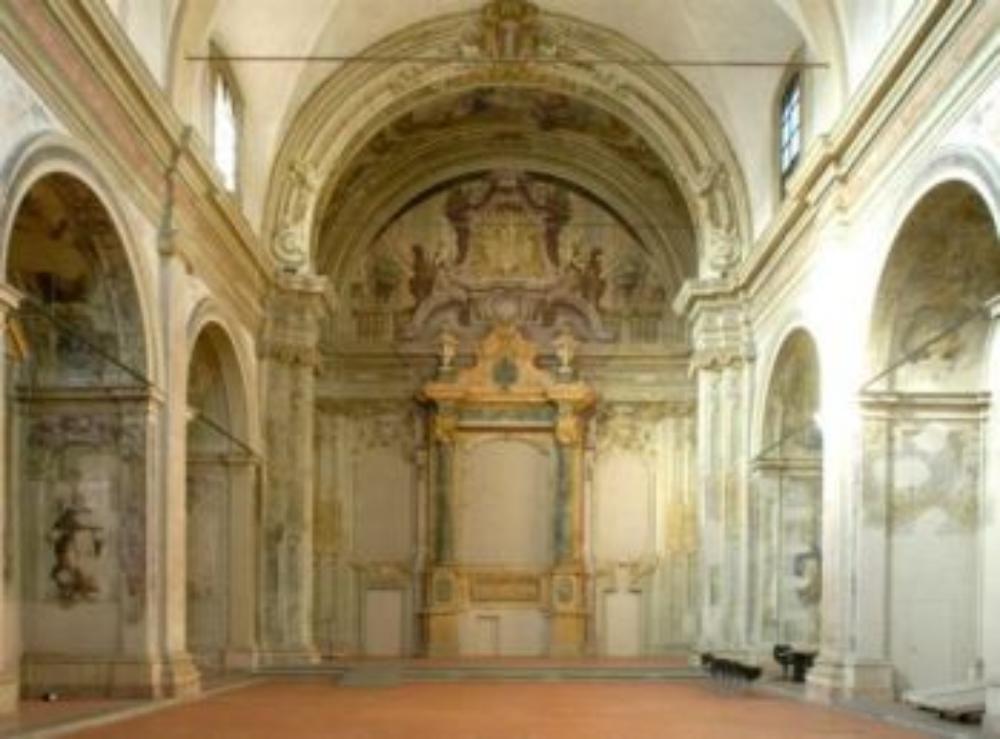

Attributed to Pietro Fiorini, the church was built starting from 1575 and consecrated in 1588. Attached to the Dominican Convent, it faces with a simple facade on via Sant’Isaia, perfectly integrated into the urban fabric thanks to the portico placed in continuity with that of the nearby buildings. The lavish and spectacular appearance of the interior is due to a “modernization” of the ornamental and pictorial apparatus carried out around the mid-eighteenth century by the “quadraturist” Pietro Scandellari and the artists Nicola Bertuzzi and Tertulliano Taroni.
From the same period dates the transformation of the serlianas and the sixteenth-century oculi in the central elevation into rectangular windows. In 1799, following the suppression of religious orders decreed by the Napoleonic government, the church of San Mattia was separated from the convent, deconsecrated, and reduced to a warehouse.
The restoration, begun in 1981 and completed in 1994 at the full expense of the Ministry for Cultural Heritage and Activities, brought to light what remained of the stuccos and frescoes. Entrusted to the Regional Directorate for Cultural and Landscape Heritage of Emilia Romagna by the State Property Agency, the church of San Mattia has become a venue for exhibitions, meetings, and conferences dedicated to architecture, urban planning, design, and the study of the historical-artistic-landscape heritage of the Emilia-Romagna territory.