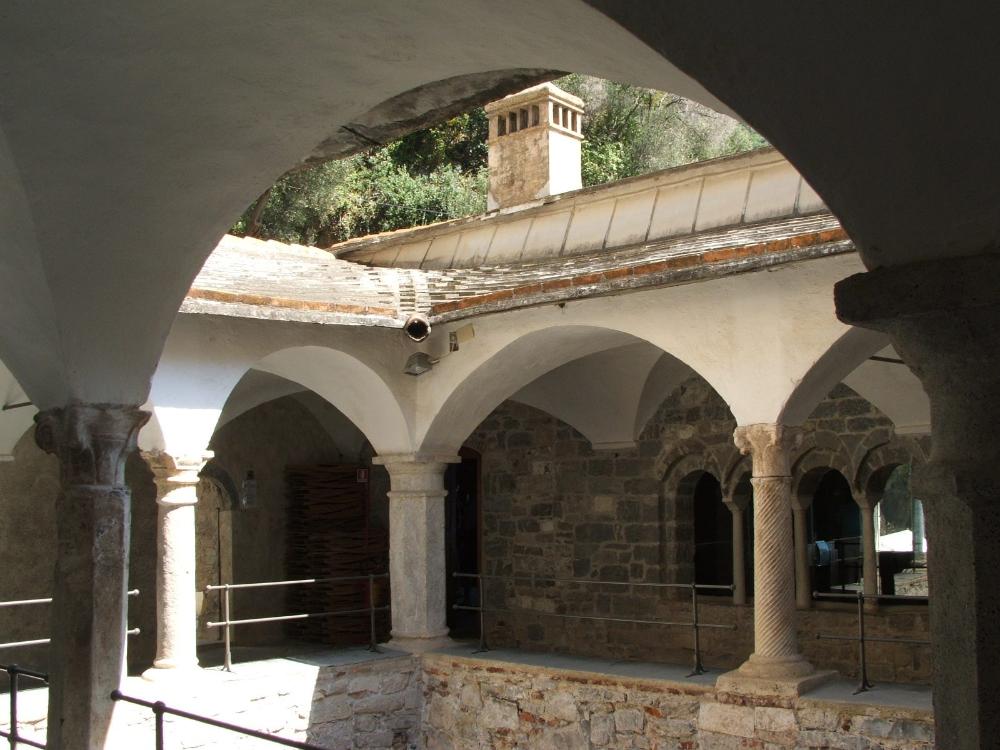

The monastic complex, singular and unique in its kind, linked to its particular location, in the bay of Capodimonte, includes: the church, the cloister and the abbey. Its origin is connected to the moving of the relics of San Fruttuoso to the bay, around the 8th century, by Greek monks.
The abbey dates back to the 10th-11th century, except for the body facing the sea which can be dated to the 13th century, composed of two orders of triforas, whose typology traces back to the noble palaces of Genoa. The bell tower built around the 10th century, initially with a spherical dome, following the Byzantine artistic canon, was later surmounted by an octagonal tower.
The cloister of the abbey was built in the 12th century and later modified by the will of Andrea Doria, today it is composed of two orders of arcades. On the upper floor, a walkway with rib vaults resting on columns overlooks the square courtyard; the lower part was used as a tomb for members of the Doria family who died between 1275 and 1305. These are tombs topped by pointed arches alternating white and black stripes, typical of Ligurian art. In addition to the tombs of the noble Genoese family there are two other tombs and an ancient Roman sarcophagus.
In the 17th century, the complex underwent a real structural decay: some rooms were used as sheepfolds, others as woodsheds. In 1730, Camillo Doria intervened, carrying out a restoration that returned the church to its original function.
In 1915, a flood destroyed part of the complex, which was restored in 1933 by the State. In 1983 the Doria Pamphili family donated the San Fruttuoso complex to FAI, and restoration works began in 1985.
Information on the Abbey of San Fruttuoso
Via San Fruttuoso, 13
16032 Camogli (Genoa)
0185774480
[email protected]
https://www.sbapge.liguria.beniculturali.it/index.php?it/222/camogli-ge-complesso-di-san-fruttuoso
Source: MIBACT