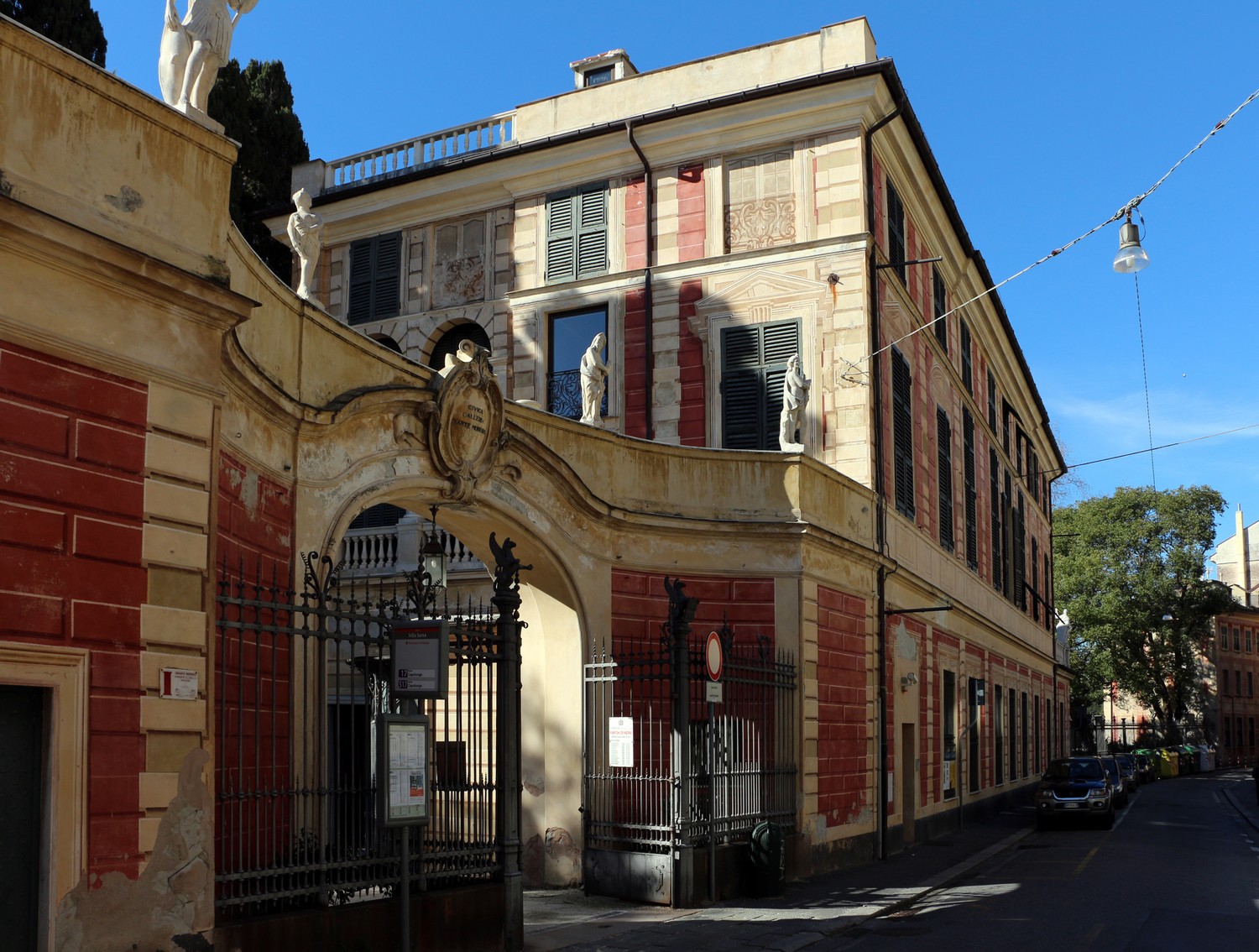


L’extremely vast area allows the construction of a grand building, comparable only to that of Doria-Pamphilj in Fassolo, while the steep slope of the land is the opportunity for the designers Domenico and Giovanni Ponzello to experiment with the innovative architectural solution that, through the succession of atrium-courtyard-staircase spaces, creates a wonderful play of perspectives.
Purchased by Gio Andrea Doria for his son Carlo, Duke of Tursi, it was completed in 1596 by Carlone and Orsolino with the addition of two side loggias that scenographically integrate it with the surrounding green spaces.
Owned by the Doria family until the early nineteenth century, it was enriched by the neighboring Palazzo delle Torrette (1716) and, having become the residence of the Savoy (1819), with a rich interior decorative apparatus of stuccoes and frescoes.
The demolition of S. Francesco allowed the expansion at the back with the construction of the clock tower and the creation of a “romantic” garden that scenographically recovers the structural and decorative elements of the church.
Transformed into a college (1838) and becoming the Town Hall from 1848, after the expansion to the north of the municipal offices based on the Albini-Helg project (1952-59), it is today part of the wider “Museum System of Strada Nuova“.