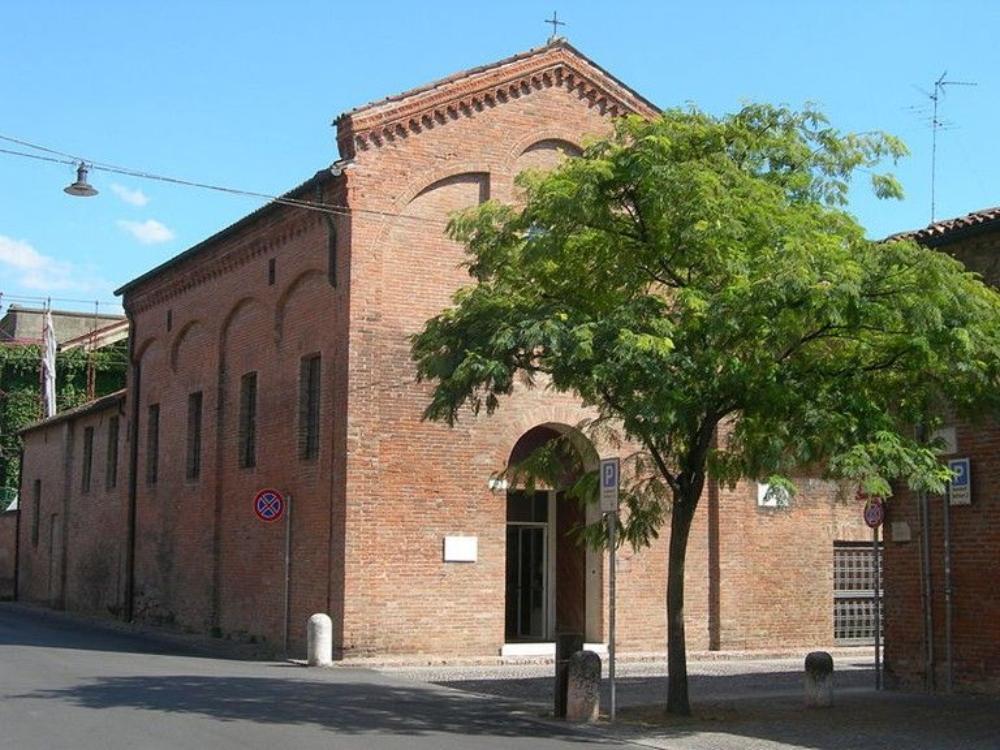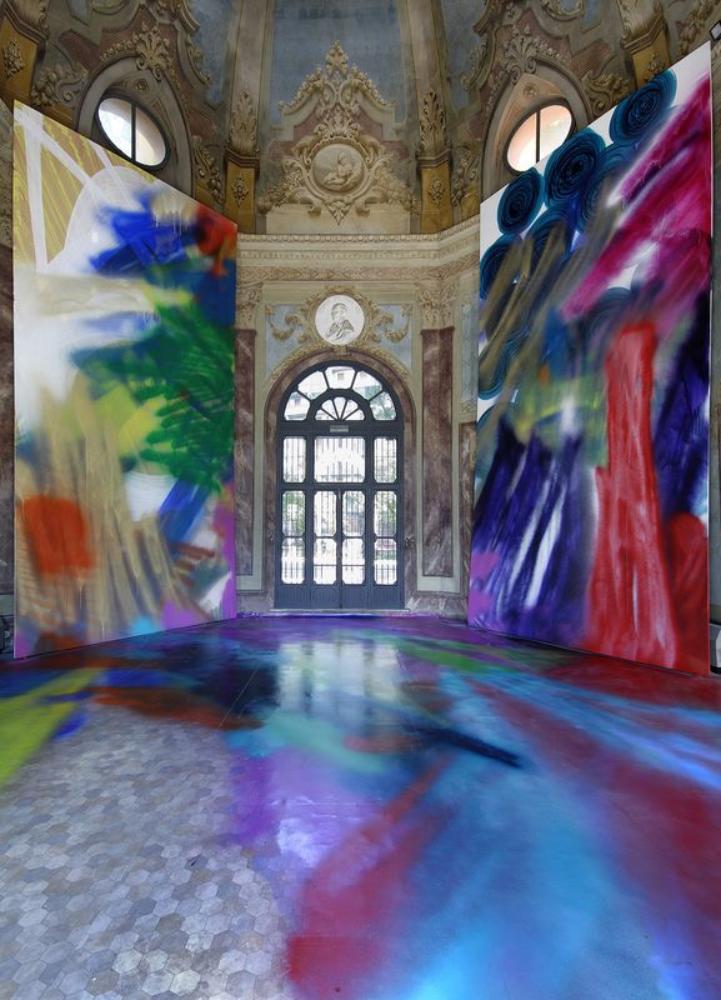


“An extremely beautiful work for the town of Cesenatico is the Theater, the construction of which began in 1863 and was completed in 1865 with an expense of L. 80,000. The architect was the municipal engineer Mr. Candido Panzani from Gambettola, and the works were directed by engineer Mr. Enrico Bocchini from Cesena. It is located in the center of the town and occupies an area of 488.99 square meters” (cit. Monografia..1866). It was inaugurated on the evening of July 11, 1865, as evidenced by the plaque placed at the entrance. Two other plaques commemorate Ermete Zacconi on the evenings of August 8 and 10, 1908, and the restorations of 1926. The brick facade, neoclassical, consists of a high plinth with continuous banded rustication up to the string course. On this rests a body with decorative pilasters with bases and Ionic capitals, ending with a cornice with brackets from which the pediment stands out in the central part. Besides the central door, there are two windows and two side doors with entrance and emergency exit on the ground floor. On the first floor, three front windows and two side ones illuminate the rooms where the local music school was housed. The access hall to the stalls and the first-tier boxes is flanked by two side rooms used for various services. The same division is repeated on the first floor, where the foyer is located. In the central hall, with a horseshoe-shaped cavea, there are two tiers of fifteen boxes each, including the “barcacce” and the gallery. The ceiling of the stalls was decorated with a large wooden rosette in the center. Around the rosette in the circular area was painted a large veil with laces. Executed with elegant craftsmanship, six medallions with busts on a gold background were placed at its extremity, representing illustrious men from the history of theater, including Goldoni, Metastasio, Donizetti. Recalled are “the decorations by painters Bellani and Canepa from Lugano, the carvings by Cuccoli from Bologna, the plaster bas-reliefs by sculptor Vittorio Rambelli from S. Giovanni in Persiceto, the gilding by Leonida Morsiani from Cesena, and the scenes masterfully painted by Pirro Rota from Forlì” (cit. Monografia..1866). The curtain, the work of the Forlì painter Pompeo Randi, depicted Duke Valentino and his entourage in conversation with Leonardo da Vinci, the designer of the Cesenatico port-canal. Lost after the war, the 19th-century valance, for which documentation was preserved, was revived thanks to the work of some students of the Scenography Course at the Brera Academy of Fine Arts (Paola Galli, Giulia Galli, and Stefania Lomi) who, guided by Gastone Mariani, faithfully reproduced the setting and characters identical to the original but with the variants suggested by the different functionality of the work in today’s theater. The frames and friezes framing the scene (typically 19th century) were therefore removed to ensure a more flexible and direct insertion into the current stage system. At the same time, the color tones were lowered compared to what was shown in the documents for the original, favoring a greater harmonization with the current context of the hall, partially deprived of 19th-century decorations. The conservation conditions of the surfaces, during the first census carried out by the Institute for Cultural Heritage, were very serious: particularly deteriorated, and in most cases lost, were the decorations of the ceiling of the hall, the carved and painted wooden columns supporting the first and second tiers of boxes, and the decorations of the parapets. From 1981 to 1992, under the direction of architect Augusto Savini, conservative restoration interventions were carried out on the building (walls, roof), while internally the floors of the stalls and the stage were completely rebuilt. Expansion works, at the back and on the side of the building adjoining the municipal courtyard, made it possible to create restrooms, dressing rooms, and storage. The intervention on the decorations consisted of redoing the external decorations of the boxes, except those of the first tier, for which part of the original ornamentation was recovered. For the ceiling, once finely painted and now definitively lost, it was deemed not appropriate to reconstruct the original decoration but to treat the surfaces with neutral materials. The current visual impact with the hall is pleasant and makes this small theater a true gem, although the ensemble, with its chromatic and decorative accents, will over time regain the light and atmosphere typical of this particular type of environment. The theater, owned by the municipality, is part of the circuit of small and medium theaters of Romagna managed by the Cooperative “Accademia Perduta – Romagna Teatri” of Ravenna and Forlì for all production and theatrical programming activities, while the artistic direction is entrusted to Sandro Pascucci. Currently, the theater is operational and offers series of prose, dialect theater, children’s theater, and a “school theater” series for the schools of Cesenatico and the surrounding area. (Nadia Ceroni / Lidia Bortolotti)
Information about the Municipal Theater of Cesenatico
Via Mazzini 10-12,
47042 Cesenatico (Forlì-Cesena)
Source: MIBACT