


Within the grounds of Capodimonte Park you’ll find sixteen structures including residences, hunting lodges, artisan workshops, depots, and churches, as well as fountains, statues, hunting facilities, vegetable gardens, orchards, and the Capuchin cemetery of the Hermitage.
The history of the park, together with the Capodimonte Palace, began with the accession of Charles of Bourbon to the throne on May 10, 1734. He launched an ambitious project for royal estates directly managed by the Crown, known as the “real sites.” Capodimonte, high up, breezy, overlooking the gulf and visible from much of Naples, was deemed the ideal place for the royal residence.
The boundaries of the hunting estate were already completed by 1736. The entrance was through the Porta di Mezzo, which led to a grand semicircular court from where the system of avenues fanned out.
Traditionally, the design of this dramatic layout was attributed to Ferdinando San Felice and Domenico Antonio Vaccaro, but more recent studies suggest it was the Roman architect Antonio Canevari. What is certain is that San Felice renovated the Royal Porcelain Factory in 1743 and, two years later, built the Church of San Gennaro at the end of the first broad avenue.
Naturalistic scenery, statues, and fountains, as well as walled gardens, were essential in a royal wood. The vegetation was arranged to suit the hunting types favored by the king: dense areas of holm oaks, chestnuts, hornbeams, and elms alternated with myrtle, olive, and bay laurel, interspersed with clearings and bird-catching areas. Large tracts were cultivated to provide food for domestic and wild animals kept in special enclosures.
Produce from the woods and fields were partly for the royal court’s needs and partly for sale. In 1738, work began on the Royal Palace in the most scenic part of the estate, called the “Spianato.”
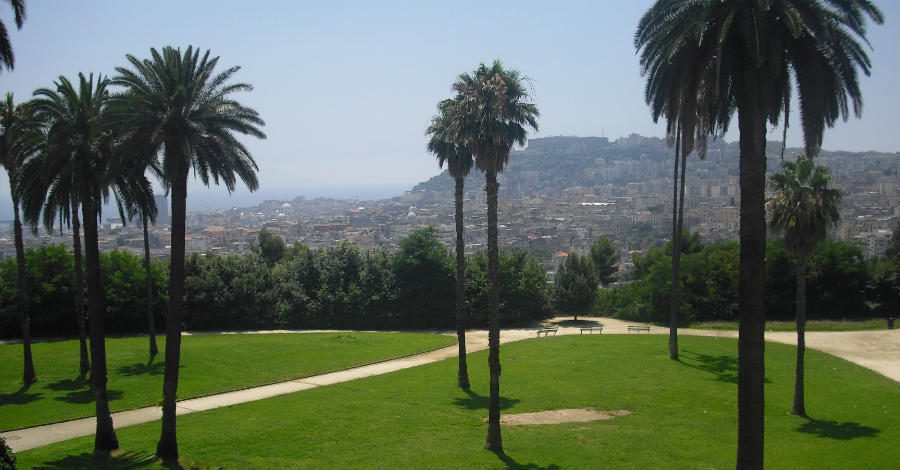
Palace and Woodlands, originally separate, became a single complex, independent from the city, only during the French decade. Then, a boundary wall was built around the Spianato, featuring the Porta Grande on the Ponti Rossi road and the Porta Piccola on the route to Miano.
A major innovation was the new road designed by engineer Romualdo De Tommaso: the Corso Napoleone (today Amedeo di Savoia), inaugurated in 1809, a straight stretch linking the area of the museum and Capodimonte. The road crosses the Sanità valley via a bridge and overcomes the Spaccata mountain with the scenic Tondo roundabout, built by Niccolini in the early 1800s.
In the Park, starting in 1817, Ferdinand I had the Capuchin Hermitage built and began the first redesign of the green areas “English-style” to reflect the trend that had swept across Europe. The Savoy restored hunting in the Woodlands and altered the areas adjacent to the Palace and the Casino dei Principi.
Visitor Information – Capodimonte Park
Via Miano, 4 80145 Naples – Tel. 081.7410080/081.5808278
Capodimonte Museum and Park Opening Hours
The Capodimonte Museum is open daily except Wednesdays, from 8:30 am to 7:30 pm. Last admission is at 6:30 pm. Museum closing operations and visitor exit begin at 7:00 pm. The museum is closed every Wednesday, January 1, and December 25. The Bosco di Capodimonte is closed on December 25, January 1, and Easter Monday (April 17).