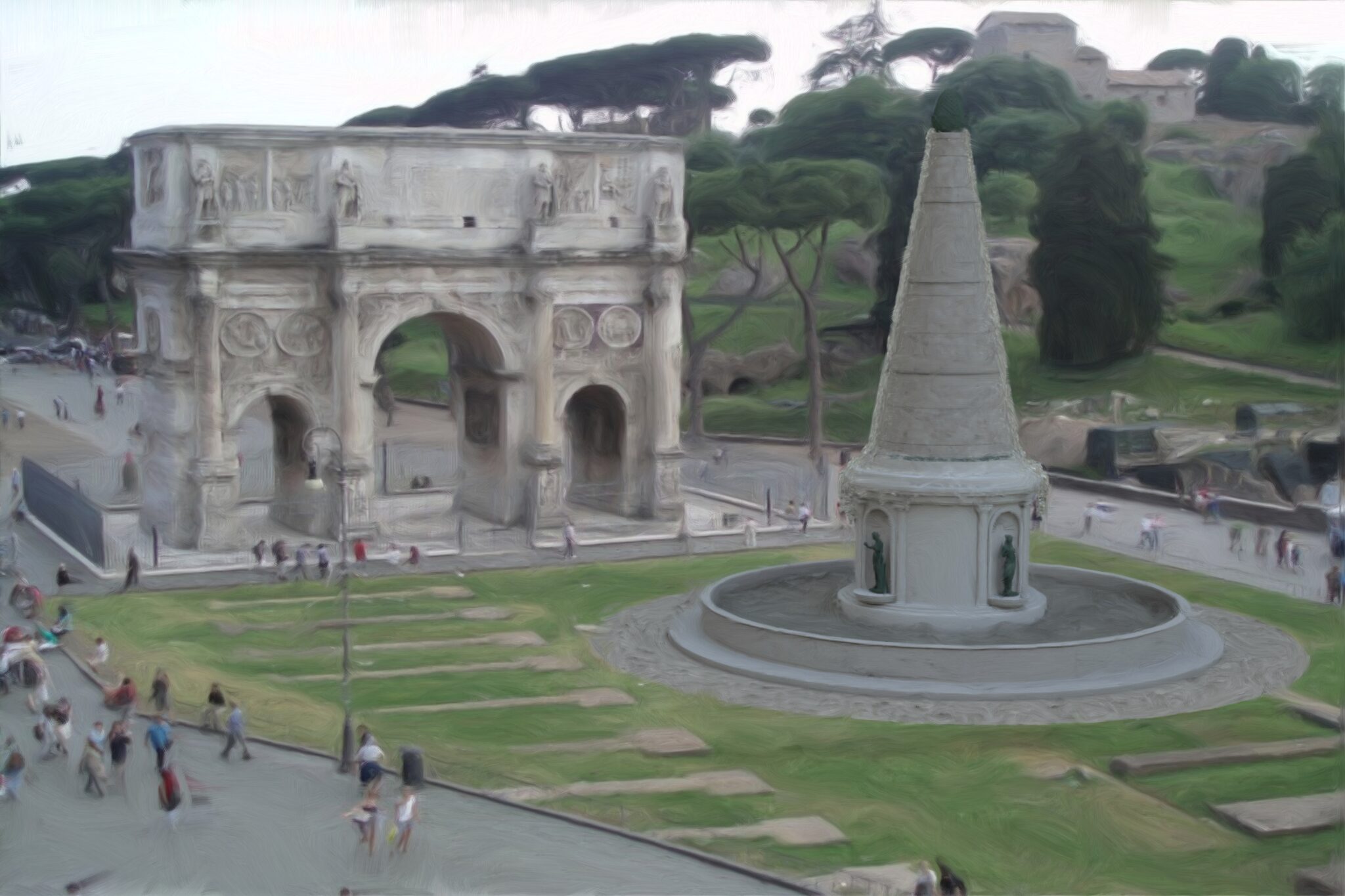


The fountain, depicted on coins from 80-81 AD, was in use until the 5th century AD when the backfilling of the Valley began to obstruct the drainage channels. The ruins were demolished in 1933 for the creation of via dei Trionfi.
Thanks to the coin depictions and the drawings made at the time of demolition, it is possible to reconstruct the original appearance: a base cylinder covered with marble and perhaps divided into niches, a conical upper element decorated on top with a flower or a sphere.
Today only the foundations of the circular basin and a concentric perimeter added in the 4th century are visible.
The Meta Sudans occupied a site of great urban importance, near one of the vertices of the sacred boundary of the city of Rome, at the intersection of two roads connected to the triumphal route and at the meeting point of four regions of Augustan Rome.
In the same area, Augustus had already erected a smaller fountain, mentioned in sources and found during recent archaeological excavations.
The Flavians thus perpetuated the memory of a strongly symbolic monument.