


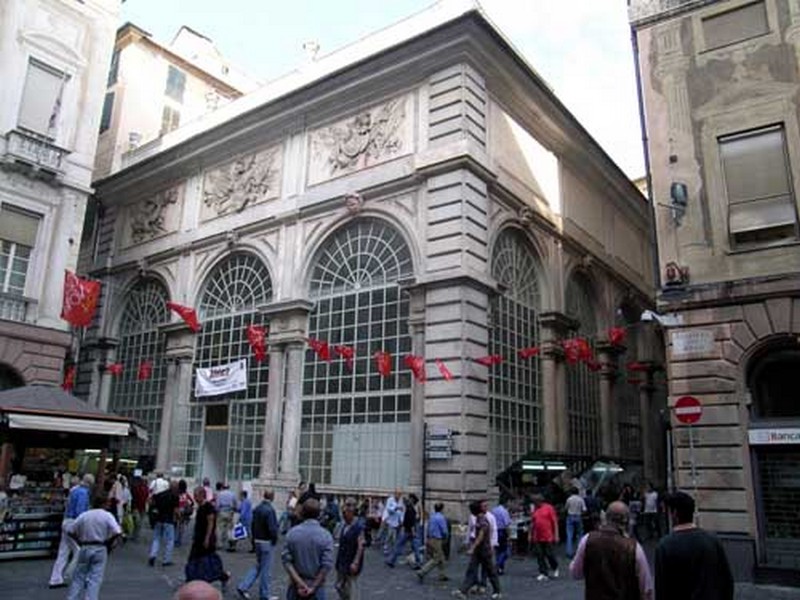


The main figures are the same who built the church: on one side the designers Cantone, Ponsello, and Ceresola known as “Vannone”, and on the other the Deputati alla Fabbrica who secured the necessary funds by constructing thirteen new shops on the side opposite the Loggia.
The architectural solution, the work of Vannone and mistakenly attributed to Alessi, is a large pavilion-shaped space supported by semicircular arches on paired columns, a 16th-century reinterpretation of the medieval Genovese arcades. In the 19th century, the loggia became the site of the first Italian Commodity Exchange, and the arches, designed by Resasco, were enclosed with glass, but already at the beginning of the 20th century it lost its function due to the construction of the Stock Exchange Palace in Piazza De Ferrari, the new “financial center” of the city.
After a long period of abandonment, in 1991 a “National Ideas Competition” was announced to repurpose it as a venue for exhibitions and events, the first attempt to redevelop the historic center ahead of the 1992 Columbian Celebrations that would transform the entire port area.
After hosting exhibitions and small temporary commercial activities, since 2011 it has housed the Urban Center of the Municipality of Genoa, a place dedicated to communication and discussion about the city’s urban transformations.



