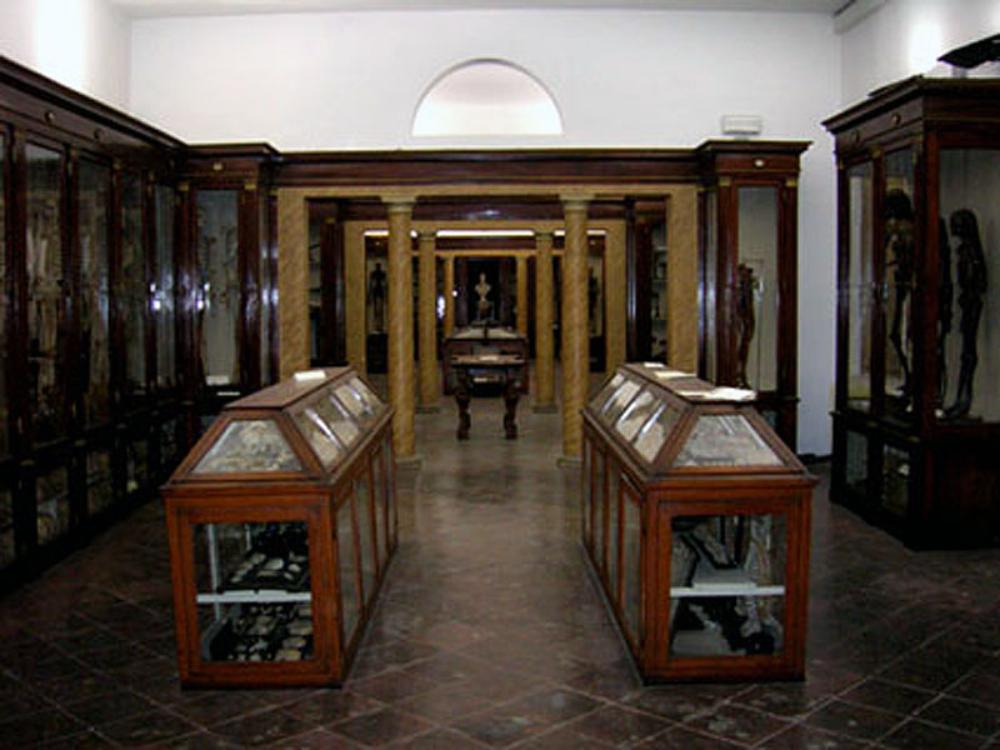
The International Museum and Music Library is located in the historic center of Bologna inside the prestigious Palazzo Sanguinetti. The building was reopened to the public after a long and careful restoration, which restored the internal frescoes to their original splendor, painted between the late eighteenth and early nineteenth centuries. The noble floor of the Palace houses the nine rooms of the exhibition path, which retrace about six centuries of European music history with over a hundred paintings of illustrious musicians, more than eighty ancient musical instruments, and a wide selection of highly valuable historical documents: treatises, volumes, opera librettos, letters, manuscripts, autograph scores, all from the legacy of Father Giambattista Martini. The museum also hosts, on the ground floor, a faithful reconstruction of the workshop of the famous Bolognese luthier Otello Bignami, donated by his heirs.
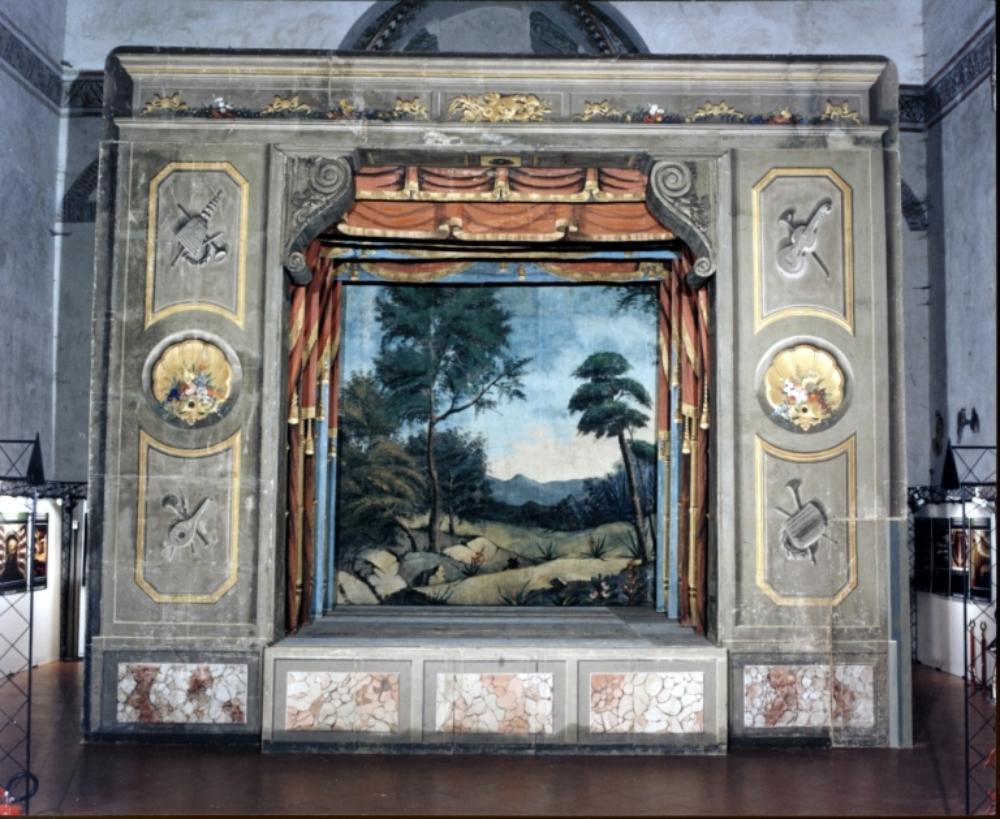
The museum route opens among the “luxuriant” decorations of the hall called Boschereccia, with some symbolic works that serve as a prologue to the visitor preparing to embark on a journey inside the musical universe. Rooms 2 and 3 are dedicated to the spiritual father of the new museum, depicted in an oval by Angelo Crescimbeni: Giambattista Martini, whose precious moral, intellectual, and material legacy is celebrated here and introduced to the general public. In particular, room 3 illustrates the relationships between Father Martini and prominent figures in the musical world of the time such as the young Mozart or Johann Christian Bach, portrayed in a famous Gainsborough portrait. In the same room, visitors can also admire the famous music library doors by Giuseppe Maria Crespi.
Next, in room 4 (“The Idea of Music”), the focus is on music theorists from the 15th to the 17th centuries, featuring important examples of musical treatises, portraits of their respective authors, and some highly significant musical instruments such as the unique clavicembalo omnitonum by Vito Trasuntino (Venice 1606). Some of the most remarkable pieces are exhibited in the following Art Hall (room 5), dedicated to “Books for music and instruments from the 16th and 17th centuries.” Displayed inside ultra-modern circular glass cases, placed at the center of the room to complement the rich floor decorations, rare texts from the late 1400s to the famous Harmonice musices Odhecaton A.—the first printed music book produced by Ottaviano Petrucci—can be admired. Then the instruments: lutes; Manfredo Settala’s flute harmony from 1650, a veritable one-of-a-kind; pochettes, small violins used as instruments by dance masters; and then hurdy-gurdies, serpentones, and the extraordinary series of horns and cornets from the 16th and 17th centuries; finally, a singular stage instrument like the Theorbo in the form of a khitára.
Italian opera takes center stage in the subsequent rooms. First, the 18th century in room 6, dedicated to the famous singer Carlo Broschi known as Farinelli: his beautiful portrait painted by Corrado Giaquinto dominates the room, along with portraits of castrati of various eras and composers of the time, most notably Antonio Vivaldi and Domenico Cimarosa. In room 7, the 19th century and Gioachino Rossini, whose name is inseparably linked to Bologna, are featured: portraits, busts, librettos from the first performances of Isabella Colbran, singer and his first wife, the autograph score of The Barber of Seville, as well as curious personal effects such as his dressing gown or wig, and also the grand piano made in 1844 by Camille Pleyel which belonged to him.
The journey continues, through the centuries, musical customs, and fashions, in room 8 dedicated to “Books for music and instruments in the 18th and 19th centuries”: viols d’amore and transverse flutes alongside scores composed by Torelli, Vivaldi, Bertoni, etc., then clarinets and the beautiful Buccin made in Lyon by Jean Baptiste Tabard (1812-1845).
Information about International Museum and Music Library
Strada Maggiore, 34,
40121 Bologna (Bologna)
0512757711
museomusica@comune.bologna.it
https://www.museomusicabologna.it
Source: MIBACT