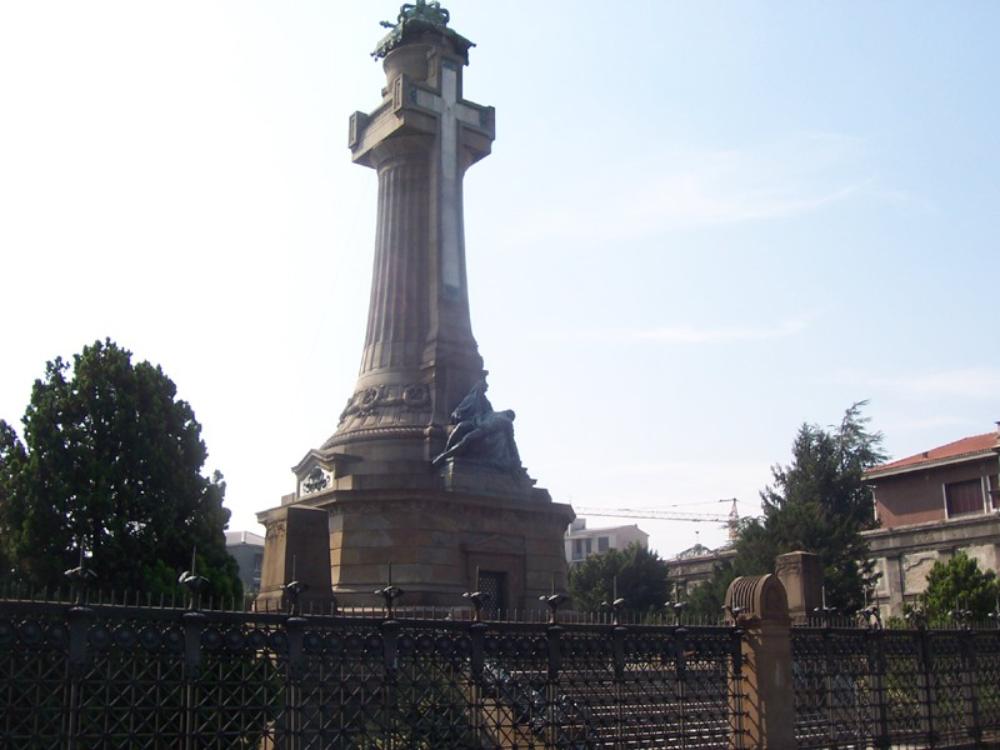


The Expiatory Chapel is a memorial in Monza, commissioned by Vittorio Emanuele III to commemorate the assassination of his father, Umberto I. Shortly after his father’s death (which occurred on July 29, 1900), the king entrusted the project to architect Giuseppe Sacconi, who had previously designed Rome’s Vittoriano. Construction was completed in 1910, making it ready for the tenth anniversary of the attack. The monument, built exactly on the site of the assassination, is surrounded by a tree-lined garden enclosed by a wrought iron fence. The interior of the circular-plan temple is adorned with mosaics inspired by Byzantine art and marbles of various colors and origins. Various mosaic subjects depict, in the vaults, angels with the symbols of the Passion of Christ, and, in the roundels, saints and blessed members of the House of Savoy. From the outside, access is granted to the crypt below, which has a Greek cross floor plan and is clad in polychrome marbles and bronze. The vaults feature mosaics representing a starry sky. At the intersection of the four arms of the crypt lies a black marble stele engraved with the date July 29, 1900, marking the spot where King Umberto I was killed by the anarchist Bresci. A faint golden light filters through ten windows covered by alabaster slabs. Every July 29, as has been done since 1911, a ceremony commemorating the regicide is held with a celebration inside the chapel. A few years later, the monument was visited by Benito Mussolini, who inscribed with a stone the words: Monument to Bresci. At night, every July 29, the monument is illuminated from within through two alabaster crosses.
Information about the Expiatory Chapel
Via Matteo da Campione, 7/a
20052 Monza (Monza and Brianza)
Source: MIBACT