


In the journey to discover ghost towns, the village of Balestrino stands out for its timeless, haunting atmosphere, just a short distance from the lively Ligurian Riviera.
Where is Balestrino?
Balestrino is a small town in the province of Savona, home to just over 500 residents. It’s counted among Italy’s ghost towns because in 1963, due to a hydrogeological threat, the historic center of Balestrino was abandoned as the community fled, worried about unstable ground. Today, an ancient sundial symbolizes the relentless passage of time, no longer measured by anyone except the occasional hiker or TV crew—often from abroad—who come to capture this place’s mysterious stories.
The Castle of Balestrino
Overlooking the old town is the Castle of Balestrino, also known as the Castle of the Del Carretto family—historic feudal lords of the area. The castle clings stubbornly to its rocky outcrop, defying the risk of landslides. Everything appears frozen in time—over 50 years ago—both outside its crumbling walls and within, where overgrown plants take root among cobblestones, and the alleyways stand silent and melancholic.

What to See in Balestrino
Visiting Balestrino invites you into a journey through mystery and time. This atmospheric Ligurian spot, in the province of Savona, is included among abandoned towns or ghost villages.
While the municipality of Balestrino is home to about 600 people, the main draw is the deserted historic center of Balestrino: completely lifeless, emptied and left to nature, with old buildings overtaken by vegetation following the residents’ departure decades ago. Visitors are inevitably drawn to the Castle of Balestrino, or Del Carretto family Castle, longtime lords of Balestrino and the surrounding lands.
It’s undoubtedly one of the sights of Balestrino, but a visit inside is not possible: the castle was vacated around fifty years ago due to landslide risk. While the site stands abandoned, the tower and main entrances remain remarkably well-preserved.
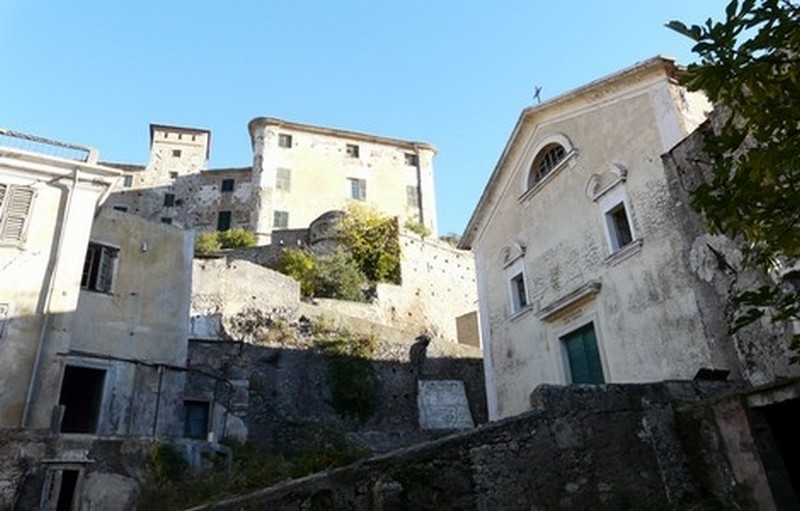
Another site of note is the ancient church of Sant’Andrea, although it is currently inaccessible and in urgent need of restoration.
There are plans for the restoration of the historic village, with hopes to preserve these unique places.
No guide to Balestrino would be complete without mentioning the church of San Giorgio, home to 15th-century frescoes well worth seeing.
As a whole, exploring Balestrino’s oldest area isn’t fully possible, so the best option is to observe it from the “new Balestrino” developed further downhill.