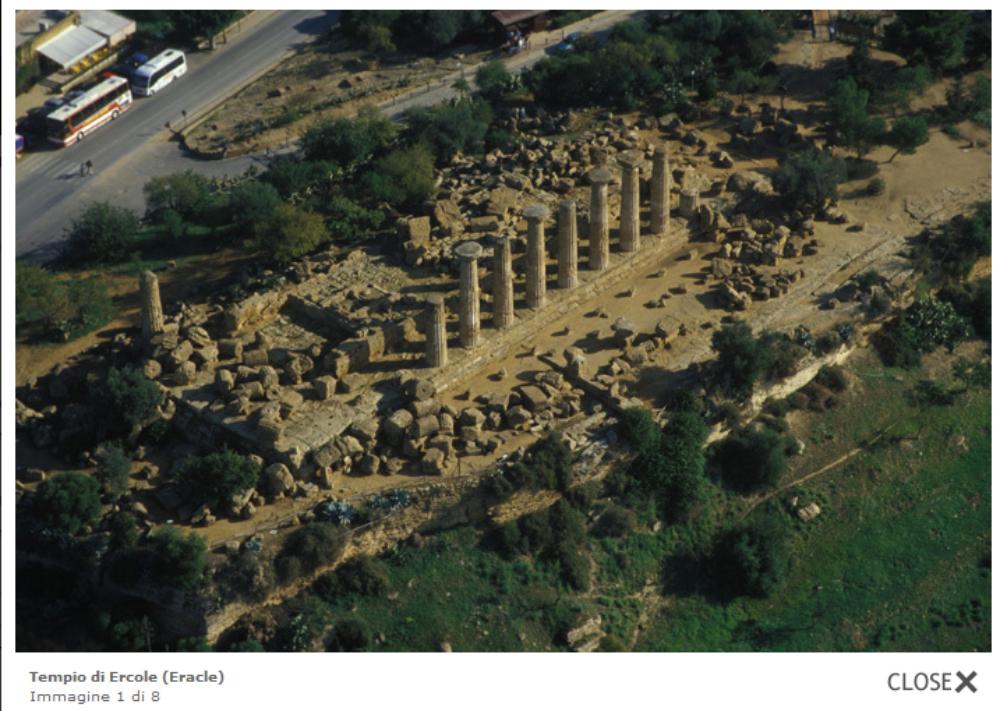


The Park, covering about 1300 hectares, preserves an extraordinary monumental and landscape heritage that includes the remains of the ancient city of Akragas and the surrounding territory extending to the sea. In the Valley of the Temples, declared a UNESCO World Heritage Site in 1997, there is one of the largest archaeological complexes in the Mediterranean, set in an agricultural landscape of rare beauty mainly consisting of centenary olive trees and almond trees. Akragas was one of the most important Greek colonies of Sicily, covering approximately 450 hectares, founded around 582 BC by colonists from nearby Gela and Rhodes.
The chosen site was a plateau naturally protected to the north by the Rupe Atenea and the Girgenti Hill and to the south by the long Hill of the Temples, bordered on the sides by the rivers Akragas and Hypsas, which converge to the south into a single course whose mouth was the ancient port (emporion).
From the beginning – under the tyranny of Phalaris (570-554 BC), famous for his cruelty – the city, arranged in terraces, was characterized by a regular urban layout. The Rupe Atenea was the acropolis serving sacred and defensive functions; the Hill of the Temples housed the monumental sanctuaries; the central area contained the settlement and public buildings, while the dead were buried in necropolises outside the city. In the last decades of the 6th century BC, Akragas was surrounded by a mighty city wall 12 kilometers long with nine gates. The colony gained fame and power under the tyrant Theron (488-471 BC), victor over the Carthaginians at Himera in 480 BC and especially during the years of democracy (471-406 BC) established by the Akragan philosopher Empedocles. During this period, the extraordinary series of Doric-style temples on the southern hill was built.
A second conflict against the Carthaginians marked the end of a prosperous era and in 406 BC Akragas was destroyed. Subsequently, the city experienced a new phase of development with the arrival (between 338 and 334 BC) of Greek colonists led by the commander Timoleon, but it never regained its former power and its fate was tied to the struggle between Rome and Carthage for control of the Mediterranean. During the Punic Wars, Akragas was a base for the Carthaginians against the Romans, who conquered it in 210 BC and changed its name to Agrigentum. Under Roman rule, the city experienced another phase of prosperity linked also to the sulfur trade (2nd-4th centuries AD). In the Christian era, churches and cemeteries were built on the Hill of the Temples.
When the city was conquered by the Arabs in 829, the residential quarters had already moved up to the Girgenti Hill, so named after the medieval name of the city (from the Arabic Gergent or Kerkent), where the current town of Agrigento extends.
Information about the Archaeological and Landscape Park of the Valley of the Temples
Via Passeggiata Archeologica, SNC
92100 Agrigento (Agrigento)
0922/621657
[email protected]
https://www.parcodeitempli.net/
Source: MIBACT