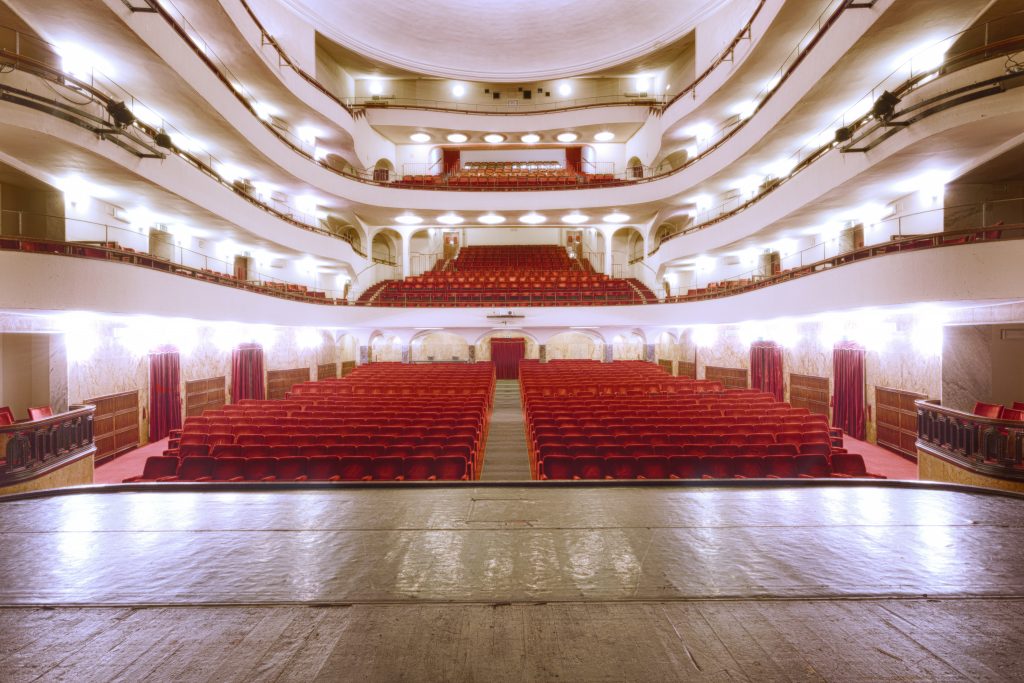


The need to equip the city with a public theater was strongly felt in Rimini as early as the 17th century. In fact, in 1681, the construction of a permanent theater in the Arengo Hall was approved, with an auditorium divided into four tiers of twenty-one wooden boxes. Due to its wooden structure and insufficient capacity, it was subsequently closed and demolished in 1839. At the same time as this performance venue, in 1731 the Arcadic Theater operated, belonging to the Academy of Arcadia and consisting of two tiers of boxes. Francesco Galli Bibiena carried out restoration works there in 1732, but no further information about the theater is available from the mid-18th century onwards. After the demolition of the old theater, the small and private Buonarroti Theater was opened to the public in 1816 by members of the Academy de’ Pilati. The City Council ordered its closure in 1843 due to the precariousness of the architectural structures. A provisional wooden stage was then built in the Municipal Hall, equipped on the occasion with a double tier of loggias; the expense was borne by the citizens. The aristocracy and wealthy merchant bourgeoisie’s desire for a representative building in the urban fabric that could serve as a social hub led to the decision to build a new theater, designed architecturally and functionally as an autonomous building. Among the most suitable sites for construction were Piazza del Corso and Piazza della Fonte: after a long discussion between supporters of both sites, the choice fell on the latter square, now Piazza Cavour, where the Forni building used as a military barracks by the Municipality stood. The decision to erect the theater in this area dates back to July 14, 1840. On December 9 of the same year, the task of designing was assigned to the Modena architect Luigi Poletti. “Designed by Engineer Commendatore Luigi Poletti, the Rimini Theater departs from the style of modern theaters: its architecture is monumental and grand, so that one might say it is a work from strong Roman times” (cited in Monograph..). “On August 8 of that year [1843] the solemn laying of the first stone took place and the shell of the building was completed on November 22, 1846. The finishing and decoration works could only resume in 1854 and be completed in 1857” (cited in Monograph…). It was inaugurated on August 16, 1857, with the performance of the operas Trovatore, Lucrezia Borgia, and Aroldo, featuring Giuseppe Verdi. By municipal decree in October 1859, it was named Teatro Vittorio Emanuele. It was a monumental composition inspired by the concepts of classical architecture: the main facades’ morphological reference, characterized by arches and piers, was Leon Battista Alberti’s Malatesta Temple. The building consisted of a rectangle divided into three parts, the first including a large portico, the entrances, and staircases accessing the boxes: the atrium and stairs were adorned with statues sculpted by Pietro Tenerani. The central body contained the stalls, and the last the stage. From the atrium, one accessed the horseshoe-shaped stalls, enclosed by an ambulatory, consisting of three tiers of twenty-one boxes each, above which was the gallery. Inside, the morphological motif of arches (on the first tier of boxes) resting on a high plinth was repeated. The second and third tiers were framed by twenty Corinthian columns supporting the entablature and the gallery balcony. The proscenium included two boxes per side. The theater hall decorations “in glossy scagliola and gilded stuccoes” were the work of Corsini from Urbino and Fiorentini from Imola. The ceiling, divided into three concentric zones depicting the Hours and the zodiac signs and portraits of the most illustrious dramatic authors, was decorated by the Bolognese Andrea Besteghi. The stage, of notable dimensions, featured two stair systems, ambulatory, dressing rooms for actors, and an apse-shaped backdrop. “The curtain was commissioned to the famous Coghetti, who depicted Caesar crossing the Rubicon, according to Lucan, differently from the Rimini painter Capizucchi who had painted the old theater’s curtain showing him addressing the city’s forum” (cited in Compendium..). The sets were executed by Michele Agli, a native of Rimini. Currently, only the first part of the original building, consisting of the portico, entrances, and stairs, remains, as the auditorium was destroyed during a bombing in 1943. The space where it once stood has been converted into a gym. The monumental foyer has been used as a council chamber. The completion of this area was entrusted to the Rimini architect Gaspare Rastelli, who did not respect Poletti’s design. This surviving part of the theater is in excellent condition thanks also to restoration work. Around the mid-1970s, a national competition was announced for the submission of projects related to the reconstruction of the destroyed parts of the theater. The results were unveiled in a exhibition held in Rimini in spring 1976, accompanied by a catalog curated by Giuliano Gresleri and Stefano Pompei. The winner of the competition was Professor Adolfo Natalini from Florence, who coordinated a group of six architects for the project. The project was not realized due to constraints imposed by the Archaeological Superintendence and the Superintendence for Environmental and Architectural Heritage. Meanwhile, appropriate investigations, including archaeological excavations in the area, revealed, among other things, a Roman domus, Byzantine findings, and traces of the ancient Malatesta walls, meaning the theater’s restoration should be carried out in agreement with the protection bodies and respecting the context and enhancement of the archaeological site uncovered. Recently, a philological reconstruction of the theater has been proposed by several parties, which would allow the recovery of an extraordinary building with strong symbolic value. A large hall located on the ground floor of the surviving forward part, consisting of portico, entrances, and grand staircases, has been adapted as an exhibition space. The exhibition activities, already ongoing for several years, were temporarily interrupted due to essential consolidation works but resumed in 2001. Annually, the Cartoon Club exhibitions are held here within the framework of the international comic festival in Rimini; subsequently, the space is mainly granted to private individuals for art exhibitions according to a municipal regulation establishing times, methods, and costs. (Nadia Ceroni / Lidia Bortolotti)
Information about Amintore Galli Theater (Former Vittorio Emanuele II)
Piazza Cavour,
47921 Rimini (Rimini)
Source: MIBACT