1 Florence, Scoppio del Carro
The Easter ceremony in Florence dates back to the heroic act of Pazzino de’ Pazzi, the first to climb the walls of Jerusalem during the Crusades. As a reward, Pazzino received three splinters from the Holy Sepulchre, which became central to a local Easter tradition: lighting the Easter candle. Over time, the so-called “Holy Fire” taken from Pazzino’s relics was carried through the city on a cart adorned with fireworks, which are set off in what’s now known as the “Scoppio del Carro”.

2 Barile, Via Crucis
In Barile, Basilicata, the Easter event is meticulously prepared weeks in advance, involving the entire community. On Good Friday, a procession featuring symbolic characters reenacts Christ‘s path to Calvary. Hundreds of locals take part, making Barile’s Via Crucis a unique and spectacular celebration.

3 Tredozio, Sagra e Palio dell’Uovo
In Tredozio (province of Forlì), the town hosts the Sagra and the Palio dell’Uovo, with whimsical competitions including egg-cracking contests, egg-and-spoon races, and hard-boiled egg eating. On Easter Monday, the fun continues with a race rolling a giant fake egg through the streets, a search for a hidden egg in a haystack, and the day concludes with a raw egg battle.

4 Urbania, Gioco del “Punta e Cul“
In Urbania (province of Pesaro), on Easter the “Punta e Cul” egg game takes center stage: hundreds of hard-boiled eggs are arranged in an S-shape, and each person selects one to compete by hitting them tip to tip and then base to base. The last intact egg wins.

5 Alghero, Semana Santa
In Alghero, Easter is deeply rooted in Aragonese tradition. Festivities begin with the Procession of Our Lady of Sorrows, adoration of the Cross, and a late-night gathering in the Oratory of Mercy. Events follow with the Processò dels Misteris on Holy Tuesday, and the ceremonies of Las Cerques and Arboramento on Maundy Thursday. On Easter Sunday, an emotional meeting takes place between the statues of the Risen Christ and the Glorious Virgin.

6 Taranto, Holy Week
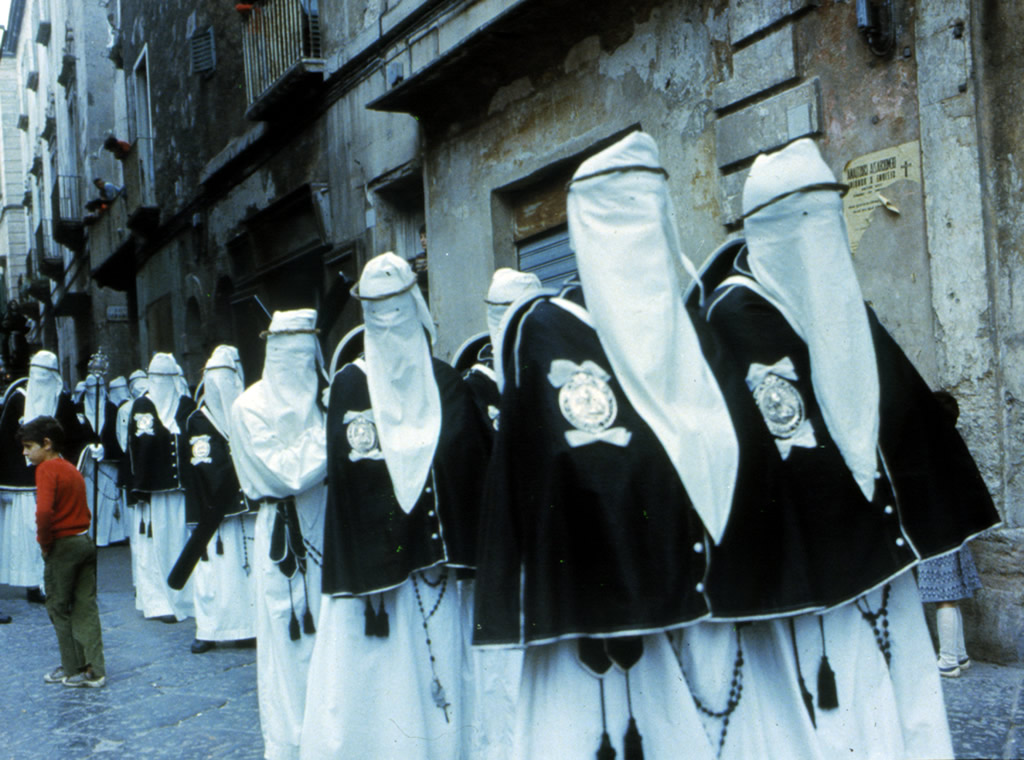
The Holy Week in Taranto is rich in rituals and symbolism. The celebrations start with the “Perdoni“—members of the confraternity symbolizing pilgrims on their way to Rome. After their procession, the nighttime Procession of Our Lady of Sorrows begins between Thursday and Good Friday, lasting until Friday afternoon and culminating at the Church of Carmine for the Procession of the Mysteries. The final phase is marked by prayer and silence, followed by the joyful ringing of bells to celebrate the Resurrection of Christ.