

There are at least five good reasons to choose a holiday in Villasimius, Sardinia. The first, obviously, is for the beauty of the beaches, the sea, and its rich aquatic fauna, preserved thanks to the Marine Protected Area. The second reason is for the beauty of its two islands.
The third is that it has the Mountains of the Seven Brothers behind it, so it is also suitable for those who love nature walks or mountain bike excursions. The fourth is that Villasimius preserves some places of historical interest, so it will not disappoint the expectations of those who don’t give up a bit of culture even during a fully relaxing stay. And finally, the fifth: Villasimius is not a tourist resort but a real town, active all year round, with all services, a lively community, festivals, and traditions.
In short, Villasimius is an ideal place for a holiday, whether you want to fill your days with sports, nature, and cultural activities, or if you want to disconnect and enjoy the utmost relaxation. And, precisely because of the wide range of possibilities it offers, it is fully enjoyable not only in summer but also in spring and autumn.

1 The beaches
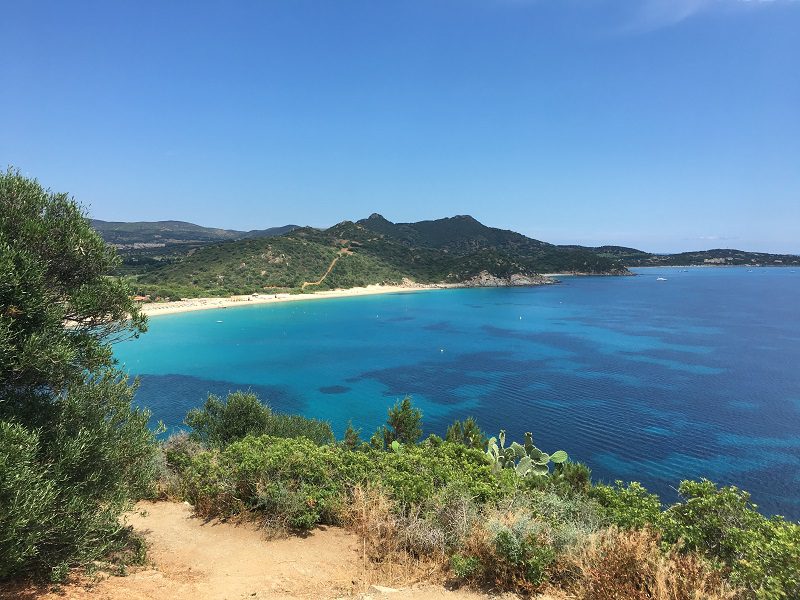
The main reason why Villasimius is known is its postcard-perfect beaches with crystal clear sea. Not only are the beaches beautiful, but the fish fauna is also very rich thanks to the Marine Protected Area, established in 1999, which has favored the repopulation of marine inhabitants. Therefore, while fishing is not allowed, it is equally true that anyone, equipped with a mask and snorkel and without having to go far from the shore, can enjoy a wonderful natural spectacle.
Arriving from Cagliari, the first bathing stop is Porto Sa Ruxi, a group of three small beaches with very white sand, sloping steeply towards the sea, separated by small promontories of rocks. The air is pleasantly scented thanks to the dense Mediterranean scrub with junipers immediately behind the beach.
The next location is Campus, with a long and wide golden sand beach, very accessible and suitable for families.
Arriving in town, you can follow the Via del Mare and reach the Simius beach. Here, about seventy meters from the shore, there is a small shoal of submerged rocks, densely populated by fish. They know they are safe in the Marine Protected Area, and therefore will gladly accept your offerings of shrimp, which they will take directly from your hands.
Just after the town, there is another unmissable spot: it is Cala Giunco, with at its center the Spiaggia dei Due Mari (Beach of the Two Seas). The second sea is actually the Notteri lagoon, behind the beach, often inhabited by pink flamingos. The sea water slopes very gently, so it is also the ideal place for those who love morning walks, with water at ankle height.
Leaving the town and taking the road to Costa Rey, at a certain point you will find a sign indicating the restaurant “L’Oleandro”: follow it along the dirt road and you will arrive at Punta Molentis, perhaps the most surprising bathing spot in Villasimius. Here a small promontory creates on one side a sheltered beach of very fine sand that gives the sea a turquoise color impossible to describe in words. On the other side of the promontory, there is the opposite situation: a cove of large granite boulders overlooking the open sea. This promontory was previously affected by quarrying activities. Given the difficulty of access, the granite boulders were transported to the main road by donkeys, “molentis” in Sardinian, from which the name of the location comes.

2 The islands: the Island of Cabbages and Serpentara
Villasimius is located on a peninsula, the Carbonara peninsula, which stretches out towards the sea and faces two small islands: the Island of Cabbages and Serpentara.
Since the time of the Spanish domination of Sardinia, these two islands were considered outposts for the defense of the territory from Saracen pirates and therefore were equipped with watchtowers. Both, due to their strategic importance, were classified as “strong towers” and thus armed with large caliber cannons.
The name of the Island of Cabbages probably comes from a distortion of the word “Cavuru” (crab) into “Cavolo” (cabbage) by the Piedmontese geographers of the nineteenth century, as happened with the Island of Mal Di Ventre in the Oristano area, which was originally called “Malu Entu” (bad wind). The Spanish tower was later used as a base for a lighthouse. It currently hosts a university center for research in biology and geology. Its coast is jagged, with granite rocks and very small beaches.
The Island of Serpentara is completely covered with Mediterranean scrub and has no human settlement. Its shoreline is particularly rugged, especially on the side facing the open sea. The western coast is part of the most protected area of the Marine Protected Area, where navigation is completely prohibited.
In Villasimius there is a very well-equipped marina, an ideal starting point to visit the islands and the coast. There you will find operators who organize excursions, as well as the possibility to rent boats and inflatables or to dock if you have your own vessel. If you move independently, it is advisable to get information about the navigation restrictions related to the Marine Protected Area. Also remember that in the most protected areas even scuba diving must be authorized.

3 The hinterland
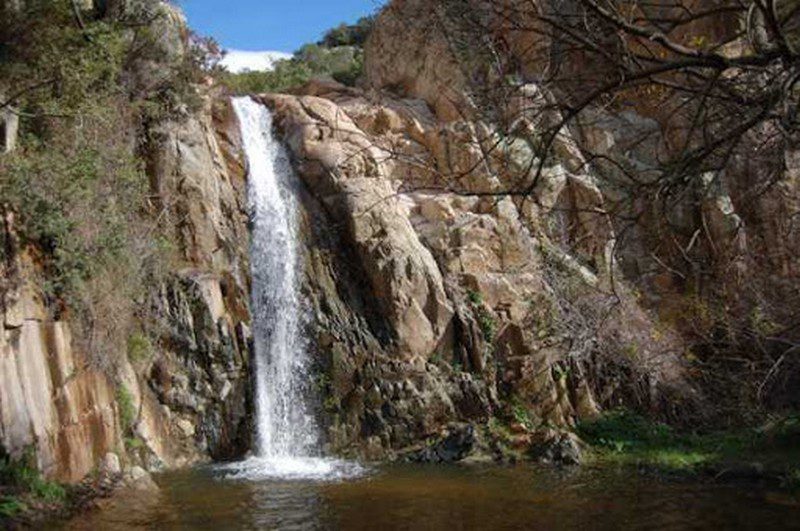
Immediately behind the Carbonara peninsula the terrain becomes immediately rugged, reaching up to about 1000 meters in altitude: we are on the Sette Fratelli Mountains, whose area is part of the Sette Fratelli – Monte Genis regional park. The vegetation shifts from Mediterranean scrub to dense woods with carob trees, junipers, and ancient olive trees. Walking through the woods, with a bit of luck, one might encounter the Sardinian deer or see a golden eagle in flight. On the mountain side facing Costa Rey, you can explore the Minni Minni forest, rich in springs and streams.
4 Places of Historical Interest
The territory of Villasimius has experienced all the historical phases of Sardinia. It is therefore not surprising that some sites of historical and archaeological interest can also be visited. Just before reaching Campus beach, along the provincial road, there is the country chapel of Santa Maria. Next to it, you can see the remains of a Roman-era thermal building.
During the period of Spanish domination, Sardinia was often targeted by pirates from North Africa. For this reason, from the 16th century onwards, the Spaniards dotted the entire southern coast with watchtowers, placed at the extreme points of the territory so that they could overlook the coast and, at the same time, be close enough to communicate with each other by light signals. In the Villasimius area, starting from Cagliari, there is the Capo Boi Tower, the Isola dei Cavoli Tower, the Cala Giunco Tower, and the one on the Isola di Serpentara. They are not accessible inside, but it is worth reaching those on the mainland on foot or by car to enjoy the view.
The Old Fortress was also part of the defensive system, located on a promontory just after the current marina. The original core is a triangular structure built by the Aragonese in the 14th century. Two centuries later, the Spaniards added four towers, three of which face the sea and one, which guards the only access to the fortification, facing the inner courtyard. The fortress is visitable and houses the permanent exhibition “Enemigos de la Fè,” about its history as a defensive bastion.
Finally, in the center of the village, there is a small but very interesting Archaeological Museum. It houses artifacts from the Phoenician-Punic and then Roman sanctuary of Cuccureddus (site not open to the public); a female statue from the Roman era found near the thermal baths close to the church of Santa Maria, and for this reason venerated for centuries as a statue of the Madonna; lastly, the Shipwreck Room is dedicated to the Aragonese shipwreck that occurred in the 14th century near the Isola dei Cavoli and displays its cargo: cannons and majolica tiles (azulejos).
5 Festivals and traditions
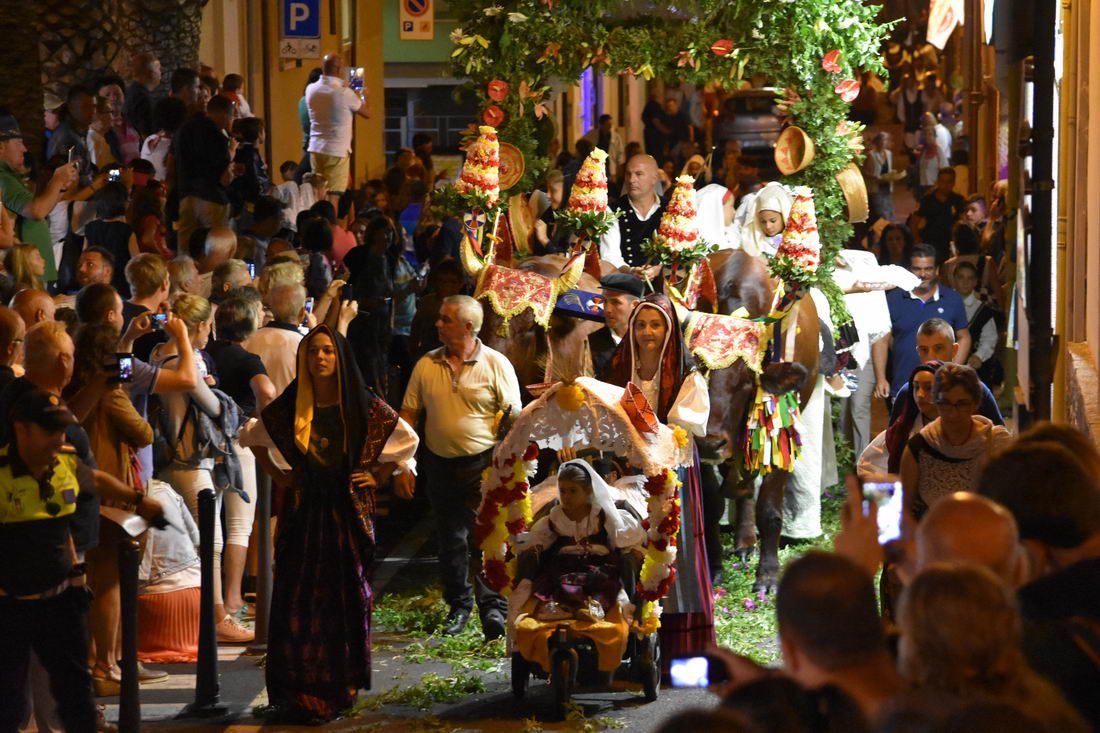
In summer in Villasimius two festivals are celebrated. As tradition dictates, the religious part is accompanied by the folkloric part, with dances and songs in traditional Sardinian costumes and delicious tastings of typical local products.
In the third weekend of July the Madonna del Naufrago is celebrated, with a procession of boats heading towards the Isola dei Cavoli where, at ten meters deep, the statue of the Madonna del Naufrago was placed in 1979, the work of the great Sardinian sculptor Pinuccio Sciola. The highlight of the festival is the Mass that is recited in front of this statue and that, thanks to an underwater microphone and a system of loudspeakers, is also followed by those around on the boats. Of a more rustic flavor is the Sagra di Santa Maria, during which a statue of the Madonna is carried in procession from the parish to the country church. It is celebrated every year around the 7th and 8th of September. These events emphasize what have always been the identifying and founding elements of the local community: the sea and agriculture.