

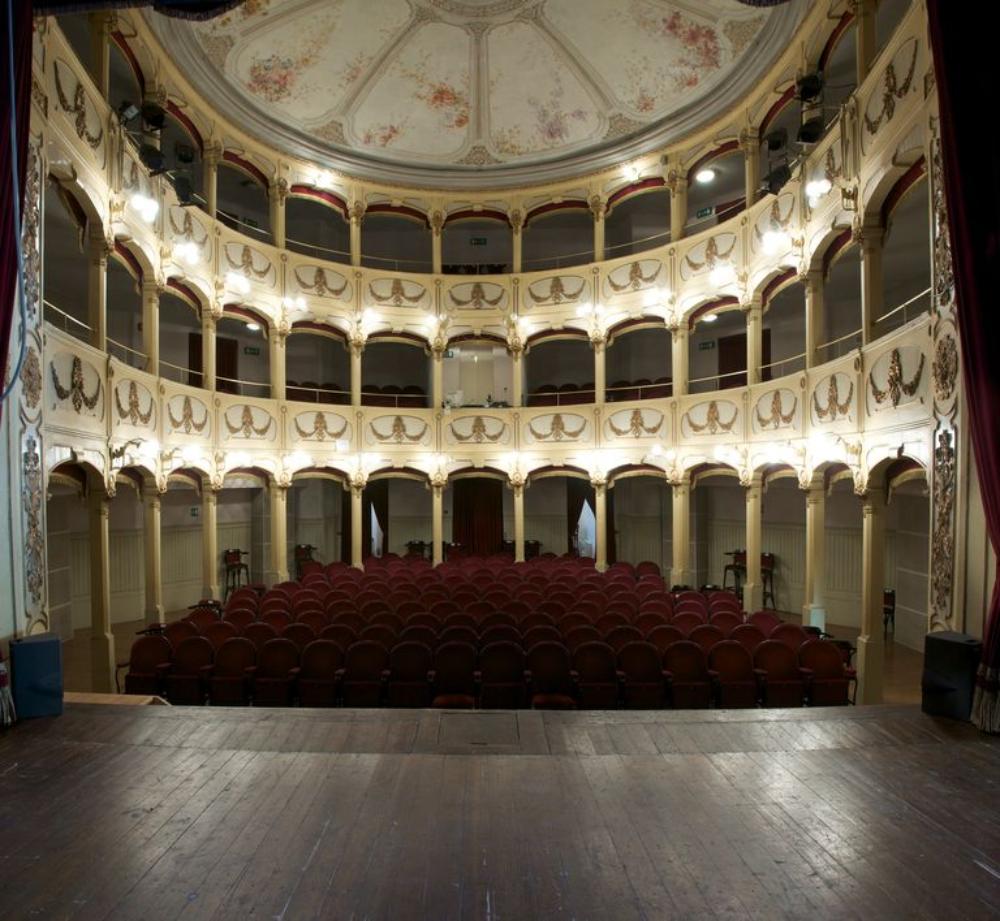

La Filodrammatica piacentina was officially established by decree of Maria Luigia in 1825, but it is reported to have been active for about fifteen years prior. Initially, the filodrammatici were granted use of the hall located in the Collegio dei Mercanti (currently the municipal headquarters), suitably transformed into a theater. When the Municipality decided to move its offices to this location, the church of Santa Franca was allocated to the filodrammatici. It was a monastic complex of sixteenth-century origins, founded by Cistercian nuns and suppressed by Napoleon in 1810. Maria Luigia ceded it to the Municipality, which initially assigned it to the national guard, then to the firefighters, and finally to the music school. The monastery became the Conservatory’s seat while the church, with a Latin cross layout and a single nave with a barrel vault, was transformed at the beginning of the twentieth century according to engineer Gazzola’s design into an elegant theater with an Art Nouveau style façade. Inside, the insertion of a large stage and a horseshoe-shaped hall with a double gallery did not substantially alter the original structure but rather became a second skin. The Teatro Laico (which only later assumed the name “dei Filodrammatici”) was inaugurated on February 19, 1909, with Romanticismo by Roventa. This theater remained active until the late seventies, even replacing the Municipal Theater in the 1978-79 season when it was closed for restoration. In May 1980, the last performance was held at the “Teatro della Filo”; subsequently, cracks in the vault and dilapidated systems led to its closure, pending suitable interventions to make the hall accessible and safe. In 1926, the theater underwent its first restoration: on that occasion, furniture and services were modernized, the ceiling was repainted by decorator Silvio Labò, who created a series of architectural motifs and floral panels on a white background completely different from the original early twentieth-century decor. The restoration of the Teatro di Santa Franca began in September 1997, under the direction of architect Ilda E. Bee, assisted by engineer Ferdinando Soppelsa from Milan: the main intent was to restore the building to its original state, retracing Gazzola’s project down to the smallest details. Lamps, floors, fixtures, doors, auditorium seats—everything was carefully reconstructed by artisans capable of this work. A complex, comprehensive intervention, which saw the restoration of masonry works, the review of structures to comply with recent safety regulations, and the complete overhaul of systems, and finally the recovery of the element that characterizes this theater most: the Art Nouveau façade. The delicate interventions on the decorative parts (boxes, columns, proscenium, and painted vault) started in early October 1999 and concluded the following January. The companies Silvia Ottolini of Piacenza and Officinarte of Bologna, entrusted with the work, faced a difficult situation. In particular, the wooden structure, mainly made of thin wood and, in the central panels of the boxes, curved, had over the years been strongly affected by the natural movements of the material and thermal fluctuations, as well as by replacements and alterations made at various times to make the structure functional for use. Also, in treating the painted decorations of the auditorium’s velarium, it was essential to proceed with extreme caution due to the characteristics of the materials used in the 1930s restorations: during cleaning, dust was carefully removed only, while efforts were focused on color fixation. The curtain, of considerable artistic value, depicts the visions of Vittorio Alfieri—created by Bernardino Pollinari and originally from the theater set up in the hall of the Collegio dei Mercanti but only later placed in the Teatro di via Santa Franca—was skillfully restored by the Laboratorio degli Angeli of Maricetta Parlatore. The theater thus restored was reopened to the public on October 25, 2000. (Lidia Bortolotti)
Information on Teatro comunale di Santa Franca (formerly dei Filodrammatici)
Via S. Siro, 9,
29121 Piacenza (Piacenza)
Source: MIBACT