


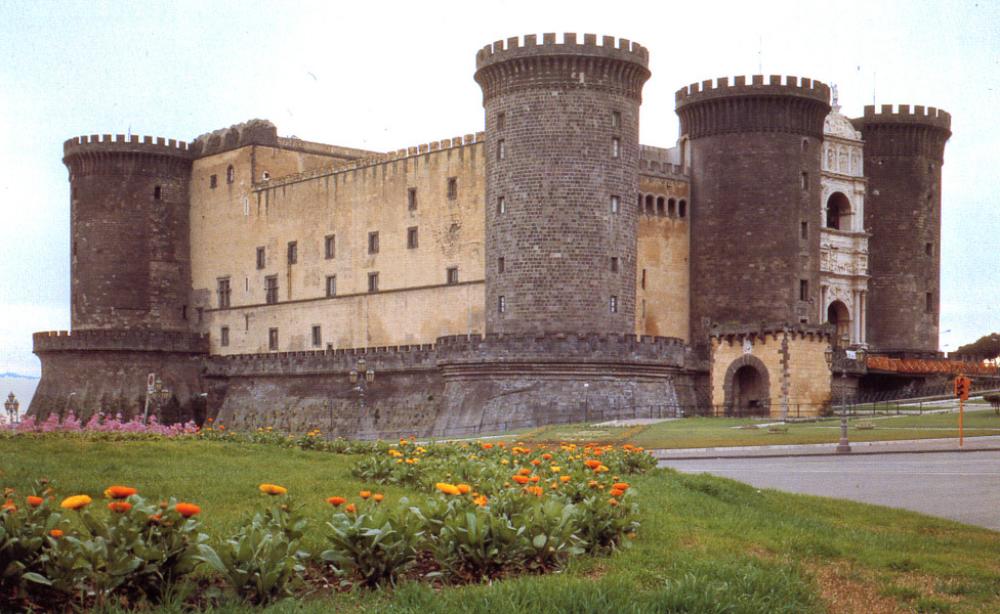


Nel 1442, with the conquest of the Kingdom by Alfonso of Aragon, called the Magnanimous, the castle was gradually rebuilt, according to the defensive needs of the mid-15th century, with the intervention of the Majorcan architect Guillem Sagrera. Since 1990, the castle has housed the Civic Museum.
The visit itinerary is structured between the Palatine Chapel, the first and second floors of the southern curtain wall of the castle. The Palatine Chapel, the only testimony of Angevin age, is characterized on the outside by a marble portal crafted by Andrea dell’Aquila.
The interior, originally frescoed by Giotto and his workshop, features works by the Florentine painter Niccolò di Tommaso and artists of the same circle from the second half of the 14th century, coming from the Balzo castle of Casaluce.
Among the works of the Neapolitan Renaissance, the Edicola by Domenico Gagini, the tabernacle by Jacopo della Pila, and the Madonna with Child by Francesco Laurana, originally located in the chapel portal, are noteworthy. On the first floor, religious commission works from the 15th to the 18th century, originating from suppressed churches and entities, are displayed. Of considerable value is the 15th-century painting “The Madonna with Child and Saints” from the monumental complex of S. Eligio and “The Adoration of the Magi” painted by Marco Cardisco (circa 1519) for the Palatine Chapel.
An example of the 17th-century Neapolitan production is the “Crucifixion” by Battistello Caracciolo from the former Royal House Santa dell’Annunziata. Among the liturgical applied art objects, a rock crystal and embossed silver crucifix from the 16th century and the reliquary bust of St. Barbara are noteworthy.
The second floor preserves works ranging from the 18th to the 20th century. In the rooms dedicated to works of the late 19th century Neapolitan style, paintings arranged by themes can be admired: historical episodes, landscapes, views of the city of Naples, portraits of women, and genre scenes.
In the visit itinerary, one can also admire the historical environments of the castle including the Hall of the Barons, the Tower of Beverello, the portico area with archaeological evidence, the patrol paths, and the panoramic terraces. Next to the museum spaces there are two exhibition rooms, respectively “Sala della Loggia” and “Sala Carlo V,” which systematically host temporary exhibitions.
The Civic Museum Castel Nuovo is part of the Campania>Artecard museum network. A privileged place of memory and identity of the territory, the castle is destined to play the role of a widespread city museum through the recovery and enhancement of additional monumental spaces and the related expansion of collections.