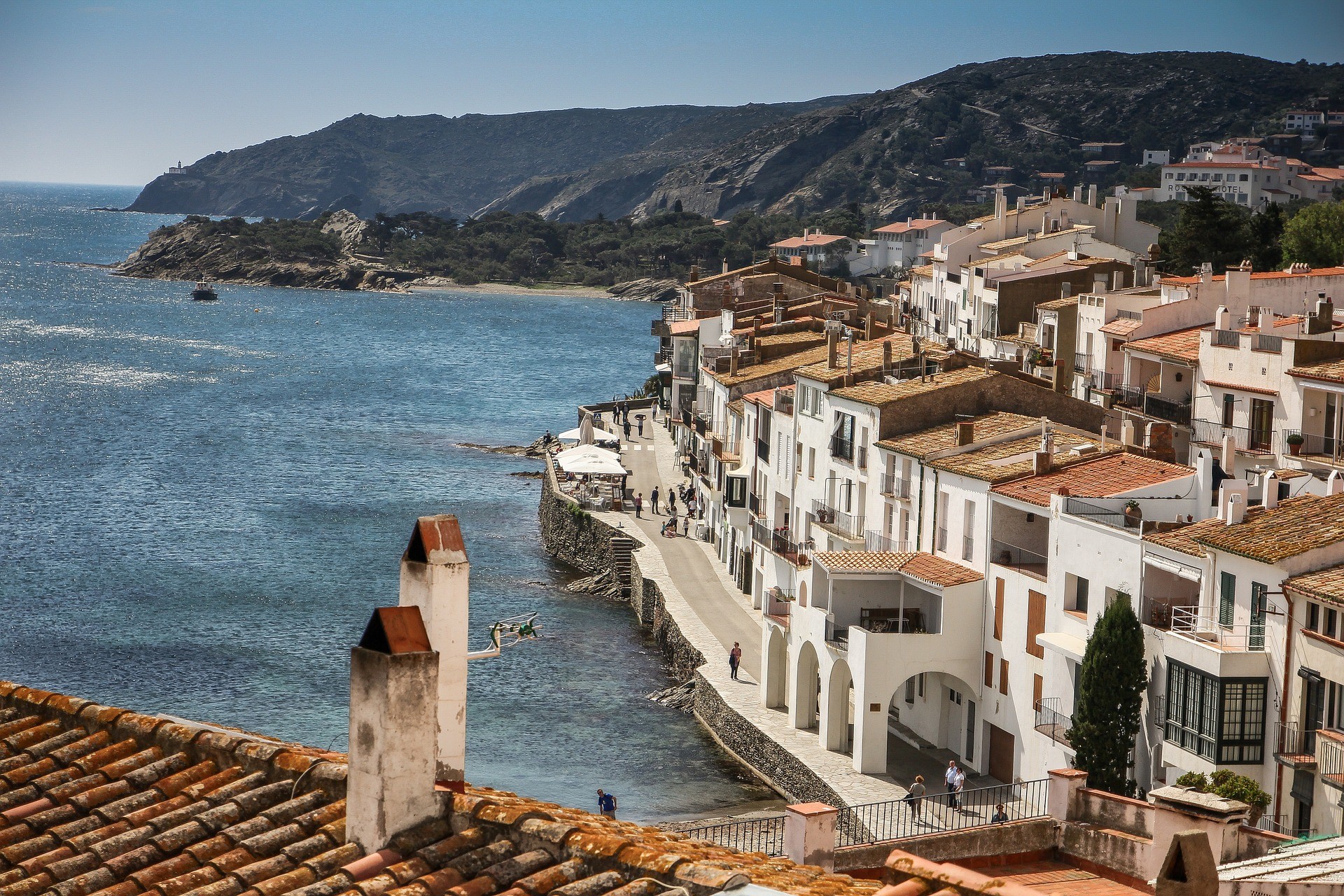


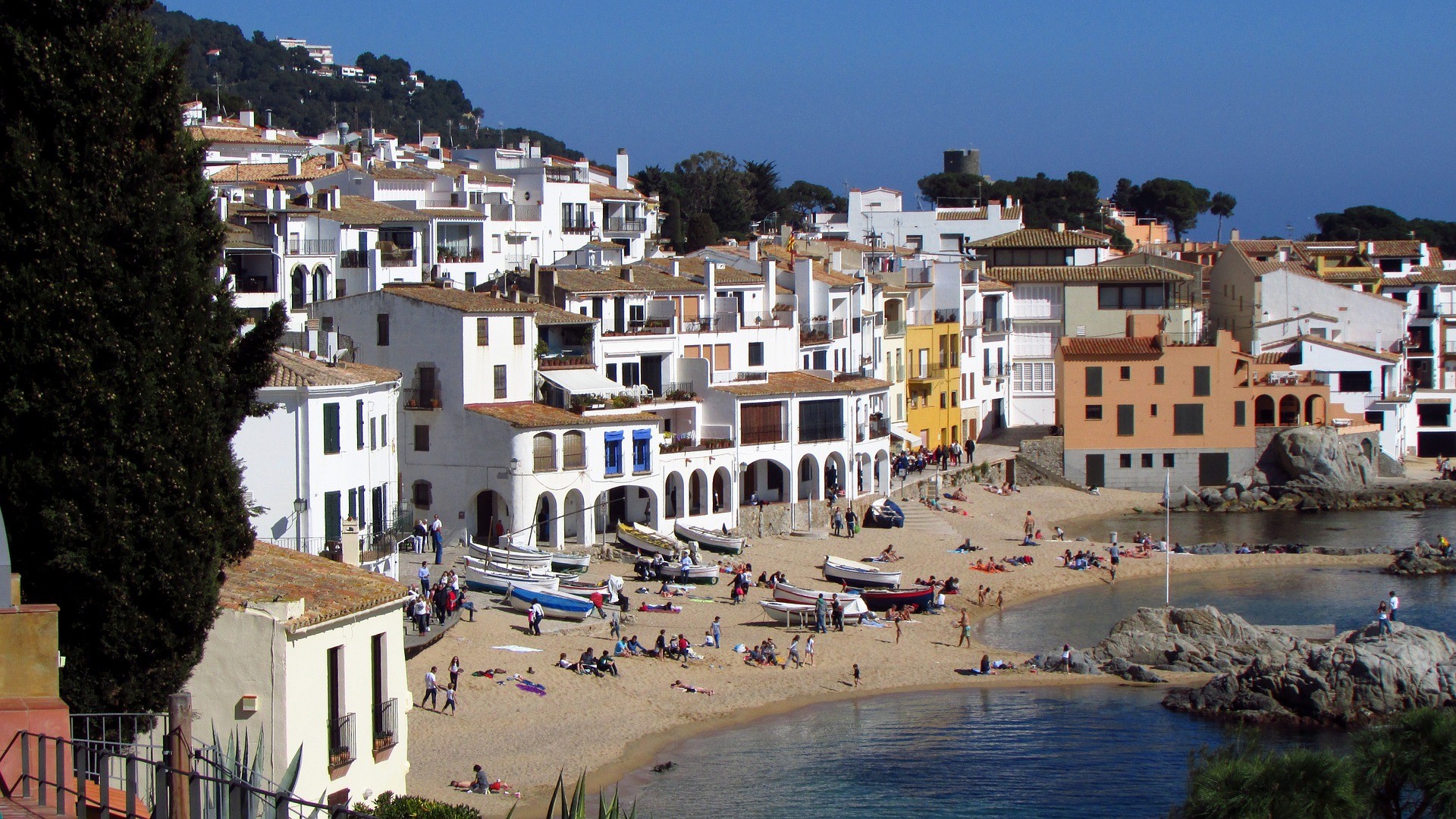

Generalmente se asocia a Cataluña con Barcelona. Sin menospreciar esta maravillosa ciudad, no se puede negar que la región también alberga muchos otros destinos de gran interés artístico, histórico y natural que valen un viaje.
Unusual Itinerary of Catalonia
Girona: what to see and do
A trip to Spain, in Catalonia, can start from Girona, a small town about 100 kilometers east of Barcelona, home to an airport that receives low-cost flights. From here you can take the bus or taxi and reach the city center in less than half an hour. Girona overlooks the Onyar river. Numerous bridges connect the two banks, but the most famous is the Pont des les Peixeteries Velles, better known as “The Red Bridge,” a metal structure designed by Gustav Eiffel.
Near the Red Bridge, the pastel-colored Cases penjades, originally fishermen’s houses, face the river. Fans of Game of Thrones will be happy to find the set for some scenes of their favorite series in Girona’s historic center. Protected by a massive Carolingian city wall, walkable via the Passeig de la Muralla, the historic center includes the Jewish quarter, one of the best preserved in Europe, and remarkable public and private buildings. The most important is the Cathedral, accessible by a spectacular staircase. The interior has a single Gothic nave which, with its nearly 23 meters of width, is second only to the central nave of St. Peter’s in Rome. Its museum, which preserves the wonderful Creation Tapestry from the 12th century, is also notable.
The other great church dominating Girona’s landscape is Sant Feliu, whose facade shows clear asymmetry due to the presence of a single bell tower. Outside, there is a medieval sculpture depicting a column on which a lioness climbs, which has become the symbol of the city. The Arab baths, a 12th-century thermal building stylistically inspired by Muslim baths, and the Monastery of Sant Pere de Galligants, one of the finest examples of Catalan Romanesque architecture, now home to the Archaeological Museum, are also worth a visit. Finally, you can relax with a stroll along the lively Rambla. To make the experience even more beautiful, plan your trip to coincide with Temps de Flors, the flower festival held every second week of May, during which every corner of Girona is transformed into a garden.

Figueres: what to see and do
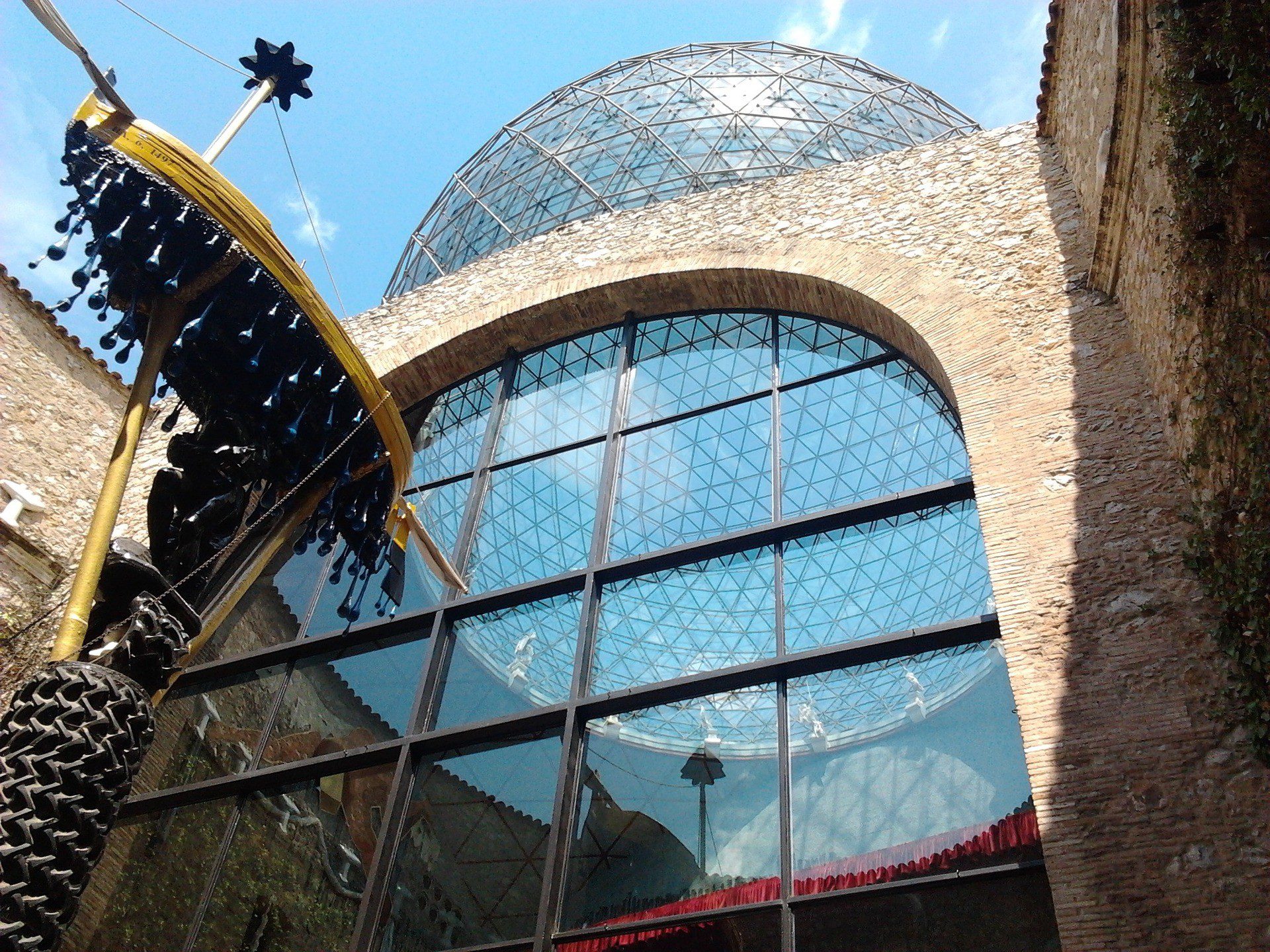
Forty kilometers from Girona is Figueres, the hometown of Salvador Dalí. The municipal theater, destroyed by a fire at the end of the Spanish Civil War, was transformed by the artist in the 1960s into the largest surrealist object in the world. Indeed, visiting the Dalí Theatre-Museum is an extraordinary experience. Passing the entrance, you find yourself in the area that originally housed the stalls. In this space, left open as after the theater’s destruction, the eye is immediately caught by a Cadillac topped by a huge female statue, followed in perspective by a column on which rests an overturned boat. All around, the perimeter walls are dotted with golden mannequins, monstrous figures, and sinks. The stage is now covered with a beautiful geodesic dome that lights up at night, characterizing the city’s skyline.
In the spaces that originally housed the theater boxes and inner rooms, the real museum is set up following a path designed by Salvador Dalí himself, which has remained unchanged. It features works spanning his entire career, but also works by other artists, such as El Greco and Marcel Duchamp, which belonged to him. The installation of the Mae West room is remarkable, where, looking through a special lens, some objects and paintings become a portrait of the actress. Or the House of the Wind where the ceiling, to which Dalí attached some of his canvases, creates disorienting perspectives.
The artist’s muse was his wife Gala, who appears in numerous displayed works. The Torre Galatea, adjacent to the theater museum and Dalí’s residence in the second half of the 1980s until his death, is also dedicated to her. Its architecture has a huge visual impact, with red walls decorated with golden loaves and huge eggs on the roof. Also worth visiting in Figueres is the Castle of San Ferran, a massive pentagonal fortress designed in the eighteenth century by military architect Vauban.
Tarragona: what to see and do
The ancient Tarraco, the oldest Roman city in peninsular Spain, was the capital of the province of Hispania Citerior. It has been declared a UNESCO World Heritage Site because its urban planning model was later used by the Romans in other cities. In particular, the layout had to adapt to the morphology of the land, with the construction of artificial terraces, still visible mainly in the provincial forum area. The city walls system, dating from the late 3rd century BC and expanded in the 2nd century BC, still visible for large stretches, was one of the first examples of Roman military architecture in Spain.
Tarragona has known continuous habitation. This means that although well preserved, the archaeological remains in the city center are rather fragmentary as they were almost always obliterated by subsequent buildings. For this reason, to get a more complete idea of Roman Tarraco, it is advisable to visit the National Archaeological Museum.
The main Roman remains visible in the city center, besides the walls, are the provincial forum and the circus. Moving away from the center, you can admire the most beautiful and best-preserved monuments: the Amphitheater, which dramatically overlooks the sea, the colony forum with its basilica and, outside the city, the remarkable 217-meter-long aqueduct, known as the Devil’s Bridge. Tarragona also preserves important evidence from the medieval period, in particular the Cathedral, with its Romanesque facade and Gothic portal, equipped with a beautiful cloister.

Reus: what to see and do
The hometown of Antoni Gaudí, it hosts the Gaudí Centre, a multimedia museum where you can explore interactively and multisensorially the shapes and concepts behind the projects of the great Catalan architect. There are no Gaudí works in Reus, but there are numerous fine modernist buildings including Casa Navàs and the Institut Pere Mata, both by Lluís Domènech i Montaner, best known for the Hospital Sant Pau and the Palau de la Música Catalana in Barcelona.
Except for the external tower, destroyed during the Spanish Civil War, Casa Navàs is perfectly intact, including the furniture, stained glass and marble decorations produced by artists of the time coordinated by Montaner. The Institut Pere Mata is Reus’s psychiatric hospital. Divided into pavilions, like the Hospital Sant Pau, it is still in use except for the Pabellón de los Distinguidos, originally the pavilion reserved for representatives of the city’s upper bourgeoisie, open to visits.

Other places in Catalonia
The cities described are well connected by the railway network. If you have a means of transport or the patience to organize yourself with regular buses and taxis, there are other places in Catalonia worth visiting:
- Costa Brava: so called for its rugged cliffs alternating with very white beaches, it is the coast of the Girona province and extends to the French border.
- Empúries: the vast archaeological area near La Escala on the Costa Brava houses the remains of the Greek colony of Emporium and the subsequent Roman city of Emporiae.
- Besalú: remarkable example of a High Medieval town preserved almost intact. The monument that has become its symbol is the bridge over the Fluvià river.
- Santa Maria de Poblet: 12th-century Cistercian monastery, UNESCO World Heritage Site for its architectural value and for having been the pantheon of the kings of Aragon.
- Monastery of Montserrat: born as a medieval hermitage on top of a rocky cliff, it is the place of veneration of the namesake Madonna (the Moreneta) depicted in a 12th-century statue.