


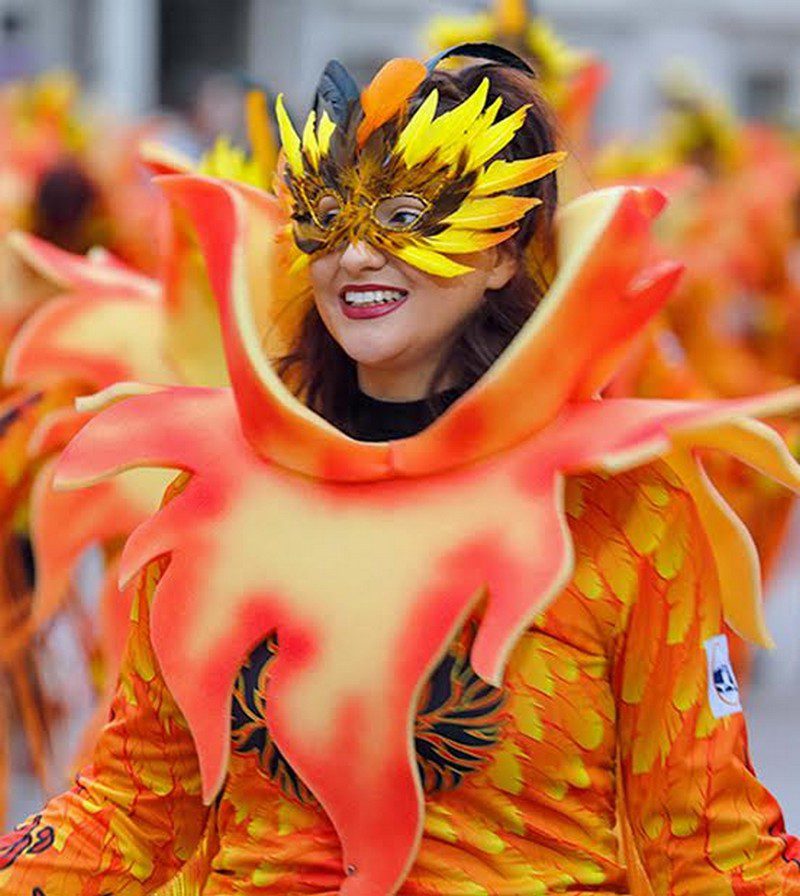
Already in 1449, in fact, a decree of the city council of Fiume (in Croatian Rijeka) prohibited the use of masks, perhaps for political reasons, but the charm of Carnival did not fade; on the contrary, by 1800 the Istrian city was already famous for its Carnival, influenced by the Venetian and Viennese ones, highly appreciated and attended by the Habsburg nobility, but also by Dalmatian peasants and fishermen, who with their horrific masks sought to drive away evil spirits and open the doors to the impending spring. After the forced pause due to wartime events, in February 1982 three small masked groups paraded along the main street, thus relaunching the old “good and healthy habit” of celebrating Carnival. Today the two major events, the children’s parade on Saturday, February 18, 2017, and the international adult parade on Sunday, February 26 – both at noon – involve about one hundred groups, including foreign ones, acclaimed every year by at least 150,000 spectators.
Rijeka Carnival
Recognized as “one of the 500 most important events in Europe,” the Rijeka Carnival begins on January 17 (the peasant festival of Saint Anthony the Abbot) with the symbolic handing over of the city keys by the mayor to Mestar Toni, the master of the Carnival, and to the Carnival Queen, and ends on Ash Wednesday, March 1. During this period the city gates are “closed” to gloom and sadness, while they open wide to joy and color, embodied by the countless masks and the carefree lifestyle. Among the events that deserve attention is the burning of the Pust (a straw effigy embodying evil, burned at the end of the Carnival after a summary trial with a foregone sentence), the Grand Pajama Party, the Mask Marathon, and the masked car rally Pariz-Bakar, on a dizzying route.
Rijeka, the third city of Croatia and the first port
Rijeka, today the first commercial port and the third city of Croatia, has majestic nineteenth-century palaces, headquarters of large shipping companies, wide avenues in the old town full of bars, restaurants, shops, and a lively nightlife. Not only that, this delightful town with a Central European imprint hosts splendid buildings, such as the fifteenth-century Civic Tower, the fourteenth-century Town Hall derived from a former convent, the Roman Arch, ancient gate of the Latin Tersatica, the baroque cathedral of St. Vitus, the city’s patron saint, the Tersatto Castle built on a Roman fortification, the Maritime Museum and some churches.
If we want to visit Rijeka during the Carnival period, it is advisable to stay in some nearby tourist location along the Istrian coast, such as Opatija-Abbazia (77 km from Trieste), 13 km away, which takes its name from an ancient thirteenth-century Benedictine abbey. The mild climate both in summer and winter made this location famous, a destination for European tourists for years.
Specialist since 1980 for all types of holidays in the former Yugoslavia is the operator “il Piccolo Tiglio” to rely on to find customized solutions also on the occasion of Carnival, with accommodations in 2, 3, 4 and 5-star facilities, at decidedly competitive prices.
For information:
tel. 0381 72 098
www.ilpiccolotiglio.com



, il più antico carnevale dell'intera regione balcanica, bello e colorato, si svolge a Rijeka-Fiume, nel nord della Croazia, e viene riproposto annualmente secondo tradizioni centenarie.)