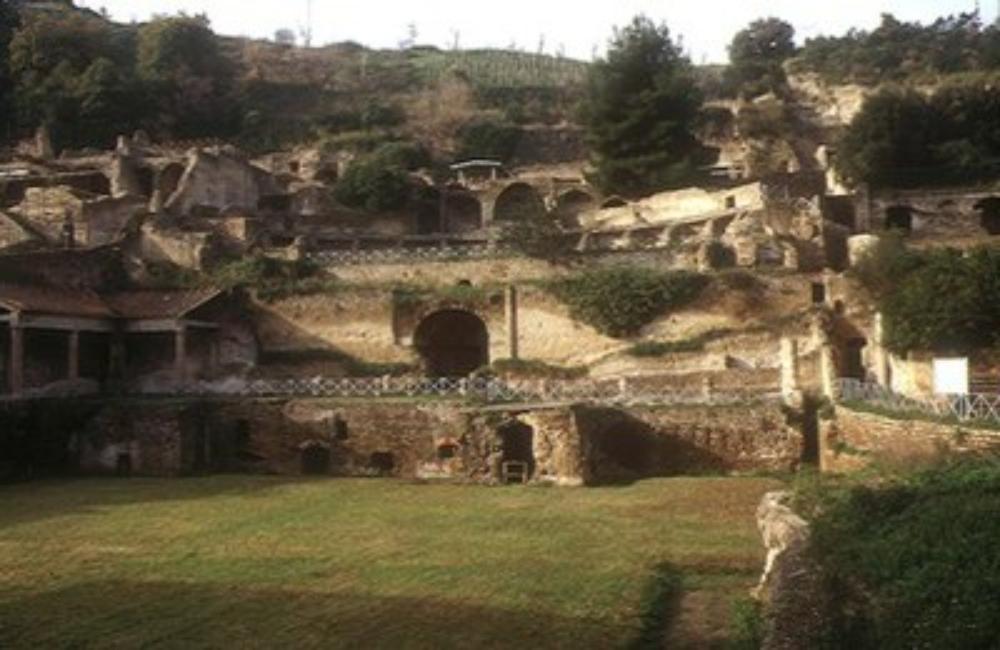
Se few remains of the odeion are known, the Roman-era theater is better known, remembered from ancient written documents and probably depicted in artistic works of the 15th and 16th centuries.
The building, made in opus mixtum of reticulatum and latericium, is dated in its now visible aspect between the end of the 1st and the beginning of the 2nd century AD, a period in which it was completely rebuilt, perhaps after the earthquake of 62 or the eruption of 79 AD. In the area of the Roman-era theater there is no trace of the Greek-era performance building, nor of the early phases of the Roman era.
The theater was then abandoned around the mid-5th century AD, when the functions of the site changed; later some parts of the public building were occupied by burial clusters, attributable to the 6th and 7th centuries AD, while others were obliterated by substantial accumulations of arable soil.
The archaeological monument actually constructs a significant example of “urban archaeology” through which it is possible to reconstruct the building history, from ancient times to the modern era, of an entire urban sector of Naples. After some fortuitous discoveries that occurred in 1859, which allowed for the first plan of the building to be drawn, the first excavations carried out between 1881 and 1891 led to the discovery of part of the cavea inside the garden of one of the houses overlooking the upper decumanus (the ancient street) of the city.
Subsequently, investigations conducted with scientific methods allowed in 1985 to accurately survey and isolate the Roman-era wall structures among the modern ones and, starting from 1997, to explore the area meanwhile acquired by the Public Domain. With the new systematic excavation campaigns, some sections of the external and internal ambulacrum were brought to light, equipped with niches and a complex water canalization system, with the related supporting wedges and vomitoria (accesses), which led to the stairways of the media cavea (the intermediate part) of the stands, as well as part of the stage with the intention of returning the monument to public enjoyment, within the framework of a comprehensive program of enhancement of the entire urban sector.
Not less significant are the surviving decorated surfaces: from the floors of the internal ambulacrum to the plasters, some of which are graffitied with interesting inscriptions, to the marble coverings of the cavea stairways. In subsequent interventions, it is planned to extend the investigation also to the scenae front (stage building) where theatrical performances took place, also celebrated in ancient sources.