

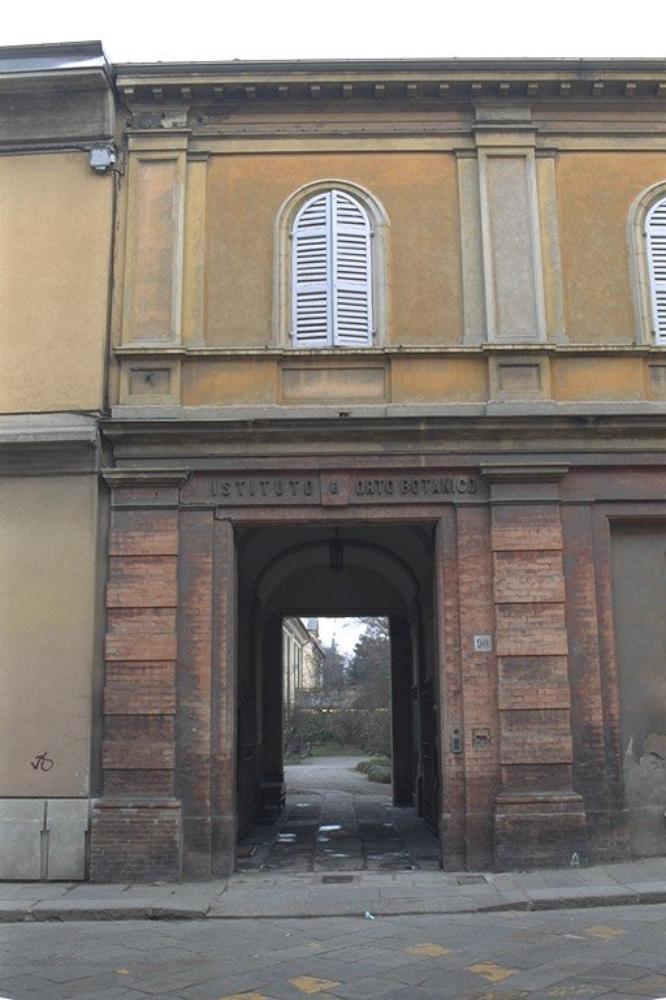

Istituted in 1768 by the will of Abbot Giambattista Guatteri (1739-1793), the Botanical Garden has its roots in the 1600s, a period in which there was a “Garden of the Simples” in Parma, founded by Ranuccio I Farnese and attached to the Faculty of Medicine according to the custom of the time, where medicinal herbs were cultivated (the “simples” were medicines derived from the plant kingdom). The construction of the greenhouses was designed by the architect Ennemond Alexandre Petitot (1727-1801) and completed in 1793. Subsequently, on the initiative of G. Passerini, who was its director from 1843 to 1893, the original structure was expanded with three other buildings: the School of Botany, where microscopic observations were made, the hot greenhouse, and the seedbed. The environment collects, protects, and preserves the native flora that offers visitors the sense of a naturalistic excursion in the territory. Exotic species collections can also be admired, while for their particular interest the xylotheque and historical herbaria are noteworthy. Among the many plants present, mention should be made of the Ginkgo biloba planted in 1791, an ornamental elm, an imposing Metasequoia glyptostroboides and collections of succulents, roses, aquatic plants, insectivores, native bonsai, and violets. The School of Botany preserves the historical herbaria of G.B. Casapini (1722) and G. Jan (1820), a xylotheque, a pollen collection including various specimens of fossil pollen from the Tertiary and Quaternary periods, and a small collection of phyllites gathered in 1960.
Information about the Botanical Garden of Parma
Via Farini, 90,
43121 Parma (Parma)
0521 233 524
[email protected]
Source: MIBACT