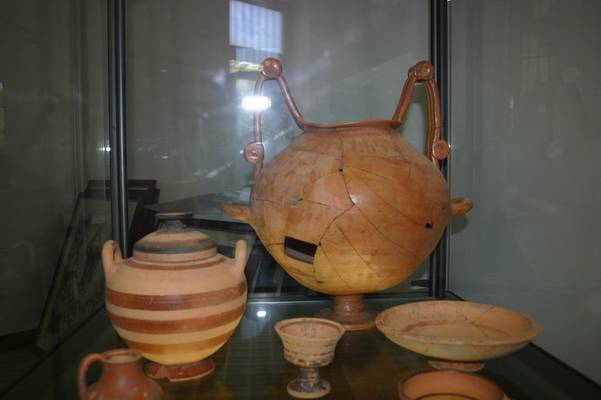
Il Museo presents some of the most significant findings related to the two Greek cities of Siris and Herakleia and the indigenous centers of the hinterland. Votive statuettes and funerary equipment from the VII-VI century BC phase of the city of Siris are attributable, with locally produced figured ceramics, among the oldest made in Magna Graecia.
Among the most significant findings related to Herakleia, matrices for statuettes found in the craft district, votive objects found in the sanctuaries, and above all important funerary equipment from the IV-III century BC characterized by splendid red-figure ceramics and refined filigree gold jewelry are presented. In some cases, these are jewels produced by local workshops, as testified by the exceptional discovery, in Herakleia itself, of the tomb of a goldsmith.
The museum also exhibits some of the most important findings made in the Enotrian (IX-V century BC) and Lucanian (IV century BC) centers of the hinterland. These are funerary equipment of extraordinary importance characterized, in the VII-V century BC phase, by bronze armor, jewelry in silver, gold, and amber, indigenous vases with geometric decoration, Greek figured ceramics, and Etruscan bucchero vases.
Information about the National Museum of the Siritide
Via Colombo, 8
75025 Policoro (Matera)
0835972154
[email protected]
https://www.archeobasilicata.beniculturali.it
Source: MIBACT