


Il monumental center of Cremona is a place of great significance for architecture and the arts. These monuments are symbols, speaking of a community that in the Middle Ages showed wealth and ambitions, with the founding in the 12th century of the Cathedral and Baptistery, with the contemporary establishment of an urban symbol like the Torrazzo, and with the buildings of civil administration, Palazzo Comunale and Loggia dei Militi, also dating back to the medieval period.
The opportunity to admire such a historical context up close is unique: undertaking a journey into the constructive wisdom of architecture with the ascent to the Torrazzo, visiting the story of devotion and biblical tales in the Cathedral’s naves (the 15th-century cycle in the vaults of the transepts and the 16th-century one on the walls of the Aula Maggiore), entering the Baptistery and observing the spectacular and clear construction of the vault, with examples of medieval sculptures, between the 12th and 13th centuries.
Archaeological Museum of Cremona
The Archaeological Museum of Cremona (opened in 2009) is located in the deconsecrated basilica of San Lorenzo and the adjoining 15th-century Cappella Meli. It exhibits the most significant part of the Cremonese archaeological collections: through finds made from the 19th century up to the recent excavation in piazza Marconi, it allows to reconstruct the image of the city founded by the Romans in 218 BC, the oldest in the territory north of the Po.
The Romanesque church of San Lorenzo stands on the remains of an older church, dated to the 10th century, built in turn on the area of an early Christian funerary building and a Republican Roman age necropolis: the museum is therefore itself an archaeological site, whose remains are still largely visible.
Romanesque Stone Museum of the Cathedral
The Romanesque Stone Museum of the Cathedral is located inside the Baptistery. It houses sculptures such as holy water fonts, putti, telamons, the famous statues of Baldas and Berta by Master Niccolò, bronzes, and medieval mosaics from the Cathedral.
Historical Chamber Archive of Cremona
The Historical Archive of the Chamber of Commerce of Cremona holds rich historical and economic documentation from the 14th to the 19th century. It also serves an educational and museum function thanks to the careful exhibition arrangement of ancient codes and various relics that testify to the evolution of the productive and commercial activities of the Cremonese community, from the medieval Universitas Mercatorum to the Unification of Italy.
Also part of the Chamber Archive’s heritage are statutory and matricular codes of the ancient Art Corporations as well as weight control instruments, ancient coins, and a very rich collection of trademarks and shop signs of the ancient Cremonese merchants, between the 14th and 16th centuries.
Civic Museum of Natural History
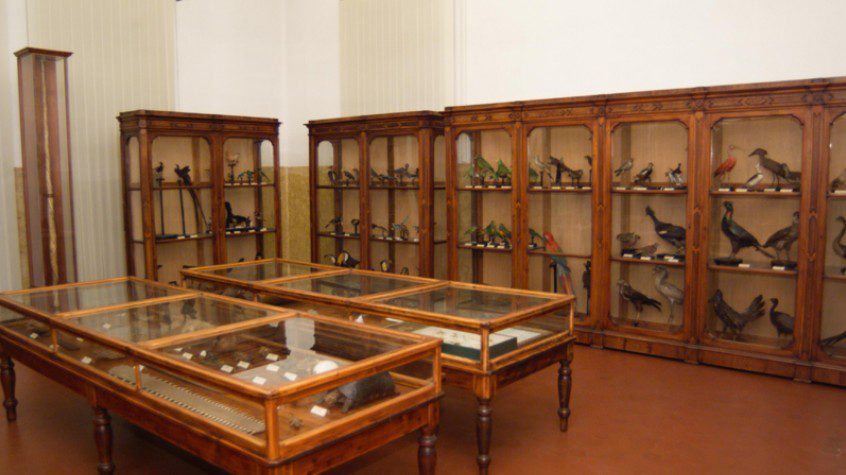
The Natural History Museum of Cremona is located inside the Parco del Vecchio Passeggio, rich in local botanical species, with a small lake that has become a natural habitat for many small animals. The museum originated from the collection of Marquis Giuseppe Sigismondo Ala Ponzone (1761-1842), a naturalist himself.
To this first core were added, over time, other small collections mostly donated by local naturalists. The path starts with the historical section, continues with a systematic passage through the individual disciplines (mineralogy, petrography, paleontology, and zoology, with a botanical section in the park), leading to the reading of the territory. The natural environment, and in particular the urban one, allow the introduction of two highly topical themes applied to the local situation: an innovative representation of the “city upside down” and, to close the path, a reflection on the conservation of biodiversity.
State Library of Cremona
The State Library of Cremona is made up of two main parts: the Governmental and the Civic.
The Governmental Library (called until 1860 Imperial Royal Library), has its origins in the library founded at the beginning of the 17th century by the Jesuits in the city of Cremona, inside their College. The Jesuits were called to Cremona by the Bishop Cesare Speciano (1539-1607, pastor of the diocese since 1591), and they mainly devoted themselves to the education of young people, without neglecting pastoral activities.
As a support for study and teaching, they immediately began to collect book material, which soon enriched with the most precious nucleus: the Speciano’s personal library, of over 1,200 volumes, including incunabula, rare editions from the 1500s, and manuscripts. The original location was at the Jesuit college (currently housing the State High School ‘Daniele Manin’, Via Cavallotti), adjacent to their church: San Marcellino. The Jesuit library was opened to the public by Empress Maria Theresa around 1775, shortly after the suppression of the order (1773). The Cremonese Enlightenment figure Giambattista Biffi played an active role in the opening.
The library remains closed for two weeks in August for the annual review and dusting operations. During this period, the information, distribution, and lending services are open from 10:30 AM to 12:30 PM.
State Archive of Cremona
The State Archive was established in Cremona by ministerial decree on November 21, 1955, but only between 1958 and 1960 did the first collections begin to be gathered. Thanks to the foresight of lawyer Giuseppe Ghisalberti, president of the Province of Cremona, the Province managed to set up the headquarters on via Palestro in premises granted by the Municipality of Cremona. Over the years, the need for expansion arose and in 1979 the Archive moved to its current headquarters on via Antica Porta Tintoria, owned by the Cremonese Educational Institute administered by the “City of Cremona” Foundation.