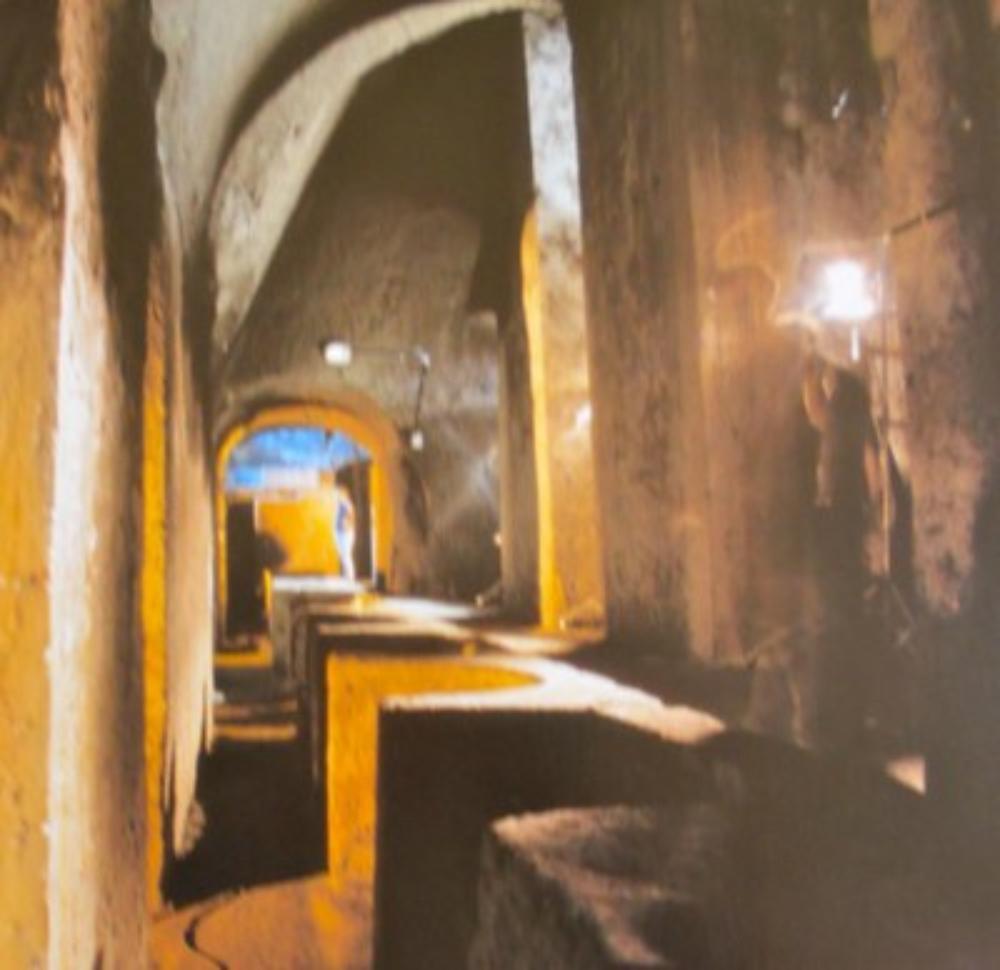


Il Museo, hosted in the prestigious building that was once a convent of the Canossian Sisters, designated by the Municipal Administration, after restoration, as an exhibition venue, offers the public, through a wide and well-considered selection of archaeological materials, the history of the territory of Nola. The visit route begins with the prehistoric section, marked by a thematic path – In the first room, the volcanic activity of Somma-Vesuvius is illustrated, outlined through different eruptive types with particular emphasis on those that impacted the history of the Nola territory, such as the “Pomici di Avellino” eruption in the Bronze Age, and the so-called Pollena eruption during the late ancient period. In the subsequent rooms, artifacts from the Early Bronze Age characterizing the Palma Campania facies are exhibited, along with materials that testify to the effect of the so-called Pomici di Avellino eruption, whose pyroclastic deposits obliterated the villages in the area. The exhibition also provides space for illustrating the results of anthropological investigations with the support of educational panels and the facial reconstructions of three individuals found inside burials. Furthermore, one of the huts discovered during the excavation of the settlement at Croce del Papa in Nola has been reconstructed: inside a full-scale wooden structure where the original distribution of furnishings and spaces is reproduced, some of the recovered artifacts still intact have been arranged.
Following the prehistoric section is one dedicated to the origins of Nola, covering a chronological span from the 8th to the 6th century BC. The tomb furnishings from the late 7th to early 6th century BC, from necropolises located in the Torricelle area and Via San Massimo, are exhibited, indicative of the Etruscan influence on the Nola community, along with Greek-made pottery linked to wine consumption during symposia, typical of the aristocratic classes’ lifestyle.
The rooms dedicated to the “City of Knights” follow, referring to the period between the 6th and 4th centuries BC. The exhibition introduces, with the aid of educational panels, the knowledge of the Samnite people, whose presence in Campania was established during the second half of the 5th century BC. Numerous testimonials from this period come from excavations carried out in the Nola territory during the 18th and 19th centuries. Among these, Attic vases with red-figure and black-figure decorations bearing mythological scenes are highlighted: for example, two Attic red-figure amphorae respectively attributed to the Alkimachos Painter and the so-called Berlin Painter, and a column-krater decorated in red-figure assigned to the so-called Naples Painter. A central point of the section is the painted box and semi-chamber tombs, arranged in the middle of the room, where a large life-size photographic enlargement of the “Knight’s Tomb” has also been placed, showing the original arrangement of the painted slabs. The box tombs from the Casamarciano area have been reconstructed on-site, including the so-called Tomb of the Togati and the so-called Tomb of the Dancer.
The museum route continues with the latest evidence relating to the Oscan presence; this is the period from the Roman conquest of the city (313-312 BC) until the outbreak of the Social War (90-88 BC). Among the displayed artifacts, some come from sanctuaries found near Cimitile and San Paolo Belsito, both testimonies to architectural currents of Microasiatic origin.
This is followed by the section dedicated to the period of Roman domination, with statues that adorned some tombs, various funerary reliefs, including those from the city amphitheater, as well as a series of epigraphic testimonies. The visit continues on the first floor of the complex with illustrations of imperial age testimonies, culminating in a room entirely dedicated to the so-called Villa of Augustus found in Somma Vesuviana.
The exhibition concludes finally with a section dedicated to the end of the ancient world and the medieval age, beginning with the evocative complex of the paleochristian basilicas of Cimitile, reaching to the modern period, thus providing a comprehensive tool for reading and enhancing the monuments and works of art, equally important, attested in these eras in the Nola area.
Information about the Historical Archaeological Museum of Nola
Via Senatore Cocozza, 2
80035 Nola (Naples)
+39.081.5127184
[email protected]
www.polomusealecampania.beniculturali.it
Source: MIBACT