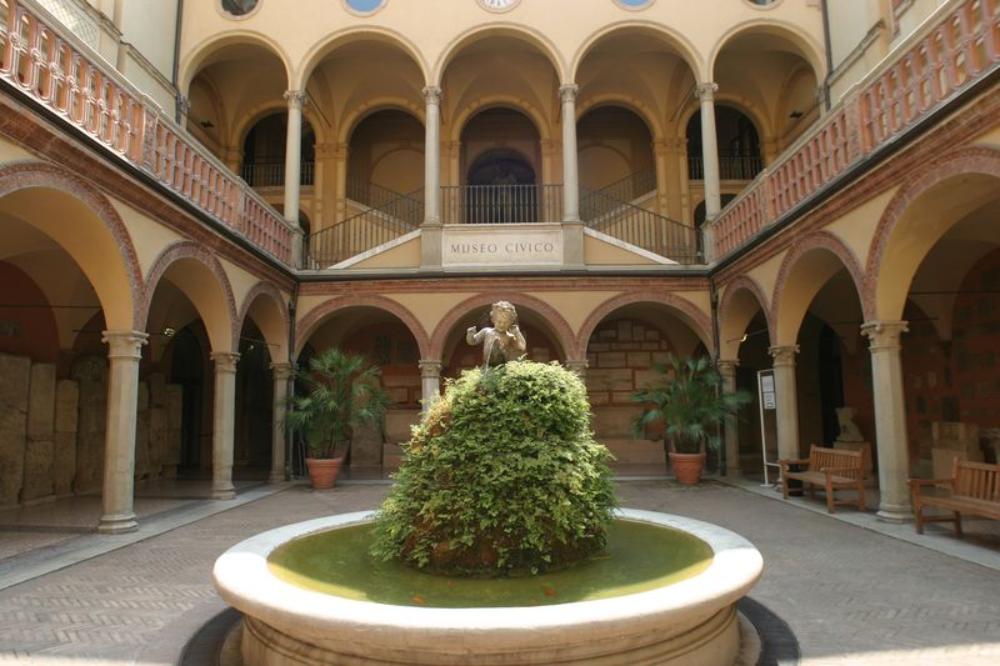


Il museo has been housed since 1898 in Palazzo Schifanoia, comprising a series of collections that testify to the city’s history. Its origins date back to the 18th century, when the Public Museum, the Library, and the Academy of Drawing were established in Palazzo Paradiso, the seat of the University. Currently, the collections, presented partially or on rotation, are arranged in the 15th-century rooms and the 14th-century wing of the palace. The first core, consisting of the lapidary collection, was formed in 1735 at Palazzo Paradiso. However, the purchase of the Bellini numismatic fund in 1758 marked the establishment of the museum. Increased by copious donations, the Medagliere, one of the main ones in the regional context, counts more than 22,000 pieces; besides the core of Italian coins, medieval and modern, it includes the Greek, Roman, Punic sections, a collection of dies and punches of the Ferrara mint, and a series of medals made by great Renaissance artists: Pisanello, Matteo dè Pasti, Sperandio da Mantova. The archaeological collections, expanded during the 18th century, originated from the amalgamation of Greek, Etruscan, and Roman ceramics, glass, lamps, and bronzes, to which the Egyptian collection was added in the 19th century. From Cardinal Riminaldi were then donated the group of engraved gems and the main core of the bronze collection, with works by Giambologna and Algardi. On rotation, a selection of Carthusian and Olivetan choirs of extraordinary quality is visible: notable are also the Bible commissioned by Borso d’Este for the San Cristoforo monastery illuminated by Guglielmo Giraldi and the incunable Decretum Gratiani illuminated by craftsmen from the time of Ercole I. Among the smaller collections, the ivory collection boasts heterogeneous pieces of great interest, including plaques with courtly scenes. In 1935 the Pasetti collection of sgraffito ceramics was acquired; in the postwar period, following the suppression of the Pious Works, a large number of sacred furnishings and a group of Ferrarese paintings from the 17th and 18th centuries arrived, with works by Bononi, Zola, Scarsellino. In the 14th-century wing are exhibited works of exceptional value, such as the alabaster polyptych by the Nottingham sculptor, from the early 15th century, the Madonna and Child, a polychrome terracotta by Domenico di Paris, and part of the wooden choir of Sant’Andrea, inlaid in the 15th century by the Lendinara workshop.
Information about Musei civici di arte antica – Palazzo Schifanoia
Via Scandiana, 23,
44121 Ferrara (Ferrara)
0532232933
arteantica@comune.fe.it
Source: MIBACT