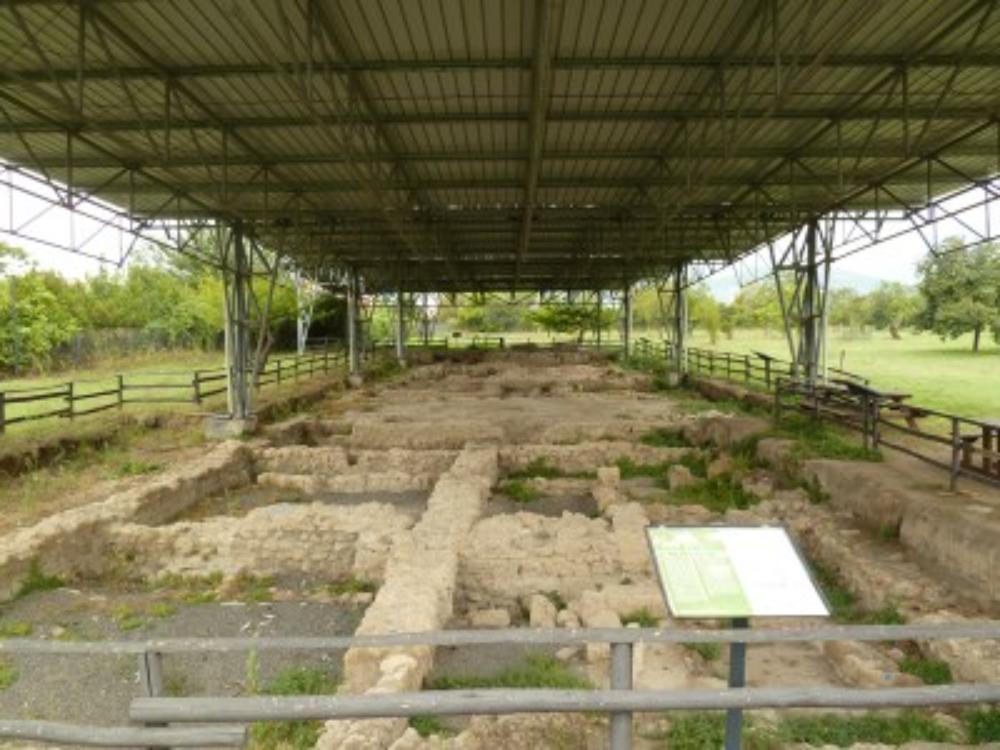
Lo Stadio di Antonino Pio, located immediately to the west of the city of Puteoli, stands on a natural terrace, with the northern front facing the ancient Via Domitiana (today Via Luciano) and the southern front scenographically overlooking the Gulf of Pozzuoli. As ancient sources inform us, the construction of the Stadium was promoted by Emperor Antoninus Pius to celebrate the philhellenic spirit of his predecessor Hadrian who, having died in Baiae in 138 AD, was initially buried in the area of one of Cicero’s villas in Pozzuoli; later, Antoninus Pius, overcoming the Senate’s reluctance, transferred the remains to Rome and established at Pozzuoli, in the place of the first burial, Olympic-type games known by the Greek name of Eusebeia. The Stadium (measuring about 300 x 70 m) has the traditional rectangular plan with one of the short sides curved (sphendone) and the other, reserved for the start of the athletes, characterized by a slight curvilinear shape. On this side – where various excavation campaigns were concentrated in the last decade of the last century thanks to regional funds – there is a monumental double curtain opening, originally covered by a masonry vault. This entrance led the athletes directly to the track and consisted of multiple arches made with large blocks of local volcanic stone (so-called piperno), coated with light plaster; of these arches only the pillars remained standing, while the voussoirs, all found in collapse, were repositioned in their original place during recent restoration works on the monument. Access for spectators, instead, was from the northern front filtered by several protrusions, of which only the first to the East was uncovered, separated by green spaces. Passing through these, one enters a corridor with cocciopesto flooring and composite vault covering; from here, through different openings (vomitoria), the public accessed the various seating sections (cavea). As in most ancient entertainment buildings, the cavea of the Stadium of Antoninus Pius was organized in three parts, corresponding to different spectator tiers. The lowest part of the cavea (ima), reserved for eminent persons, is separated from the track by a boundary wall (balteus) and preserves two rows of seats made of piperno blocks; of the intermediate and upper parts of the cavea (media and summa) the steps have not been preserved, and according to some revealed traces, they do not seem to have been made of piperno.
Information on the Stadium of Antoninus Pius
Via Campi Flegrei
80078 Pozzuoli (Naples)
081.5266007 (Office for the Archaeological Heritage of Pozzuoli)
[email protected]
https://sbanap.campaniabeniculturali.it
Source: MIBACT