



The museum is dedicated to the fascinating history of communication media from their origins to today, through over two thousand displayed items, original and operational: from the mechanical musical machines of the 18th and 19th centuries to the Phonograph, from Radio to Television. The museum path unfolds over 2,000 square meters divided into different exhibition sections. It also features a library with an important collection of rare volumes, vintage magazines, prints, philatelic material, coins and medals related to the museum’s themes, and a film and video archive.
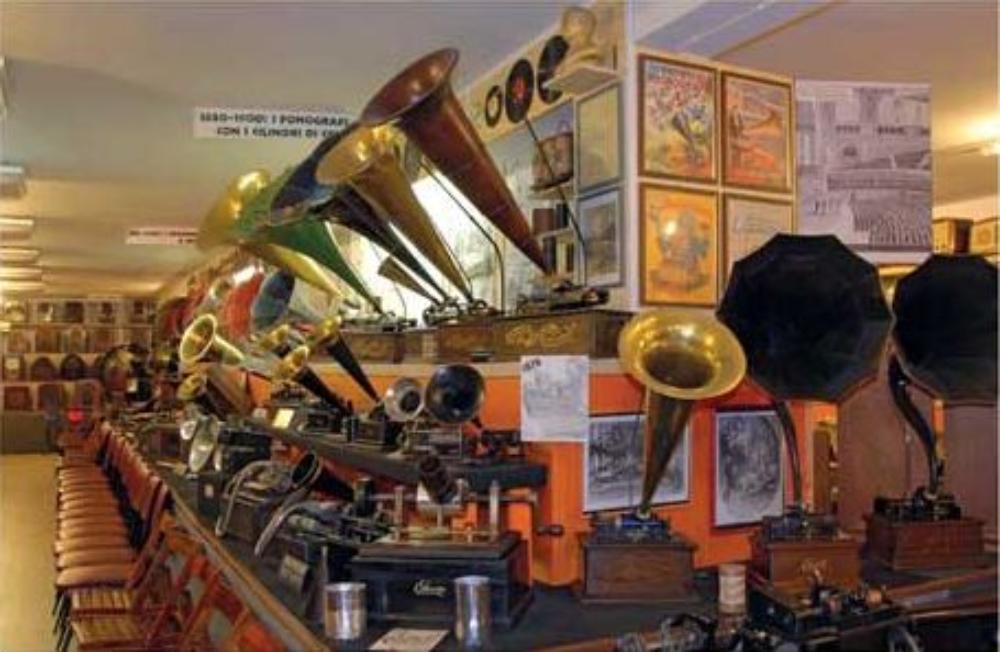
The first exhibition section illustrates chronologically and scientifically the prehistory of radio, with period technical instruments of electrostatics and electrodynamics, and its evolution from the origins up to 1960. In a specially arranged room dedicated to Marconi, numerous relics and original pieces signed “Marconi” that are now very rare are on display, as well as a philatelic collection with issues from all over the world dedicated to Marconi and the invention of radio. In the second exhibition section, reserved for the history of phonography, you can admire Edison roller dictaphones and phonographs, Pathé, etc., from the late 1800s and various types of gramophones, along with a collection of over 7,000 vintage 78 – 80 – 120 rpm records. The third exhibition section illustrates the history of music reproduction in the 18th and 19th centuries through mechanical musical organs of every kind (spring-driven, cylinder, disc and punched card types, etc.): from the tiny mechanical musical automaton that fits in the palm of your hand to the grand “orchestrions” reaching up to 2.5 meters in height, from the second half of the 1800s. It also includes a section dedicated to the history of cinema, from magic lanterns of the mid-19th century to cinematography in 35 and 70 mm, and one dedicated to the telephone, from Meucci to the modern mobile phone. Sections that revisit the history of television and the computer are also present, with examples illustrating their evolution. The room named after the Ducati brothers finally gathers civilian and military radio equipment, cameras, precision mechanical instruments as well as engines and motorcycles. The museum also offers the Hall of 18th and 19th Century Mechanical Musical Machines, the rich and comprehensive library equipped with an important collection of rare volumes, vintage magazines, prints, philatelic material, coins and medals related to the covered topics, the film and video archive with over five hundred films available in reels of 35, 16, 8, super 8 mm and VHS and a series of 1950s jukeboxes that visitors can also operate to retrace the history of Italian and Neapolitan songs and opera.
Information about G. Pelagalli Communication Museum – A Thousand Voices…a Thousand Sounds
Via Col di Lana, 7/n,
40121 Bologna (Bologna)
3388609111
[email protected]
https://www.museopelagalli.com
Source: MIBACT