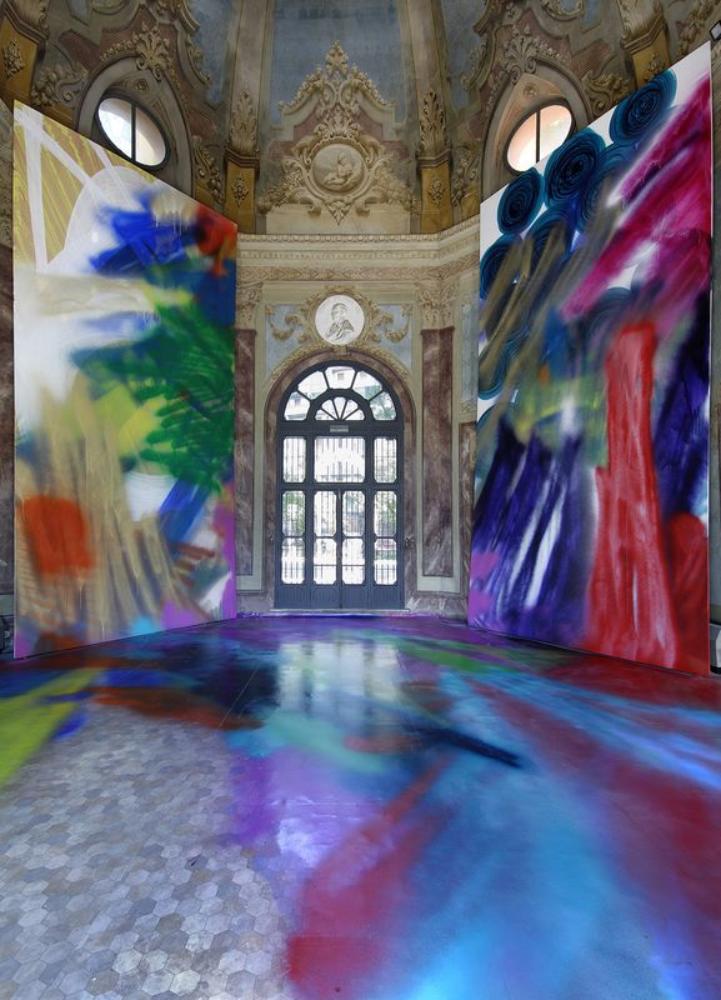


The rich heritage of the Gallery, active since the early 1960s with an intense exhibition activity focused on specific themes and artistic trends, consists of the Contemporary Drawing Collection, the Contemporary Photography Collection and the Franco Fontana Fund, and the Graphic Collection of Don Casimiro Bettelli, recently received on free loan from the Modena Curia. Since 1997 the collection has been housed in the Palazzo Santa Margherita, which accommodates areas intended for temporary exhibitions and monographic showcases, future museum rooms, and workshops. The Civic Gallery, active since 1959 and established in 1963 following a fifteen-year use as the Cultural Hall of the Municipality of Modena, was moved in 1997 to its current location, Palazzo Santa Margherita. The historic building, recently restored, was designed in 1830 in neoclassical style by architect Francesco Vandelli. No traces remain, however, of the church and convent connected to the complex, which served as the seat of the Patronage of the Sons of the People since 1874. Inside the Palace are the Antonio Delfini Civic Library, since 1992 the Figurine Museum, and soon the Orazio Vecchi Music Institute. The spaces of the Civic Gallery include the Large Hall, center of exhibition activities, the rooms on the upper floor inaugurated in November 2004, a well-equipped educational laboratory managed in collaboration with the Municipality’s Education Department, and a bookshop. The Civic Gallery, thanks to the leadership of Oscar Goldoni, Carlo Federico Teodoro, Pier Giovanni Castagnoli, Flaminio Gualdoni, Walter Guadagnini and Angela Vettese, has progressively grown in the field of graphic arts and contemporary photography represented by substantial collections: five thousand items compose the section dedicated to contemporary drawing, while about three thousand author photographs constitute the photography section. Since the late 1980s, the collection of drawings and prints of the Civic Gallery has been configured as a unique corpus: composed of works on paper, it grew exponentially thanks to purchases, donations, and monographic exhibitions that testified the evolution of 20th-century art through drawing techniques. The two exhibitions Italian Drawing Between the Two Wars (1983) and Post-War Italian Drawing (1987) further helped raise public awareness toward the specific collecting promoted by the Civic Gallery. It preserves items from regional and national actors of Visual Poetry, as well as graphic works by Giuseppe Capogrossi, Ferruccio Ferrazzi, Mario Mafai, Antonietta Raphael, Fausto Pirandello, Antonio Ziveri, Gilberto Zorio, Carla Accardi, Claudio Olivieri, Marco Gastini, Giuseppe Spagnulo, Toti Scialoja, Arcangelo, Stefano Arienti, Lucilla Catania, Massimo Kaufmann, Amedeo Martegani, Piero Pizzi Cannella, Marco Tirelli, Lucio Fontana, Mauro Reggiani, Renato Birolli, Fausto Melotti, Mario Nigro, Antonio Sanfilippo, Vincenzo Agnetti, Enrico Prampolini, Osvaldo Licini, Luigi Veronesi, Wainer Vaccari, Claudio Parmiggiani, Vasco Bendini, Piero Dorazio, Alighiero Boetti, Giulio Paolini, Dadamaino, Emilio Tadini, Gianfranco Baruchello, Enzo Mari, Luigi Malerba, Goffredo Parise, Aldo Rossi, Guido Cannella, Paolo Portoghesi, Carlo Aymonino, Ico Parisi, Romolo Romani Goccia, Renato Guttuso, Carlo Carrà, Giuseppe Penone, Pier Paolo Calzolari, Mario Vellani Marchi, Vittorio Magelli, Pompeo Vecchiati, Lucio Riva, Davide Benati, Franco Guerzoni, Franco Vaccari, Carlo Cremaschi, Giuliano Della Casa, Andrea Chiesi, Giovanni Manfredini, Alberta Pellacani. At the Civic Gallery there are also, on loan from the Modena Curia, over six hundred graphic works and multiples gathered by Prelate Casimiro Bettelli, a lover of art and poetry, who collected editions of Gino Severini, Giacomo Balla, George Braque, Arman, René Magritte, Zadkine, Andy Warhol, Jim Dine, Victor Vasarely, Sol Le Witt, Mario Schifano, Lucio Fontana, and Alberto Burri. In 1991 Franco Fontana donated his photography collection to the city, including over five hundred prints: the collection consists of images taken by the artist and by Anton Giulio Bragaglia, Man Ray, Henry Cartier Bresson, Robert Capa, Sander, Luigi Ghirri, Oliviero Toscani, Ferdinando Scianna, Fontcuberta, Hamilton, Robert Doisneau, Berengo, Gardin, Alberto Giacomelli, Richard Avedon, and many others. Additional donations from photographers who left their images to the Gallery add to the core collection, among whom Beppe Zagaglia, Gabriele Basilico, Olivo Barbieri, Mimmo Iodice, Paolo Gioli, Daniel Schwartz, Antonio Biasucci, Philip Lorca di Corcia, Aurelio Amendola. Exhibition Activity In the promotional and enhancement activities for contemporary artistic culture promoted by the Gallery, periodic exhibitions are also included. Since the mid-1950s, Modena’s cultural activity has been very dynamic in this particular sector: in 1958 the 1st International Photography Art Biennial was held, followed by other events demonstrating the Gallery’s consistent work in collecting, drawing and photography, representative of local, national, and international contemporaneity. Apart from monographic exhibitions by author, notable group shows include Exhibitions of artists from “Corrente” (1963), German Expressionism (1966), Art in Emilia (1968), and the 1st Biennial of Italian Trend Galleries (1969), followed in the 1970s by exhibitions of Ghirri, Salbitani, Vimercati, Chiaramonte, Zagaglia, Leonardi, Barbieri, Cresci, Guidi, Basilico and shows of historic masters (Michetti, Rodchenko, Brancusi), large group exhibitions, and the photography biennial, by its eighth edition called Modena for Photography. In that decade, there were events such as Arte e Critica ’70 / Signals (1970), The Sleep of Reason Produces Monsters (1974), Aspects of the Artistic Evolution of Modena in the 20th Century (1975), Avant-garde and Experimentation. Genres and Gesture (1976), From Dada to Surrealism. Exhibition of works and texts (1977), Political Practice. The Art System and the Social Fabric (1979). In the 1980s followed Transavanguardia Italy-America (1982), The Futurists and Photography (1985), Equalizations, the first exhibition of the Documentation Archive of Young Modenese Artists (1988), Collectors /1. Russian and Soviet Art in Italian Collections (1993) and Collectors /2. Then followed An Italian Collection (1993), Modenese Artists at the Venice Biennale (1993), Eyes on the City (1994), The Invention of the Landscape (1995), The Loulakis Collection. Drawings and Photographs from Klee to Mapplethorpe (1997), 1960-2000: Contemporary Art in Private Modenese Collections (1998), 1968-1998: Photography and Art in Italy (1998), The Life of Forms. Photographs, Drawings, and Graphics from Picasso to Warhol (2003), Art in the City /1: six artists and a project for Modena (2004), Pop Art UK: British Pop Art 1956-1972, Trilogy. Drawings by Mimmo Paladino, Photographs by Olivier Richon, Graphics and Multiples by Richard Artschwage (2004), The Idea of Landscape in Italian Photography from 1850 to Today, Pop Art Italy 1958-1968, the cyclic exhibitions Modena for Photography (since 1993), the biennial for young photographic artists Passaggi (since 1998) and Profiles (since 2001). Since July 2004, Angela Vettese has been the new director of the Gallery. There is an intense and close collaboration with Giovani d’Arte, a municipal structure coordinated by Ornella Corradini, which conceived Area Progetto as a recurring meeting place with the youngest artists active in the Modena area invited to interact with the architectures of Palazzo Santa Margherita. Exhibitions take place within the exhibition spaces of the Palace and in the adjacent Garden Pavilion. Among the monographic exhibitions set up at Palazzo Santa Margherita are those of Allan D’Arcangelo – Retrospective, Matteo Serri, Davide Bertocchi with Modenese Self-Portrait, Claudia Collina with The Action of Wandering Through it Meets Saints, Sleeves, Spinsters, Adrian Paci, Leonardo Greco, Yayoi Kusama, Happy Days of Ugo Rondinone, Piero Gilardi in the monographic Interdependencies, and The Strange Direction Love Takes on Certain Days by Chiara Tagliazucchi. The cultural program curated by Vettese debuted in 2005 simultaneously with two proposals: Melina Mulas, The Third Eye at Palazzo Santa Margherita, and Michelangelo Pistoletto and Cittadellarte. The Mess Hall of Cultures at the Garden Pavilion. Among the most recent collective exhibitions are Fragments of Urban Life, D.A.B. Design for Art Bookshop (since 2006), DesignER. Young Designers in Emilia Romagna, EGOmania. Just when I think I’ve understood. / As Soon as I Realize I’ve Understood. (2006), Northern Gazes. Reflecting with Images, and Mimmo Paladino for Modena. The 2008 exhibition activity continued with dual solo shows Lost Cinema Lost by Runa Islam and Tobias Putrih, Franco Vaccari – Works 1955-1975, solo exhibitions of Mimmo Paladino for Modena, one dedicated to Lewis Baltz – 89-91 Sites of Technology, Untitled 2002 by Chiara Forti, Some Thoughts That Still Engross The Mind Of Man, Simone Fazio, Transit Stations. Human Epic Passages by Ginestra Paladino, Carpet by Laura Renna, Shomei Tomatsu for Skin of the Nation, then Katharina Fritsch, Elina Brotherus, The Author’s Concealment. Artistic research of Franco Vaccari, Franco Hüller in the monographic Perspectives, Aldo Rossi and the Modena Cemetery, Luigi Ghirri with Breakfast on the Grass, Fabio Bonetti with 10 Obstructions of the Lower Abdomen (Lifeboat), Chiara Pergola. Sculptures, the group show The Sublime is Now. Bas Jan Ader, John Bock, Tacita Dean, Cyprien Gaillard, Pierre Huyghe, Deborah Ligorio, Robert Smithson, Guido van der Werve and at the Garden Pavilion Katharina Grosse. Another Man Who Dripped His Brush. Also in 2008, within the city event “Beyond the Garden,” the Gallery presented a series of artist video and film screenings including Marina Abramovic’s “Balkan Baroque,” a documentary film on the life and works of Louis Bourgeois, and “I’ll be your mirror” by Nan Goldin, as well as organizing meetings with important personalities in the world of art and architecture, among whom Yona Friedman, whose drawings were exhibited. In 2009 other exhibitions took place, including Mark Dion. Concerning Hunting, Once Upon a Ring… Jewelry by Gabi Dziuba presented by Christian Philipp Muller, Ethos of Italians. Olivo Barbieri Site Specific_Modena 08, the solo exhibition Christian Holstadt. I Confess and the group show The Don Bettelli Collection. Unpublished works from Fontana to Schifano; in 2010, among others, Pages from a Fantastic Bestiary – Italian Drawing in the 20th and 21st centuries took place, while 2011 was marked by the long-term project The Collection of the Civic Gallery of Modena: Photographs and Drawings from the Collections aimed at regularly and cyclically exhibiting photographs and drawings from the permanent collection. Within this event, the first retrospective of the Spanish artist Anna Malagrida was presented and on the occasion of “Musei da Gustare 2011” the performance “Perdersi” took place, inspired precisely by the layout of the Gallery’s permanent collection. For the Area Progetto series, in 2008 the installations Soul Searching by Elena Ascari and Flowers by Fausto Corsini, the exhibitions Gilda Scaglioni. 37 degrees, Marco Scozzaro. I’m Looking for You and the presentation of the first catalog entitled “Area Progetto 2005/2008” related to the initiative were held; at the turn of 2008 and 2009 Luca Lumaca. Art Attack; in 2009 Valerio Berruti. And ask no more, Martina Dinato. Uncertain Reality and exhibitions by other young artists such as Alessio Bogani, Ana Maria Bresciani Arenas, Giacomo Ceccagno, Giovanni Lami, and Jebe – Adriana Jebeleanu; between 2009 and 2010 Vania Comoretti. Gratia and between late 2010 and early 2011 Angelica Porrari. Naked Ruins. Precisely with this last work, Area Progetto renewed its formula becoming Area Progetto Off, bringing the works of young artists beyond the Gallery’s boundaries, like the installations Public Disturbance by the duo laCRUNA (2011) and Primary Matter by Elena Ascari (2011) at the Delfini Library. The Gallery also promoted the presentation of the second catalog entitled “Area Progetto 2009/2011” linked to the initiative. Since 2008 the Gallery hosts and collaborates on “Node. International Festival of Electronic Music and Live Media,” dedicated to the meeting of visual arts with music and new technologies, which reached its 4th edition in 2011. On the occasion of the restoration of the Ghirlandina, the city tower recognized as a UNESCO heritage in 1997, artist Mimmo Paladino was involved to create a decorated canvas that wrapped the tower in a 64-meter installation linked to the exhibition Mimmo Paladino for Modena, concluded at Palazzo Santa Margherita.
Information about Civic Gallery of Modena
Corso Canalgrande, 103,
41121 Modena (Modena)
0592032911
[email protected]
https://www.comune.modena.it/galleria
Source: MIBACT