


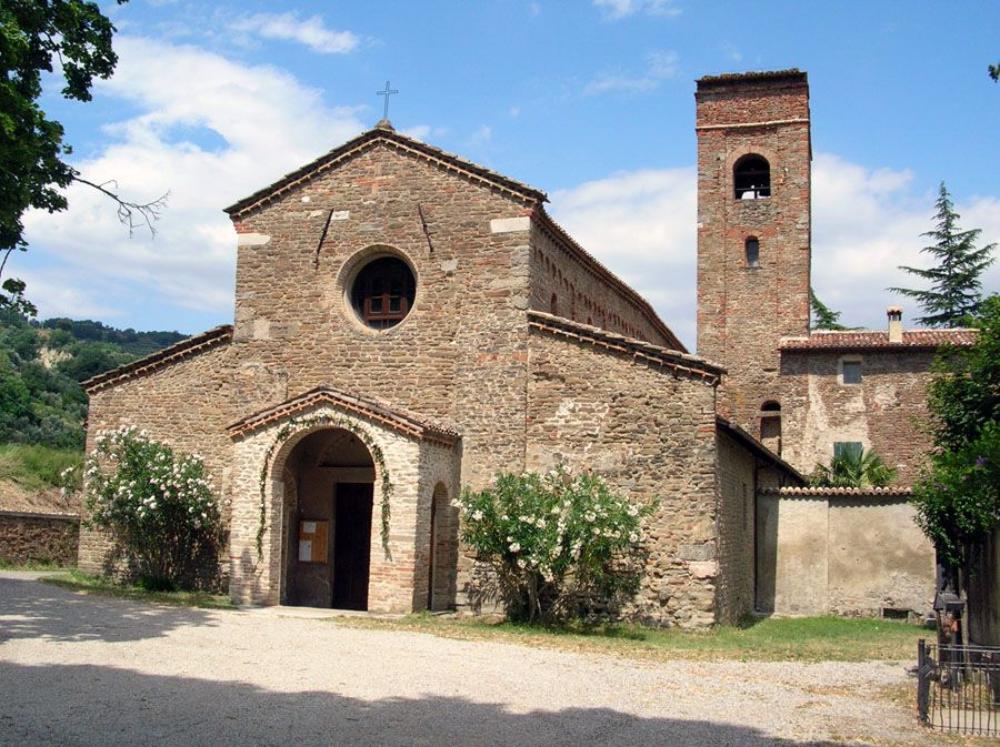

Una open staircase at the beginning of the right nave leads to the archaeological path beneath the current floor level. Excavations conducted around and shortly after the mid-20th century have revealed various traces and archaeological materials dating from the Roman era to the Middle Ages. These are elements chronologically preceding the original Christian worship building uncovered beneath the current apse, possibly used as a crypt of the church built in the Romanesque period (at the end of the 11th century – beginning of the 12th century). The well with drainage found under the central nave, variously interpreted by some as a small oven or furnace and by others as a “small room for thermal treatments,” has recently been identified as a bell casting pit. Several archaeological finds are preserved on site: handled bricks, stamped bricks, bricks with animal prints, fragments of capitals, inscribed funerary steles, a bronze, possibly votive, hexagonal floor tiles, fragments of glass balsamaries, and some large terracotta dolia marked with progressive numbering scratched on the rim. Among the spolia materials embedded in the architectural structures and wall surfaces are fragments of inscriptions, seven partially reworked capitals (from the 1st century BC to the 5th-6th century AD), some column bases, a pink Verona marble column, and eight in eastern granite: notably important is one reusing a milestone commemorating the emperors Valens, Gratian, Valentinian II, generally attributed to the route of the Via Faventina. Other finds, mostly from the Roman age, are walled in or embedded in the walls at various points of the church complex. Worth mentioning among these are the gaming board engraved on a brick, a screen of Greek marble, an olive press, several fragments of funerary inscriptions.
Information about Museo della Pieve del Tho’
Via Pieve del Tho’, 1 (c/o Chiesa di S. Giovanni in Ottavo),
48013 Brisighella (Ravenna)
0546 800 35,0546 811 66 (Pro loco)
Source: MIBACT