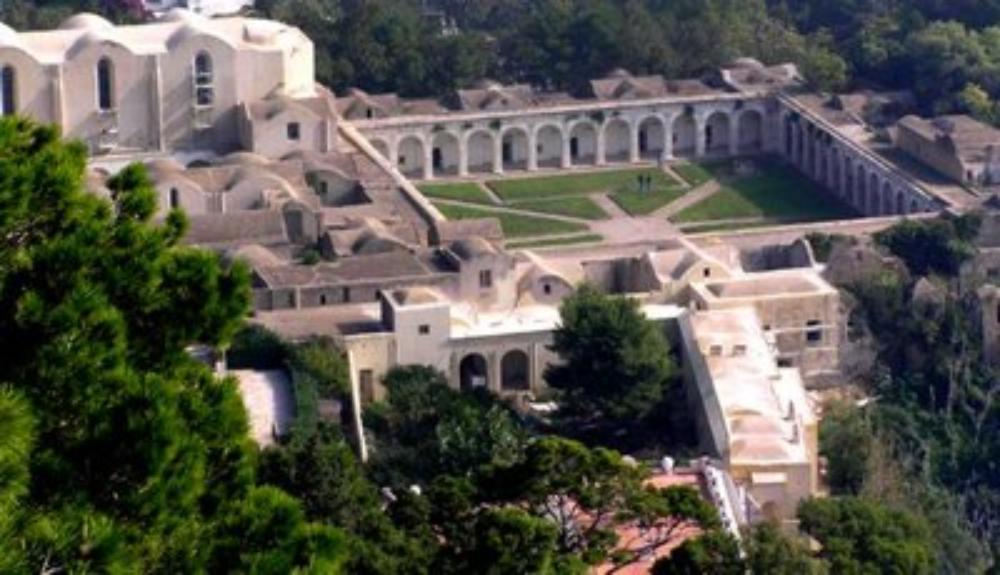
Before the 1980 earthquake, it developed around a trapezoidal courtyard with three semicircular arches from which access was gained to the rooms on the first floor; the typological layout was the result of the numerous and frequent transformations that took place over time on the ancient residence of the Caracciolo del Sole, then the Imperiale family: a loggia, a staircase with a carved balustrade, and the stable dating back to the 16th century were recognizable.
A plaque placed to the left of the entrance portal, destroyed with the collapse of the central part of the southern side of the castle, commemorated the expansion and transformation works dating back to the 18th century. From 1862 the fortress was used as a prison and courthouse, a function it retained until the 1980 earthquake when the upper floor, the building on the east side, and part of the southern side collapsed. Between 1987 and 1992, targeted works were carried out to ensure the safety and preservation of the site as well as a thorough and complete knowledge of the entire structural organism and the pre-existing elements of historical, artistic, architectural, and archaeological interest.
In particular, from the archaeological investigations directed by Marcello Rotili, near the donjon – the large tower equipped for defense built at the highest point of the hill (altitude 888m above sea level) – the structures of the ancient cathedral of Sant’Angelo dei Lombardi (11th century) completely incorporated into the southwest wing of the castle, almost entirely collapsed, and other elements present below the courtyard floor emerged.
During the dismantling of part of the west facade of the castle, two portals and the back wall of the church were subsequently discovered. Concurrently with the excavations, restoration work was carried out on the stable, the tower, and the loggia which recent studies suggest should be read as residual evidence of an ancient seat.
Following an interruption lasting several years due to lack of funds, the phase of works just described was followed by a further significant restoration intervention that completed the structural recovery of the tower, the stable, and the Romanesque church.
Then, technological systems and external and internal finishes were installed, as well as the interventions necessary to prevent and halt degradation and to create suitable visitor paths to the restored buildings and external arrangements. The stratigraphic investigation revealed, in terms of remains of material culture, a significant quantity of finds, especially ceramics as well as objects in metal, glass, bone, stone, terracotta, bricks, tiles, coins, plasters, and anthropic remains. Source: MIBACT
Information on the Museum of the Castle Area Works
Via Castello snc, 83054 Sant’Angelo dei Lombardi (Avellino) 0827 23094 [email protected]
https://www.comune.santangelodeilombardi.av.it