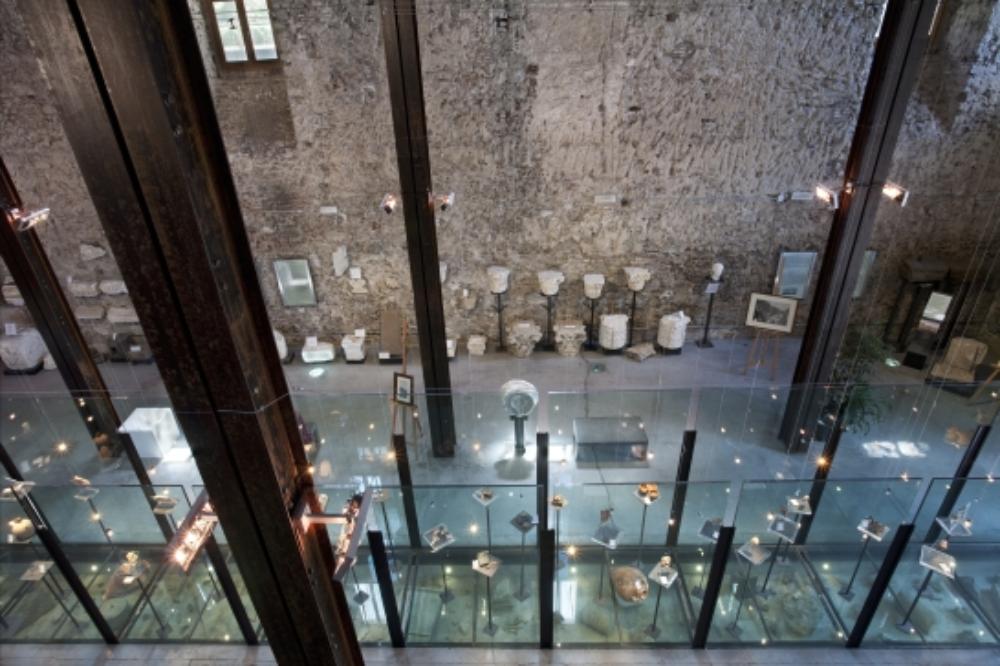


Il Museo delle Origini is affiliated with the Polo Museale of the University La SAPIENZA. Italian prehistoric materials are exhibited here, ranging from the Lower Paleolithic to the early Iron Age.
The exhibits come from the Rellini collection, the founder of the Museum, and from loans granted by various Italian Superintendencies: most of them are the result of surface collections and archaeological excavations carried out mainly in central-southern and insular Italy.
There are also some casts of particularly important objects, whose originals are exhibited in foreign museums (skulls illustrating the various stages of human evolution from australopithecines to Homo, Paleolithic “Venuses”, bone tools).
Three models illustrate: a hut from a Eneolithic settlement (Maccarese – Rome), a pile-dwelling village from the Early and Middle Bronze Age, and a nuraghe from the Late Bronze Age – early Iron Age. Among the most important complexes, we remember those from the Coppa Nevigata site with its impressive stratigraphy spanning from the Early Neolithic to the Bronze Age. Attached to the exhibition rooms is a Laboratory where other materials are stored and available on request. In this Laboratory, cataloguing and study of artifacts from the annual excavations conducted by the Institute are carried out.
The Museum also hosts an archaeometric Laboratory where specialist investigations on archaeological materials are conducted: this involves the technological and functional study of lithic, bone, and ceramic tools. The archaeometry Laboratory is equipped with various microscopes (metallographic, polarized light, stereoscopic), a photographic system for image documentation, and a video system for conducting lessons and seminars on thematic topics. Finally, there is a specialized laboratory for the restoration and arrangement of archaeological finds.