

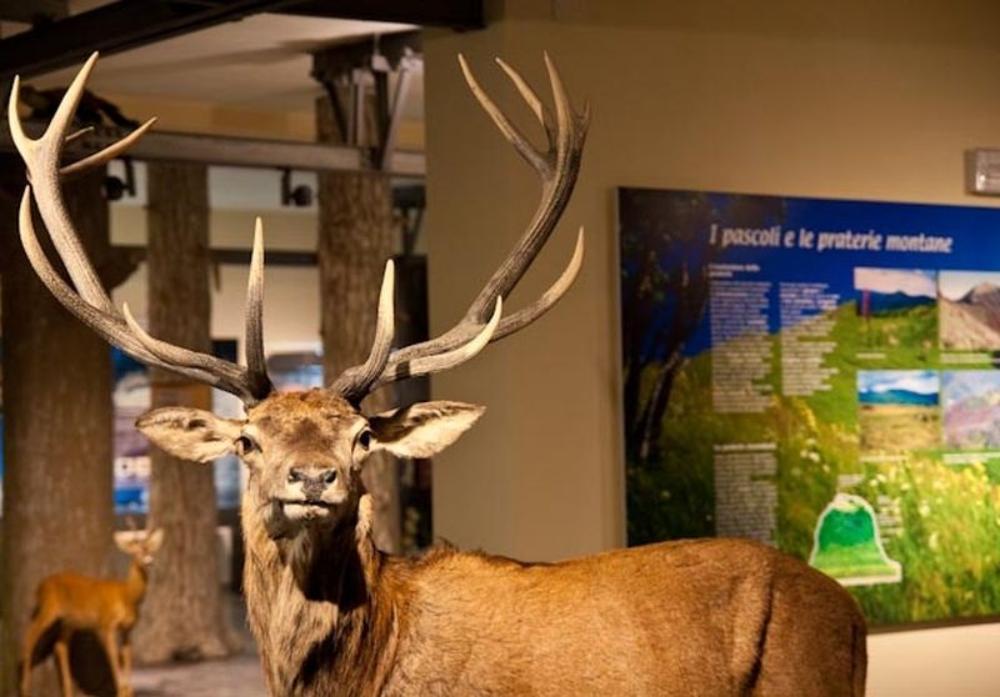


Inaugurated in 2008 inside the Fabbrica del Ghiaccio, at the former Macello of Piacenza, whose equipment has been left in situ as a significant document of industrial archaeology, the new museum route accompanies visitors to discover the natural habitats of the Piacenza area through an exhibition organized into three thematic sections: the Plain, the Hill, and the Mountain. In this way, the treatment of the three main naturalistic fields (geology, botany, and zoology) typical of each area is presented in each room with reciprocal integrations to further stimulate the visitor’s curiosity. The main core of the collections consists of petrographic, botanical, and local birdlife collections, mostly coming from the Royal Technical Institute of Piacenza and other 19th-century natural science cabinets of city school institutions. In particular, this includes the collection of display cases and scientific instruments from the “Domenico Romagnosi” Institute, where Giacomo Trabucco, Michele del Lupo, and Edoardo Imparati worked, and the herbariums of the “Flora Italia Superioris.” The exhibition extensively uses reconstructions, dioramas, life-size models that allow the public a direct approach to the multiple natural-environmental aspects of this provincial district and is richly supplemented with multimedia supports, films, and sound materials that, with their suggestions, project the visitor into the very heart of the different habitats.
Already by the end of the 19th century, the “Romagnosi” Commercial Institute had a significant and valuable naturalistic endowment. Its first description dates back to 1833 by Michele Del Lupo, holder of the science chair and director of the Natural History Cabinet, who annotated and reorganized a collection of rocks, minerals, fossils, animals, and plants. His successor, Giacomo Trabucco, thanks to a series of excursions in the Piacenza valleys, collected characteristic types of local petrography, gathering almost 400 rock samples from allochthonous and autochthonous terrains of the Apennines and the plain, up to the Po. Edoardo Imparati, a doctor and ornithologist, curator of the Natural History Cabinet from 1895, mainly expanded the bird collection, which with existing specimens and new acquisitions exceeded 300 units under his tenure. The scholar’s interests were not only focused on birdlife but also on beetles of Piacenza.
In the Botany section of the Museum, the “Flora Italia Superioris” stands out for historical importance, dating back to around 1820, consisting of a collection of 1,253 “dried” specimens in excellent conservation condition. Alongside it are the “A. Poli” herbarium, consisting of 1,153 specimens of mostly spontaneous Phanerophytes, the “Parmigiani” and “Pavesi” herbaria, and that of the Institute of Botany of the Faculty of Agriculture of the Catholic University of Piacenza. This heritage has largely found placement in the three museum rooms, before entering which the visitor is invited to observe a synthetic representation of the city’s nature, focusing attention on the particular ecology of this environment and some of the most characteristic species.
The Plain room has been schematically divided into two main sectors – the floodplain belt and the extra-floodplain territories – through a stylized realization of the master embankment of the Po river as a separating element between the two areas. The Hill room identifies as the focal element of the exhibition the reconstruction of the three main forest types characterizing the landscape: oak forest, chestnut grove, and pine forest. Animals are exhibited as they might be encountered in a hypothetical natural forest (not always prominently visible), and the visitor is encouraged to observe the environment carefully to spot them. The Mountain room is divided into two main sectors, one dedicated to the evidence of the last glaciation that also affected the Apennines locally and the other reserved for mountain environmental types such as streams, summit pastures, and beech woods.
Information about the Civic Museum of Natural History of Piacenza
Via Scalabrini, 107,
29121 Piacenza (Piacenza)
0523334980
[email protected]
Source: MIBACT