


Napoli underground has a history that dates back several centuries, let’s explore it together.
Underground Naples history
In 1787 during his trip to Italy, Goethe wrote about Naples: “… under the purest sky, the most unstable ground,” referring to the dynamic Vesuvius to the east and the fervent eruptive activity of the many small volcanoes in the Phlegraean Fields to the west. If the writer had descended into the Neapolitan underground, he might have spoken of the city as a true “Swiss cheese,” made of tunnels and underground walkways, ancient aqueducts and immense cisterns, and many tuff quarries.
- Napoli underground has a history that dates back several centuries, let’s explore it together.
- Underground Naples history
- Underground Naples from World War II to Today
- Extraction of Tuff in the Underground of Naples
- Naples Underground: the route and tips
- Naples Underground Hours
- Naples Underground School Entrance Hours and Reservations
- Useful Numbers to Contact the Association: Naples Underground Ticket Cost
- Naples Underground Hours and Prices
- Naples Underground Prices
An engineer of the Municipality of Naples, Guglielmo Melisurgo, in 1889 traveled through all the caverns used for the city aqueduct, and counted more than five thousand caves and two thousand wells; since that expedition until today less than 50% of the Naples underground has been explored, totaling 638,000 square meters among quarries and channels, reservoirs and conduits from the Greek and Roman periods.
It is not known who began to dig these cavities, although the oldest news dates back to the time of the Cimmerians, skilled miners from the Caucasus who in the 8th century BC populated the region; Pliny the Elder and many other authors of the time tell that the Cimmerians lived not far from Naples, on the shores of Lake Avernus, in caves and underground dwellings called argillae, and lived off the earnings from their mines. The geographer Strabo, on the other hand, reports to us about the Eumelids, a people who lived in Neapolis and took care of mines and tombs.
All the cavities of underground Naples, however, date back to very ancient times and were made by man for the extraction of the “Neapolitan yellow tuff,” an excellent building stone. Although many tunnels became catacombs, pagan caves or aqueducts and the large cavities were used as rainwater cisterns and granaries.
Underground Naples from World War II to Today
During the last world war Underground Naples became a vast and effective air-raid shelter, equipped with toilets and electric lighting. For 3000 years and until the use of reinforced concrete, the material for building Neapolitan houses was tuff. Perhaps the Greeks who chose these places to found their ancient Neapolis were attracted precisely by the yellow rocks of Mount Echia, a small extinct volcano rising behind the current very central Piazza Plebiscito; in fact, according to many archaeologists, the tuff used to build the citadel on the nearby islet of Megaride was extracted from that mountain.
As of December 31, 1897, as many as 69 active quarries were registered with almost 2000 workers involved in extraction, and so, while the cubic meters of void increased in depth over the centuries, a city developed “positively” on the surface, with its palaces and castles. Today the most representative examples of how Neapolitan architects used the yellow tuff are Castel dell’Ovo built on the islet of Megaride, Castel Sant’Elmo from 1329 on the hill of San Martino, and the seventeenth-century Palazzo di Donn’Anna on the sea of Posillipo. Naturally, there are tuff houses and palaces everywhere and in the city there is growing attention for the recovery of buildings made with this material.
In 1997 the director of the French Institute Grenoble, Jean-Nöel Schifano, just after completing the restoration of the facade of his Institute, naturally all of tuff, organized a big party to underline the cultural importance of this Neapolitan stone: with the “Babà-Tufo” party, the eccentric Director paired the two “cornerstones” of the city, tuff and babà (a famous Neapolitan dessert) in a highly effective intellectual game.
Naples was therefore built with the same stone as its underground, with a “geological continuity” perhaps unique in the world: the foundations of palaces often rest directly on the underlying tuff bank. According to some, this practice made the city more “elastic,” saving it from the many earthquakes that have occurred over the centuries, and furthermore, the terrible seismic wave would be attenuated thanks to all the cavities of its underground.
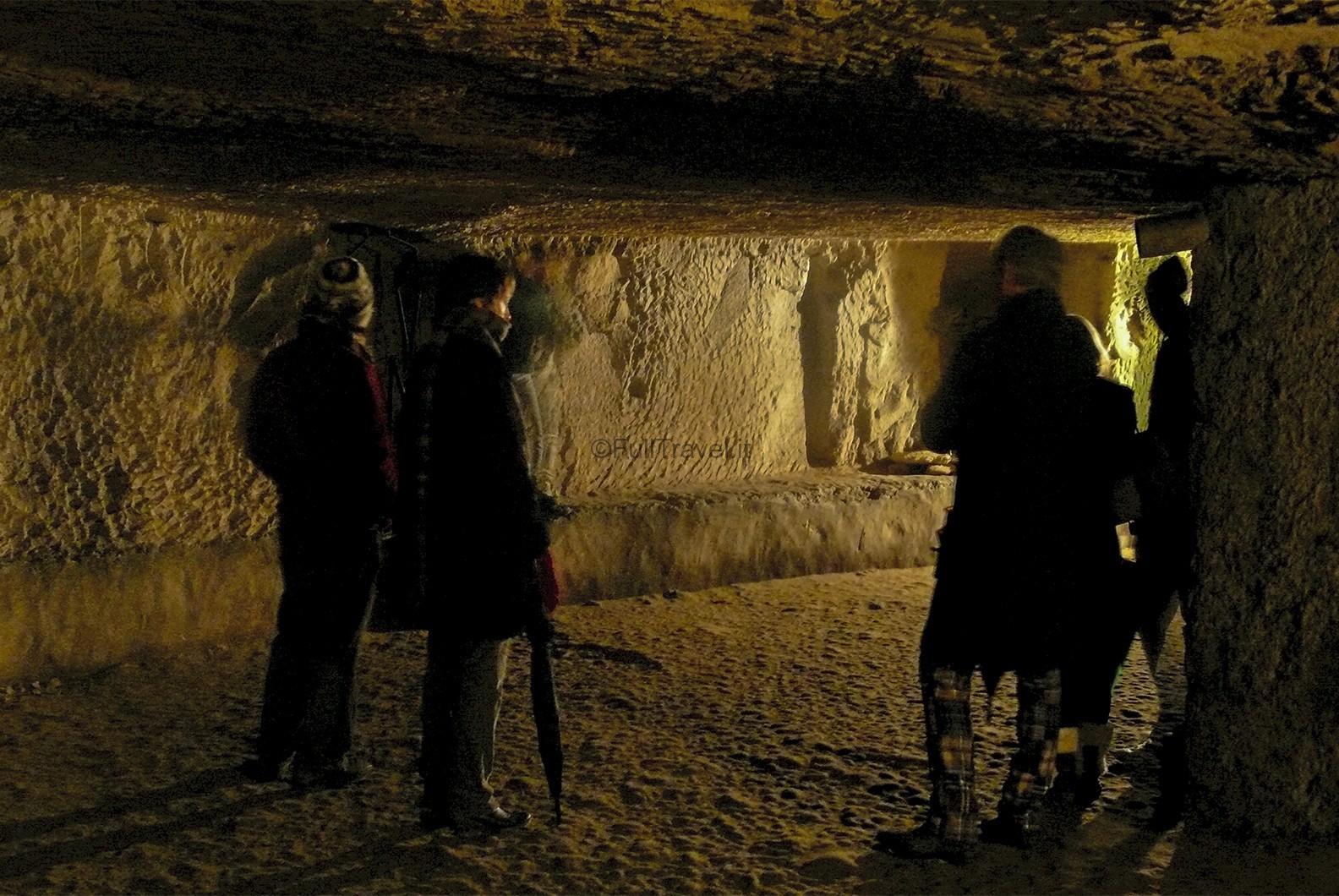
Extraction of Tuff in the Underground of Naples
In recent centuries, some changes have been recorded in the internal architecture of the quarries: in the oldest ones, considered the safest, the structure is shaped like an isosceles trapezoid, while those from the nineteenth century are elliptical. This new shape made the quarry more unstable, as demonstrated by the many partial collapses of the vaults, but allowed for greater material extraction.
However, the technique for extracting tuff over these three millennia has remained essentially unchanged, even though metallurgical progress has introduced new work tools. The digging and cutting tools are the same as in the past, such as the straight-cut pick used to isolate the stone blocks, the pole and iron wedge essential for detaching the rock from the wall, and the cleaver-shaped hammer used to break the block into small regular pieces, which have always been the only means for extraction.
In the city, 75% of the quarries were underground and the tuff bank was reached via stairs or shafts. Excavation was done among the pyroclastics for three or four meters to provide solid protection to the sides of the opening, then work would begin in the first chamber to the desired depth; from there, various galleries would extend to other tuff banks, and thus through a network of tunnels and corridors, other large cavities would be reached from which material necessary for building houses was extracted. If we closely observe the smooth walls made vertical by the excavated tuff, we will notice some small holes dug into the rock, 20 centimeters apart and all in the same row: these are the “grappiate,” the steps that allowed the most skilled workers to work the stone up to 20 meters high, sometimes even on an overhang. True “free-climbers” of antiquity, capable of manually creating over 8 million cubic meters of underground void, who through their work enabled first the Greeks and then the Romans to build the Bolla and Claudio underground aqueducts (the latter even under pressure), a sophisticated water network that guaranteed the city’s supply until 1883, for a total of 2300 years.
Naples Underground: the route and tips
Participating in the excursion means taking a journey through history spanning 2400 years, from the Greek era to the modern age, 40 meters deep among tunnels and cisterns. During the excursion, besides admiring the remains of the ancient Greek-Roman aqueduct and the air-raid shelters from the Second World War, you will visit, among others, the War Museum, the Hypogean Gardens, the “Arianna” Seismic Station. Finally, it will be possible to visit for free the remains of the ancient Greek-Roman Theatre, accessible from a private property.
It is recommended to wear comfortable shoes and a sweatshirt in the summer months. Narrow paths, such as the tunnels, are completely optional.
Naples Underground Hours
There are several options for visiting Naples Underground, but the main entrance of the official route is located at Piazza San Gaetano, number 68 (near Via dei Tribunali, right in the center of Naples). The tour for visiting Naples Underground lasts about 2 hours. The route is guided by authorized guides who speak multiple languages and have an in-depth knowledge of the city’s underground area.
Tours in Italian:
10:00-11:00-12:00-13:00 – 14:00-15:00-16:00 – 17:00-18:00
(Thursday at 9:00 PM only by reservation with a minimum of 10 people)
Tours in English:
10:00-12:00-14:00-16:00-18:00
(Thursday at 9:00 PM only by reservation with a minimum of 10 people)
For groups smaller than 10 people, reservations are not required. Tours in other languages, groups or tours outside opening hours only by reservation.
Naples Underground School Entrance Hours and Reservations
Schools can book guided tours at times different from those indicated by sending an email to info@napolisotterranea.org or request information at the following phone numbers (+39) 081 296944; (+39) 081 0190933; (+39) 333 5849479; (+39) 349 1046436. By sending an email or calling the numbers listed, it is possible to arrange with those responsible for managing excursions for school groups, as well as briefing lessons about the site which, at the school’s request, can be held before the visit; it is also possible to arrange or request information about educational workshops.
Useful Numbers to Contact the Association: Naples Underground Ticket Cost
Phone: (+39) 081 296944
Mobile: (+39) 333 5849479 – Mobile: (+39) 334 3662841 – Mobile: (+39) 392 1733828 – Mobile: (+39) 340 4606045 – Mobile: (+39) 349 1046436
Email: info@napolisotterranea.org
Naples Underground Hours and Prices
Naples Underground Prices
Naples Underground cost: Full: € 9.30; reduced: € 8.00; students and teachers: € 6.00; for children from 5 to 10 years; reduced with artecard; 10% discount.