

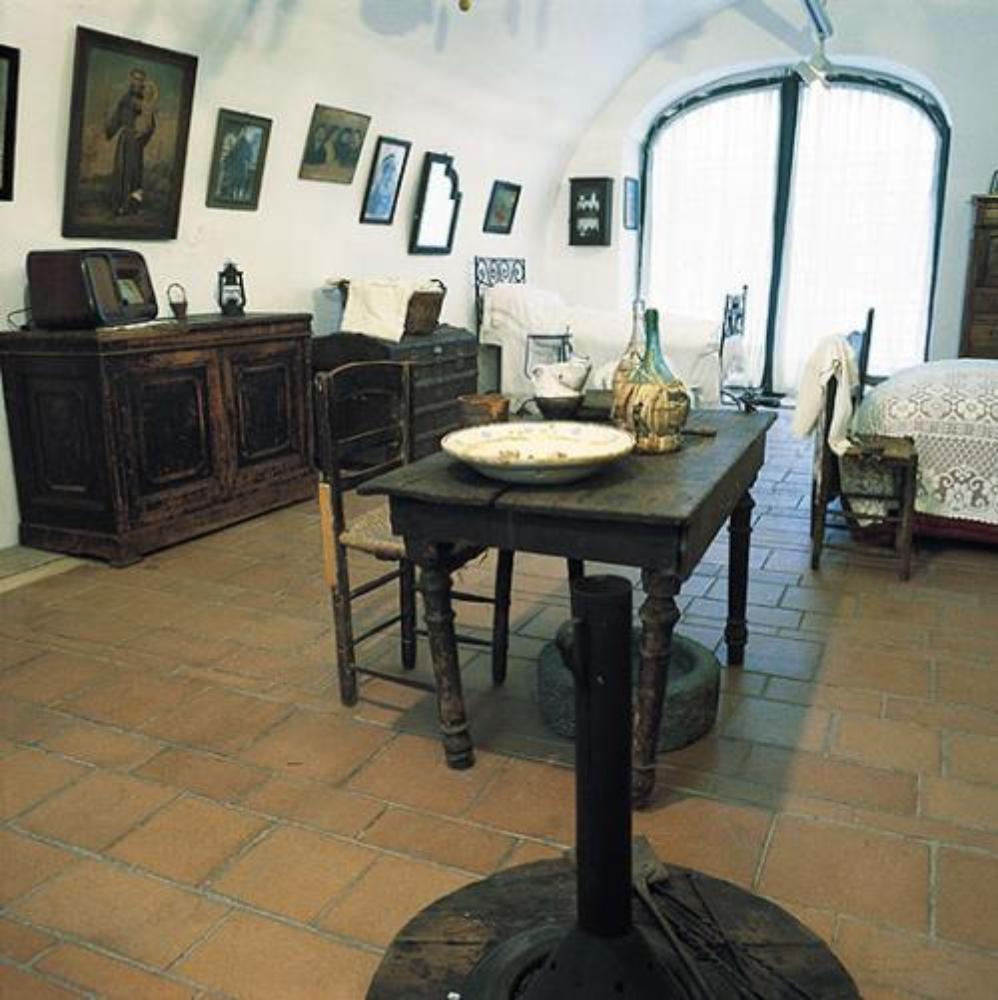

In a wing of the Castle on the ground floor and the first floor with entrance from the latter, it is possible to visit the Museum of Pulcinella, folklore, and peasant civilization. The Museum was founded and set up by the “Acerra Nostra” Culture Center in 1992. It is a particular Museum, different from the many scattered all over Italy. In this Museum, among worn-out plows and old utensils, an attempt was made to reconstruct not only the materials but above all the soul of the peasant culture of Terra di Lavoro, the ancient Liburia, from which the very mask of Pulcinella originated. In the rooms, alongside agricultural work tools, there is also the reconstruction of domestic environments in which much of life took place. In this cultural context and agrarian dimension, Pulcinella was born: the non-urban mask, the mask of the funny and foolish countryman. Since the 1500s, in fact, Pulcinella and Acerra had become an inseparable pair. For some, Puccio D’Aniello, Paolo Cinella, Paoluccio della Cerra were those characters who gave body and soul to the first Pulcinella. For others, it was a Zanni Policiniello, little chick, with a voice made hoarse by the pipe or the use of the mask, the great and first Pulcinella. For others still, the Acerra mask represents the last heir of Maccus, the funniest and silliest character of the Atellan comedies, performed in Campania in Roman times. The Museum is arranged in the ancient kitchen rooms and on two entire floors of the Castle belonging to the city’s feudal lords. There are an Archive, a Library, and a Videotheque attached, with a research section dedicated to Alfonso Maria di Nola, twelve exhibition rooms, kitchens, the monument to Pulcinella by Gennaro d’Angelo. The Museum includes a section dedicated to Pulcinella and one to the Folklore of Terra di Lavoro ancient Liburia. The Pulcinella section unfolds along a path illustrating the multiple origins of the mask:
The journey of Pulcinella and the Commedia dell’arte;
The origins of Pulcinella;
Acerra and Pulcinella;
The costume, the mask, and the horn;
Pulcinella and the moon;
Pulcinella, hunger, and macaroni;
Pulcinella and the masters;
The saints, the toys, the nativity scene, and Pulcinella;
The square and the theatre;
The Guarattelle puppets;
Pulcinella in the world;
The monument to Pulcinella.
In this section are collected and exhibited: original documents referring to popular, literary, and theatrical traditions about Pulcinella; ancient and modern artworks; costumes, masks, and photos of actors who interpreted Pulcinella, from Antonio Petito to Massimo Troisi; rare objects and works of Campanian crafts, ancient and modern. Also reconstructed are a 17th-century square theatre booth, a Pulcinella nativity scene, and a Guarattelle puppet theatre.
Information about the Museum of Pulcinella, folklore, and peasant civilization
Castello Baronale di Acerra – Piazza Castello, 1
80011 Acerra (Naples)
0818857249
[email protected]
https://www.pulcinellamuseo.it
Source: MIBACT