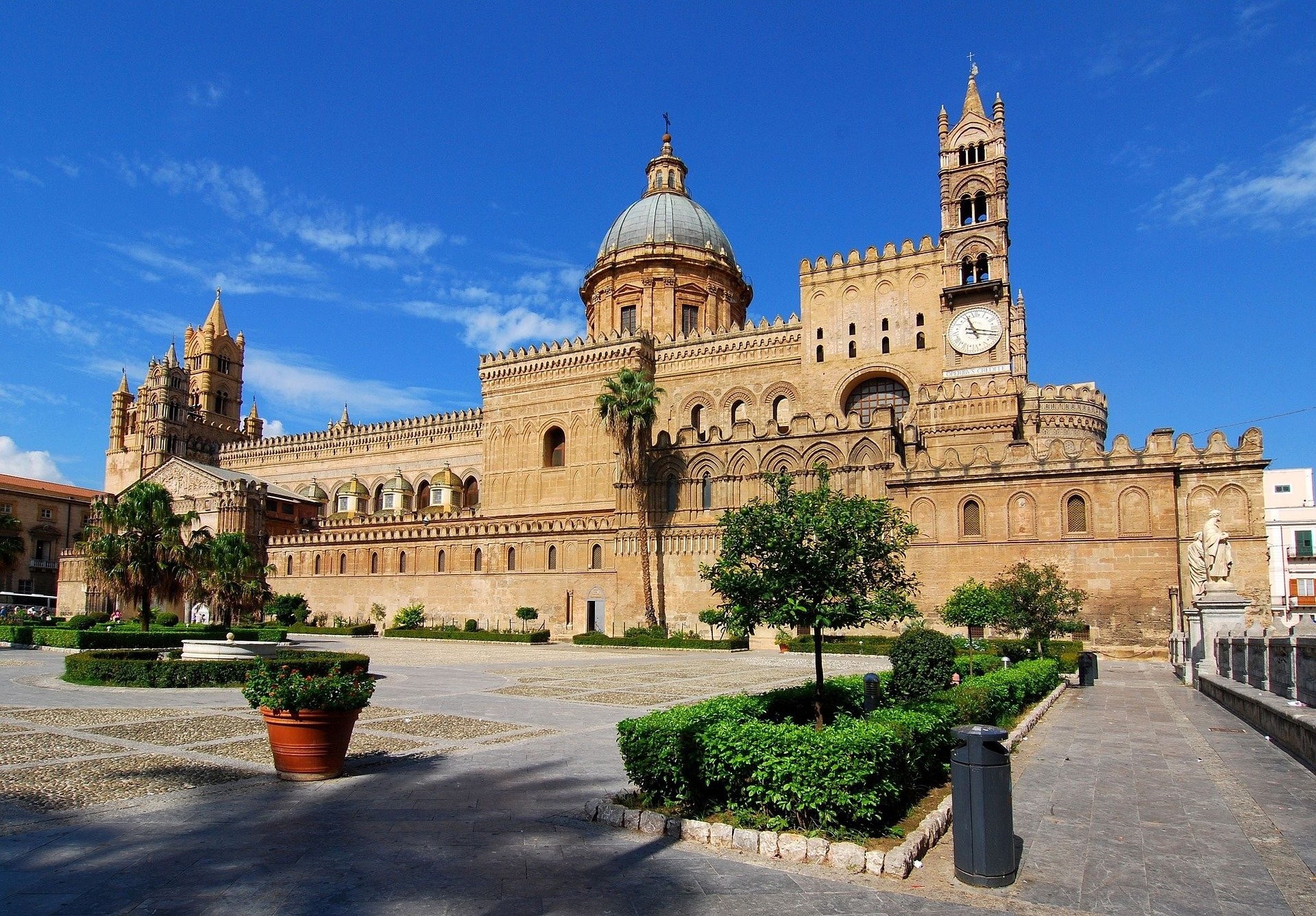
Also called the Church of the Holy Trinity. Along with the adjacent Cistercian abbey, the church was founded in 1191 by Matteo Ajello, chancellor of the Norman kingdom. In 1197 it was handed over to the Teutonic Knights Order and became the seat of the “Mansio,” that is the order’s preceptor: hence the name Magione. The church is the last building constructed by the Normans in Palermo. It combines the essential geometric volumes of Fatimid derivation, evident in the external masonry and façade, with an internal spatial distribution of Nordic origins. Among the works of art in the church are to be remembered: two holy water fonts from the 16th century placed on either side of the entrance; the funerary monument of F. Perdicaro (d. 1576), probably by Vincenzo Gagini, positioned under a 15th-century stone Cross with the emblem of the Teutonic Knights; from the 16th century are a Virgin with Child together with a blessing Christ both from the Gagini workshop; a tabernacle from 1528 and a Madonna painted on board, a late Gothic marble triptych, with in the center a Madonna with Child and St. Catherine. The Pietà by Campini from 1953 has been placed at the entrance, replacing the sculpture by Vincenzo Gagini, destroyed by bombing during World War II. Finally, in the floor there are graves of 15th-century Teutonic Knights, whose tombstones are displayed in rooms adjacent to the cloister. The cloister, truncated on the short sides and placed—against the more common custom—to the west of the church, is all that remains of the original Cistercian monastery. From a door located to the left of the church’s façade, you access the Chapel of St. Cecilia, interesting for the works of art it preserves: a large fresco of the Crucifixion, a fragment of a 13th-century fresco and the red ochre Sinopia of the crucifixion itself.
Information about the Former Magione Convent
Piazza Magione, snc
90133 Palermo (Palermo)
0916162231
[email protected]
Source: MIBACT