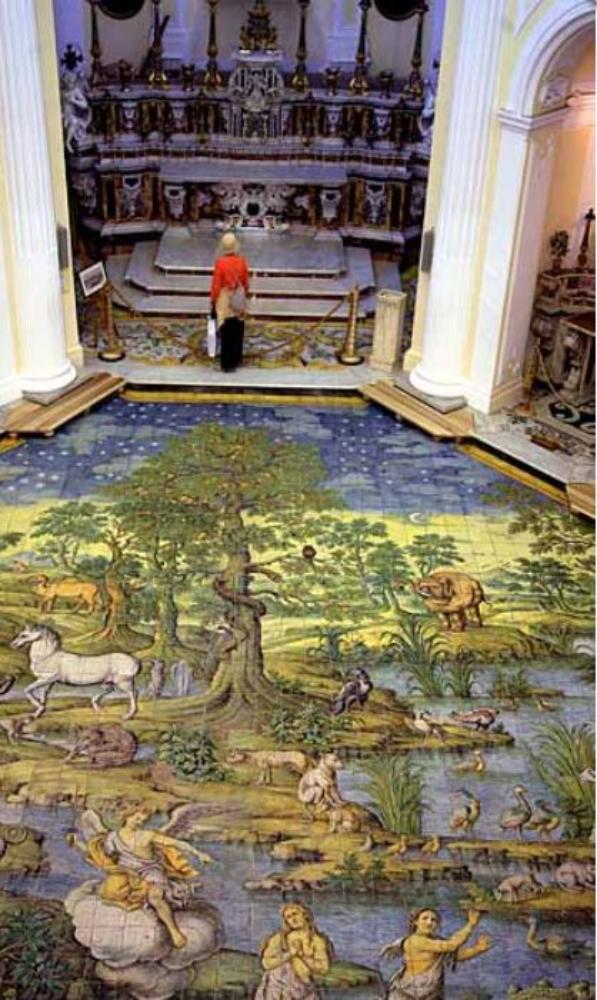
Nel 1325 the Charterhouse of San Martino in Naples was founded and the designated architects were the Sienese sculptor Tino di Camaino and the Neapolitan Francesco De Vito.
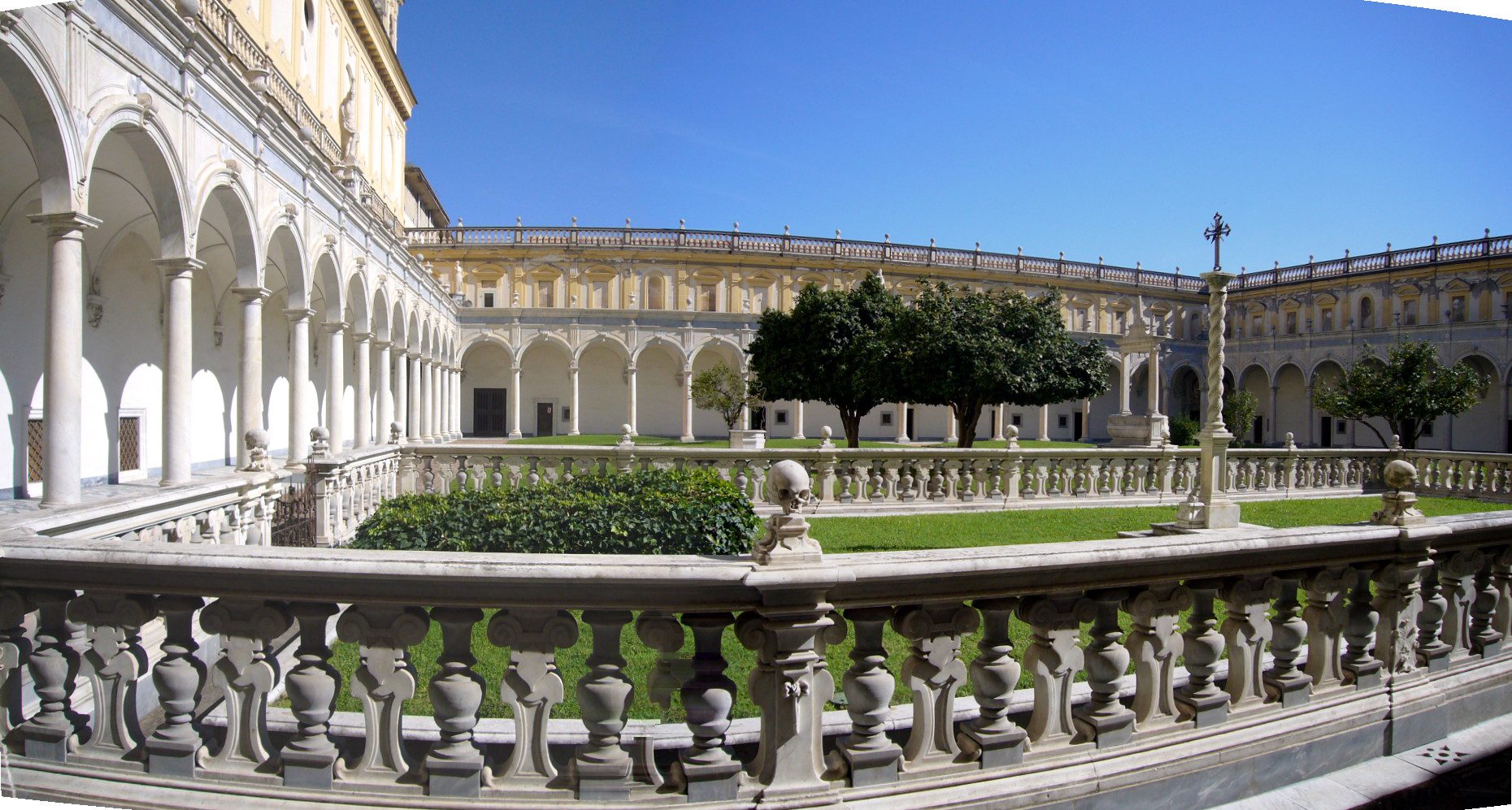
Over five centuries, the Charterhouse of San Martino underwent constant renovations. In 1581, a grand expansion project began, entrusted to the architect Giovanni Antonio Dosio, aimed at transforming its austere Gothic appearance into the current precious and refined Baroque style.
The growing number of monks required a radical restructuring of the Great Cloister: new cells were built and the entire water system was revised. The promoter of this new and spectacular appearance of the Charterhouse of San Martino was the prior Severo Turboli, in office from the last two decades of the sixteenth century until 1607. The works started under the direction of Dosio were continued by Giovan Giacomo di Conforto, who built the monumental cistern of the cloister.
In 1623 the collaboration began with the San Martino workshop of the architect Cosimo Fanzago, which, through various events, lasted until 1656, while respecting the original setting of Tuscan Renaissance style by Dosio. Fanzago left his unmistakable mark with his powerful personality on every part of the monastery.
He soon became responsible for the entire workshop and decided to maintain contracts with the same painters, sculptors, and artisans who had already collaborated with Dosio and Conforto. He continued the project of expanding the monastery and modernizing the monumental spaces: intervening in the church, adjoining rooms, and the apartments of the Prior and the Vicar. Fanzago‘s work is characterized by an extraordinary decorative activity, transforming traditional geometric decorations into arrangements composed of foliage, fruits, stylized volutes, to which chromatic and volumetric effects lend an exceptional character of realism and sensuality. The Charterhouse of San Martino thus becomes, in the 1620s and 1630s, a place of excellence for the experimentation of the ornamentation of the era.
In the following years, the direction of the works was taken over by: Bonaventura Presti, who among other things designed the magnificent church floor; the royal engineer and architect Andrea Canale, and around 1723, his son Nicola Tagliacozzi Canale, better known as an engraver and creator of scenic apparatuses, participated in the intense artistic expression known as Rococo, which manifests as a perfect synthesis of painting, sculpture, and architecture.
During the revolution of 1799, the complex suffered damages and was occupied by the French. The king ordered the suppression of the Carthusians suspected of republican sympathies, but eventually agreed to their reinstatement and the monks returned to San Martino in 1804.
When the last monks abandoned the Charterhouse of San Martino in 1812, the complex was occupied by the military as a House of War Invalids until 1831, when it was again abandoned for urgent restorations. In 1836, a small group of monks returned to settle at San Martino only to leave definitively later.
After the suppression of religious orders and the complex becoming State property, the Charterhouse of San Martino was designated in 1866 as a museum by the will of Giuseppe Fiorelli, annexed to the National Museum as a detached section and opened to the public in 1867.
The visit to the Charterhouse and Museum of San Martino includes: the Church, the Monks’ Pharmacy, the Naval Section, the Prior’s Room, the Nativity Scene Section, the Nineteenth-Century Neapolitan Section, Images and Memories, the Cabinet of Drawings and Prints, the Theatrical Section, the Decorative Arts Section, the Museum of the Work, and the Gothic Underground.
The Charterhouse and Museum of San Martino are located at Largo San Martino, 5 80129 Naples. Phone: 081.2294502.
Opening Hours Charterhouse and Museum of San Martino, Naples
- open daily 8:30 AM – 7:30 PM; closed on Wednesdays
- ticket office closes one hour earlier
Sections open by scheduled appointment:
10:30 AM: Carthusian itinerary (Museum of the Work of the Charterhouse and extension of the Prior’s Room)
11:30 AM: Theatrical section
12:30 PM: Historical itinerary – Images and memories of the City and the Kingdom
3:30 PM: City views itinerary – Nineteenth-century Neapolitan and Alisio Collection
4:30 PM: Historical itinerary – Images and memories of the City and the Kingdom
Tickets Charterhouse and Museum of San Martino, Naples
- full price: € 6.00
- reduced: € 3.00
- Admission cost and hours may vary with ongoing exhibitions
- free: for European Union citizens under 18
- free: first Sunday of every month