

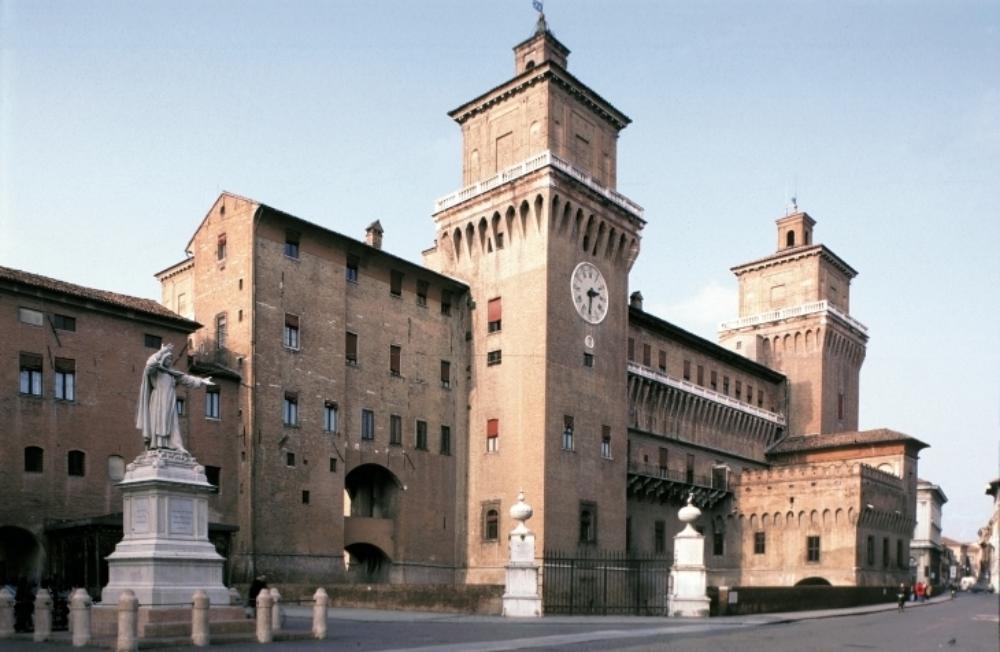

Inaugurated in 1998, the museum itinerary includes the basements, the Gothic rooms on the ground floor, the former kitchens, the Lion Tower, the Mirror Apartment, and allows visitors to explore fifteen rooms of the Castle, following a path that connects the undergrounds of the Lion Tower, with the prisons, to the ground floor and then to the noble floor. This way, you retrace the rooms once inhabited by the Dukes, where it is still possible to admire the decorative apparatus characterized by marble and frescoes. Between 2001 and 2003, the most historically, artistically and architecturally significant areas were connected through a philological reconstruction with a strong educational impact, designed by architect Gae Aulenti. The visit revolves around four themes, different from each other but related to the Castle: the building as an image of power, the dynasty, the urban history of Ferrara, and finally the Este domains. Since 2006, the Castle has also been a representative venue for the Ermitage Italia project, the result of an agreement between the Hermitage Museum of St. Petersburg and the Province of Ferrara, aimed at cataloguing the Italian works of the Russian museum, with special attention to the Este heritage. The visit path winds through the Gothic Halls, the Ducal Kitchens, the Cordolo Hall adjacent to the original tower, of which it incorporates part of the structure, and Don Giulio’s Prison. On the noble floor is the Aurora Hall, located inside the Lion Tower, which, along with the Games Room and the Small Games Room, comprises the private and representative apartments built by the Dukes starting from the second half of the 15th century. The decoration of the rooms was entrusted to the Filippi family (father Camillo and sons Cesare and Sebastiano), assisted by Leonardo da Brescia and Ludovico Settevecchi: all date back to the third-to-last decade of the 16th century. Also noteworthy are the “Alabaster Cabinets” intended for the ducal collections, which included paintings by Titian, Dosso Dossi, and Garofalo arranged according to an iconographic program centered on the theme of the bacchanal and alternated with sculptures by Antonio Lombardo.
Information about Estense Castle
Piazzetta Castello, 1,
44121 Ferrara (Ferrara)
0532299111
castelloestense@provincia.fe.it
https://www.castelloestense.it
Source: MIBACT