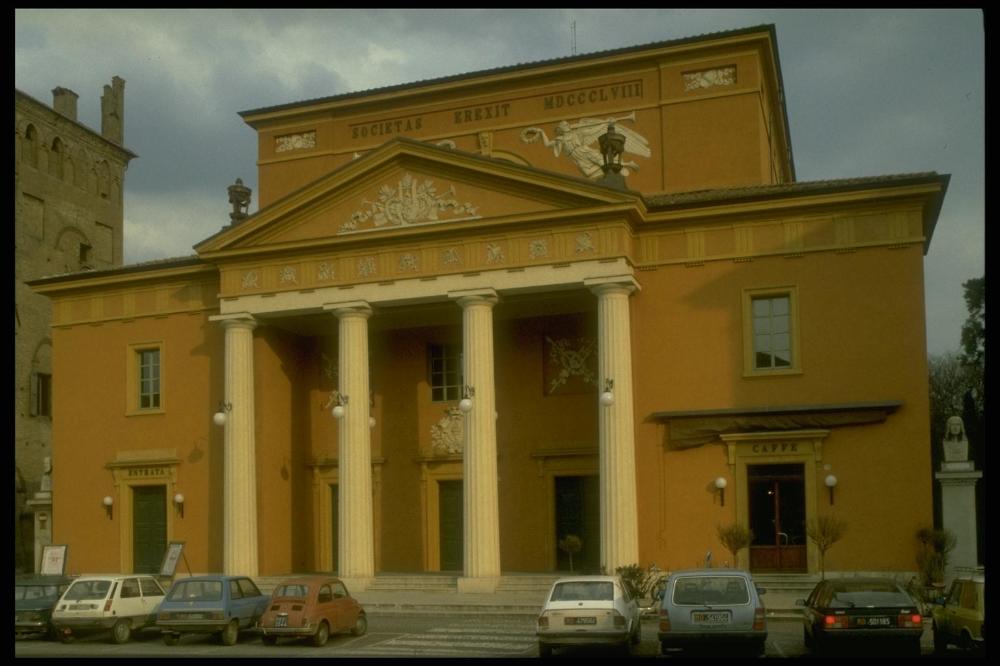


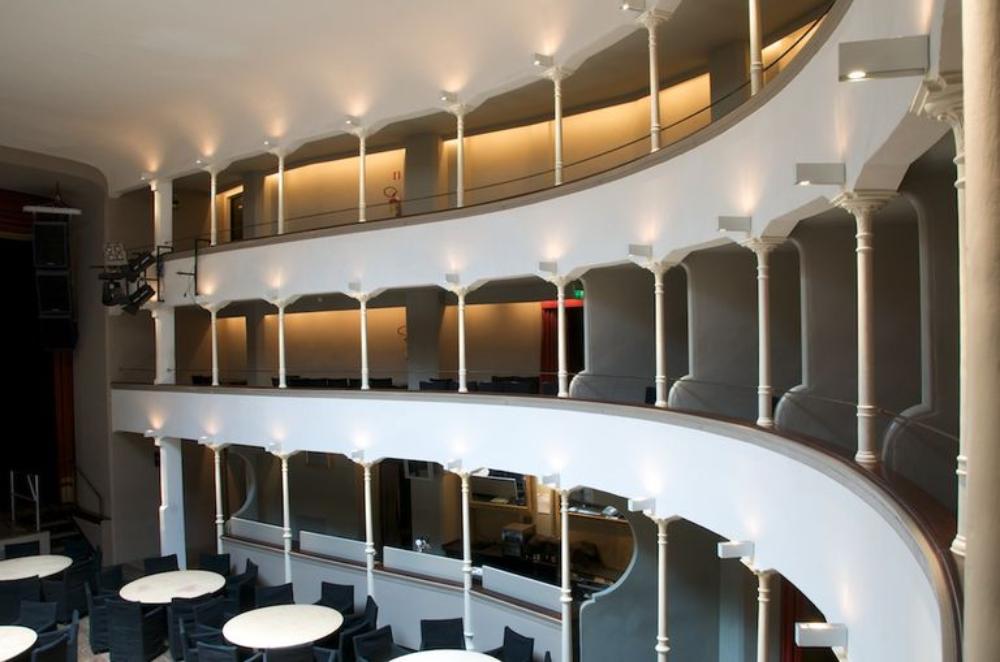

L’origine of the current Teatro Verdi dates back to 1874, when the Arena Giardino was built near the old city wall of Cesena, where the public garden of the city was also created; a short distance from the Teatro Bonci. Later, the arena was modified to take on the appearance of an elegant theater, retaining the name ‘Giardino’, with an elliptical stalls area and three superimposed tiers in a continuous band, respectively of galleries and balconies on the first level, boxes on the second, and the gallery on the third; supported by thin cast iron columns, proscenium boxes, and decorated ceiling. Various kinds of performances are regularly held there, including plays, operettas, opera, and gymnastic exhibitions; in December 1896, the first film screening in Cesena took place there and, after a period of disinterest in this invention, from 1904 film shows regularly occupied the programming of this venue, interrupted in April 1907 when a fire significantly damaged the theater, which was rebuilt in a short time. From 1919 it took on the name Teatro Verdi, which it still retains today. Variety shows, operettas, carnival balls, and film screenings continued to alternate there, and evenings dedicated to political debates were not lacking as the theater was also rented by various parties. In 1975 it underwent a comprehensive renovation which, without radically altering the structure, introduced a sort of masking of the original appearance. The last theater season took place in 1977-78, after which the space was exclusively used for film screenings. Until the present day, when a radical intervention redefined its appearance and functions. The character of a multipurpose space, intended from its origin to host the most varied forms of entertainment, has been fully recovered and reinterpreted in a contemporary key, thanks to a restoration project entrusted by the owners to architect Sanzio Castagnoli of Cesena. The main intent of the designer was to remove what had been overlaid on the original structure over the years; through an extremely respectful philological operation that eliminated numerous superimpositions and brought out the framework, the architecture of the hall was presented again in its graphic essence. Only some ‘memories’ of the cinema function were preserved, such as the access staircase to the projection booth (which was removed), as well as the ‘projection aperture’. The concrete stalls were replaced with appropriate wooden flooring, while the removal of the film screen brought to light the original stage, revealed to be of considerable proportions, complete with a winch and period wooden grid. The restoration of the central skylight, made possible within the ancient perimeter, allows zenithal light to flood the hall, enabling daytime usability. The design proposed by Giacomo Strada regarding the ‘dynamic’ furnishings, coherently studied with the stylistic identity of the theater machinery, to allow effective mobility of objects, represents, together with the sculpture installed in the foyer, the most avant-garde impact. Francesco Bocchini actually created for the foyer of this theater a large wall composition consisting of 160 iron sheet masks painted with oil, ironically and irreverently dedicated to characters of classical music and entertainment. The newly renovated theater is characterized by a particularly diverse cultural and entertainment offering. Starting from the assumption that art language, in the broadest sense of its multiple expressions, is capable of renewing the spirit of aggregation, creativity, and culture, the Verdi operators have created a program that interprets the theater in its most eclectic facets. Furthermore, outside the official programming, these spaces are made available for other activities, whether aimed at promoting an interactive and dynamic relationship with contemporary art through exhibitions, presentations, meetings between the public and critics, or for conferences and corporate initiatives. Since spring 2008, nine bronze sculptures dedicated to the characters of the Commedia dell’Arte, works created by sculptor Domenico Neri who donated them to the city, have been placed in the park adjacent to the theater. (Lidia Bortolotti)
Information about Teatro Verdi
Via Sostegni 7,
47521 Cesena (Forlì-Cesena)
Source: MIBACT