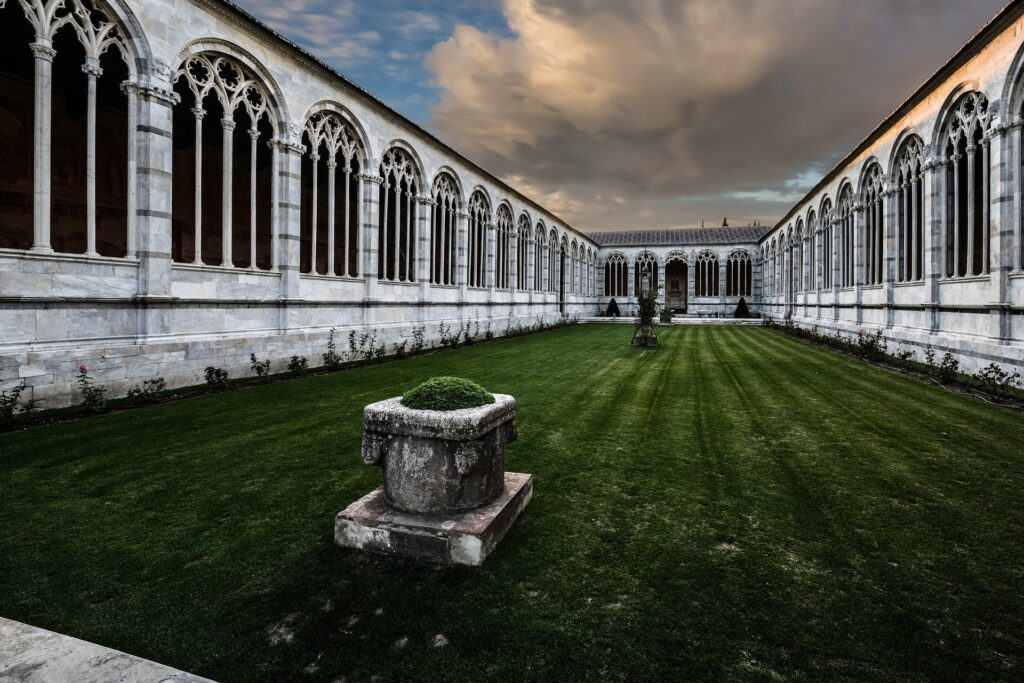


Cathedral Square of Pisa is located in the northwest of the city. Inside the square, known as Square of Miracles, are the most important monuments of the city: the Cathedral, the Baptistery, the Campo Santo, and the Leaning Tower also known as the Tower of Pisa. Since 1987, Cathedral Square of Pisa has been a UNESCO World Heritage Site. Cathedral Square is pedestrianized and covered, featuring a large lawn.
The Cathedral of Pisa
The Cathedral of Pisa is the duomo of Santa Maria Assunta. Located in the center of the Piazza dei Miracoli, it is a true tribute to Pisan Romanesque. It dates back to 1063 and was designed by the architect Buscheto. It blends different stylistic elements: classical, Lombard-Emilian, Byzantine and particularly Islamic, proof of the international presence of Pisan merchants at that time. Since 2000, access to the Cathedral of Pisa has been regulated, distinguishing tourist use from religious use. Visiting hours have been established and an entrance ticket has been instituted, making the cathedral a museum monument. This allows for better tourist enjoyment of the building without hindering the religious function of the cathedral and ensures better preservation of the artworks kept there.

Leaning Tower of Pisa, the leaning tower
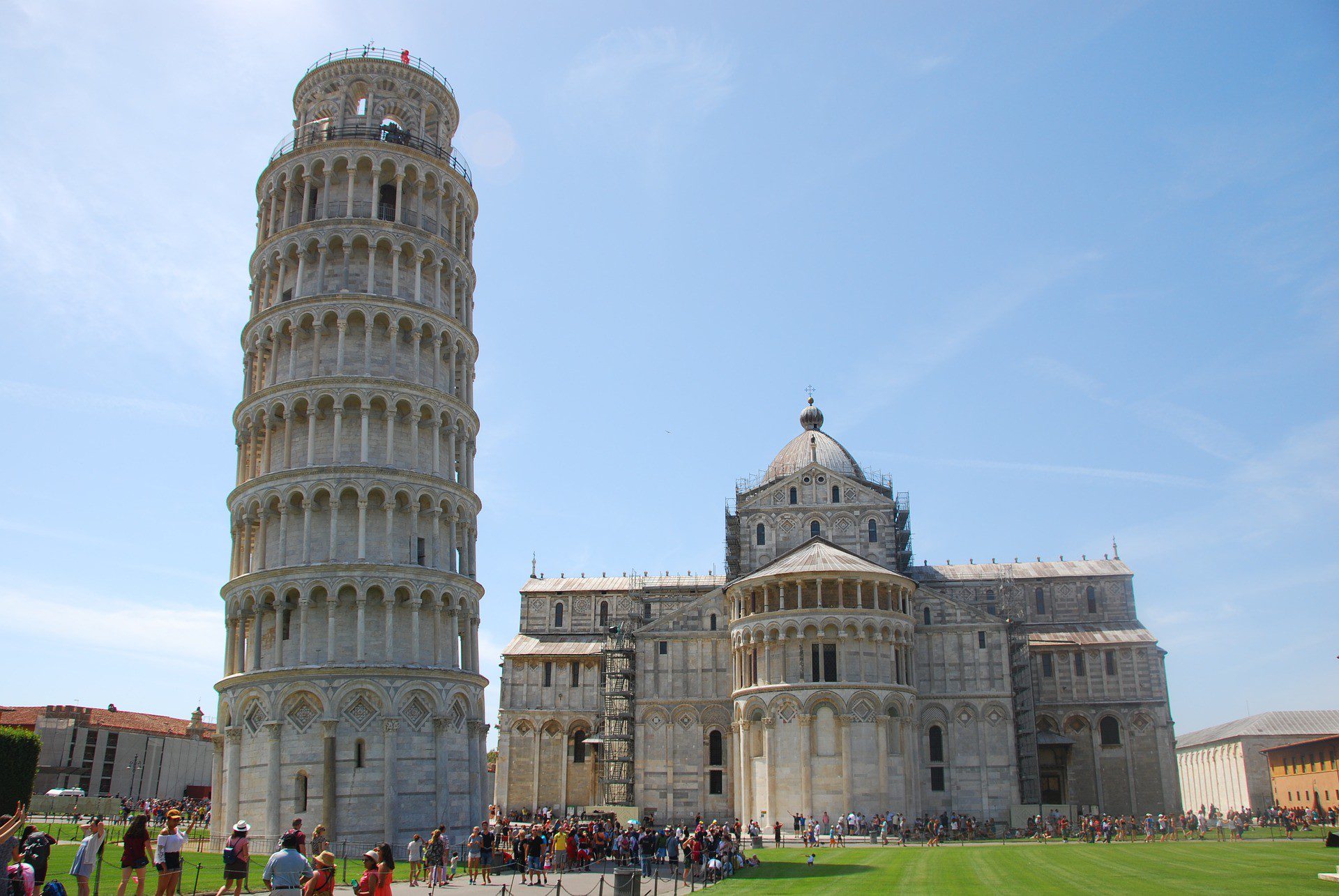
The so-called Leaning Tower of Pisa (leaning tower or Tower of Pisa) is the bell tower of the Cathedral of Santa Maria Assunta, in Cathedral Square, which today is the most famous monument due to its characteristic tilt. It is a freestanding bell tower about 56 meters above ground (58.36 meters considering the foundation level), built over two centuries, between the twelfth and fourteenth centuries.
Weighing 14,453 tons, it is dominated by the curved line, with rounds of blind arches and six stories of loggias. Its lean is due to ground subsidence that occurred already in the early stages of construction. The current tilt of the building measures 3.97° relative to the vertical axis.
The Tower of Pisa remains balanced because the vertical line passing through its center of gravity falls within its base of support.
It was proposed as one of the seven wonders of the modern world. After years of studies and work to reduce its tilt and secure it, the tower was reopened to the public in the summer of 2001. Inside, a staircase of 294 steps leads to the top, from which a unique view of the Square and the entire city of Pisa unfolds.
Construction began in August 1173 and continued with two long interruptions for about two hundred years. The foundation of the building is attributed to Bonanno Pisano, also the author of the cathedral’s bronze doors. The construction of the bell chamber was assigned to Giovanni di Simone in the 14th century. Already during construction, the tower began to lean due to ground subsidence. The Tower of Pisa is prohibited for children under 8 years old, children between 8-12 years must be held by the hand during the visit, and minors under 18 must be accompanied by adults.
Baptistery of Pisa
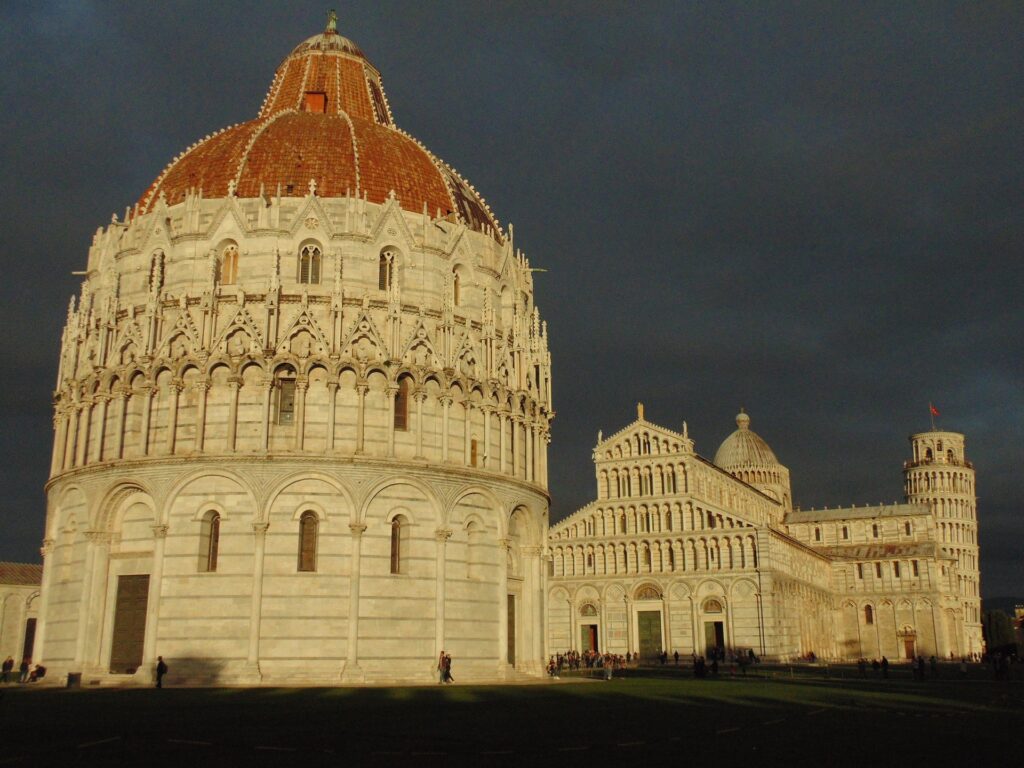
The Baptistery of Pisa is a monument open to the public with similar modes to those of a museum, which is part of the complex of museums and monuments of the Opera Primaziale Pisana. In addition to the architectural structures, the visitor can see the important works of art preserved inside.
You can climb to the matronea on the first floor from where you can enjoy a beautiful view of the Piazza dei Miracoli. In the history of the construction of the entire monumental complex of the Piazza del Duomo di Pisa, the Baptistery represents the first essential stage of the formation of the Christian, in a path that accompanies him from birth to death, from Baptism, to awareness until post-mortem rest, all concentrated in the space of the piazza dei miracoli and marked by the architectural masterpieces that compose it.
Camposanto monumentale di Pisa
The monumental cemetery of Pisa, built from 1278 by Giovanni di Simone, housed an extraordinary cycle of frescoes from the 14th and 15th centuries (Taddeo Gaddi, Andrea Bonaiuti, the Master of the Triumph of Death, Benozzo Gozzoli), which suffered severe damage during the last world war.
After the delicate restoration work that returned to us the precious fragments of medieval and early Renaissance painting, the frescoes, already seriously compromised by a long and troubled history, are now heading towards their natural and definitive reinstallation, returning to decorate the monumental walls of the Camposanto, their original location and therefore the only one capable of restoring the majesty of a cycle that was unparalleled for its time.
The Opera Primaziale Pisana in agreement with the Works Management is planning for 2006 a public presentation of the works that have affected and will affect, with the necessary pictorial restoration, the cycle of frescoes and soon visitors will be able to admire again the Camposanto in its structural and decorative integrity. It also contains 84 ancient sarcophagi and many medieval funerary monuments.